
Bearded dragons facts for kids
Quick facts for kids Bearded dragons |
|
|---|---|
.jpg) |
|
| Eastern bearded dragon (P. barbata) | |
Scientific classification  |
|
| Kingdom: | Animalia |
| Phylum: | Chordata |
| Class: | Reptilia |
| Order: | Squamata |
| Suborder: | Iguania |
| Family: | Agamidae |
| Subfamily: | Amphibolurinae |
| Genus: | Pogona Storr, 1982 |
| Type species | |
| Agama barbata Cuvier 1829
|
|
| Species | |
|
|
Bearded dragons, also called Pogona or "beardies," are a group of eight amazing lizard species. These reptiles get their name from the spiky "beard" under their throat. This beard can puff up and turn dark, often black. They do this when they feel scared, want to show off, or are trying to find a partner.
Bearded dragons love to climb! They spend a lot of time on branches, in bushes, and even near people's homes. You can often spot them resting on rocks or sunny branches in the morning and afternoon. They sleep at night, which means they are active during the day. Their main food is plants, but they also enjoy eating insects. You can find these fascinating lizards all over Australia, living in places like deserts and shrublands.
Contents
Discover Bearded Dragons: Amazing Lizards
What Do Bearded Dragons Look Like?


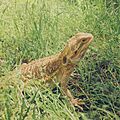
Bearded dragons have wide, triangular heads and flat bodies. Their bodies are covered in rows of spiky scales. When they feel threatened, they puff up their bodies and beards. This makes their spikes look more dangerous to scare away predators.
These lizards have special ways to communicate. They might do a "hand-waving" gesture to show they are not trying to challenge another dragon. They also do a "head-bobbing" display to show who is in charge. Bearded dragons can even change their color a little bit! They might turn darker to soak up more heat from the sun. They come in many colors, like browns and blacks. Through special breeding, some can even be all dark or completely white. Male bearded dragons can grow up to about 60 centimeters (24 inches) long. Females are a bit smaller, reaching about 51 centimeters (20 inches).
Bearded dragons have a special body feature that helps them resist venom from certain snakes. This unique trait helps them survive in their natural habitat.
Where Do Bearded Dragons Live?
Bearded dragons make their homes in many different places across Australia. You can find them in woodlands, heaths, deserts, and even sandy coastal dunes. They live in the eastern parts of Australia, reaching into South Australia and the Northern Territory.
These lizards love to climb! They are often seen high up on fallen trees, rocky spots, and bushes. Climbing helps them find the best sunny places to warm up. It also helps them show who is in charge and claim their territory. People in Australia often spot them on fence posts or high rocks. At night, they like to dig holes to sleep in. They also climb into trees or hide in cracks and caves to stay safe and warm.
Surviving Extreme Weather: Brumation
When the weather gets cooler, bearded dragons go through something called brumation. This is like hibernation for reptiles. During brumation, they don't eat for months, but they do drink water sometimes. They become much less active.
Brumation happens when nighttime temperatures drop below about 15.5–21.0 °C (60–70 °F). Daytime temperatures also need to be cooler, around 24.0–26.5 °C (75–80 °F) for several hours. If it gets too hot, they will dig burrows underground to escape the heat. These burrows also protect them from predators and changing weather at night.
Types of Bearded Dragons
There are several different kinds of bearded dragons. Here are six of the main species:
| Species Name | Common Name |
|---|---|
| Pogona barbata | eastern bearded dragon |
| Pogona henrylawsoni | Rankin's dragon, Lawson's dragon, black-soil bearded dragon, dumpy dragon, dwarf bearded dragon |
| Pogona microlepidota | Kimberley bearded dragon, Drysdale River bearded dragon |
| Pogona minor | western bearded dragon, dwarf bearded dragon |
| Pogona nullarbor | Nullarbor bearded dragon |
| Pogona vitticeps | central bearded dragon, inland bearded dragon |
How Do Bearded Dragons Behave?
Adult bearded dragons are very protective of their space. As they grow, they claim areas as their own territory. They use special actions to show who is in charge or to avoid fights. A dominant male might stand tall and get ready to defend his territory or food. He might also do this when trying to attract a female. If another male approaches without showing respect, it's seen as a challenge. Male dragons can bite harder than females, which is linked to their larger heads.
Talking Without Words: Dragon Communication

The "beard" of a bearded dragon is very important! They use it to show aggression or to attract a partner. It also helps them control their body temperature. Both male and female dragons have a beard. However, males use it more often, especially when trying to find a mate. Females also puff out their beards to show they are upset. The beard turns dark, sometimes even black, and inflates during these displays. A dragon might also open its mouth wide to look even more scary. If a predator threatens them, they might hiss, puff up their whole body, and lean towards the danger. Bearded dragons have strong jaws, but they usually only bite if they have no other choice.
Another common behavior is "head bobbing." Dragons quickly move their heads up and down. They often darken their beards while doing this. Different speeds of head bobbing can mean different things. Males head bob to impress females. A male often needs to show he is strong before a female will accept him. Smaller males might respond to a larger male's head bobbing by "arm waving." This is a sign that they are not trying to fight. Females also arm wave to avoid aggression, especially when a male is head bobbing. They might lower themselves and wave their arms while moving away from a dominant male. This helps them either calm the male or escape.
Bearded dragons are also smart! Scientists have shown they can understand optical illusions. In one study, dragons were given two plates with the same amount of food. One plate looked bigger than the other. The dragons often chose the smaller-looking plate. This showed they understood that a bigger plate doesn't always mean more food. This was the first time this kind of intelligence was seen in a reptile!
Bearded Dragon Reproduction and Life Cycle
After brumation ends, male bearded dragons look for a mate. They perform a special dance to attract females. The male bobs his head, waves his arms, and stomps his feet. He then chases the female and gently bites the back of her neck. He holds on while they mate.
Female bearded dragons can store sperm inside their bodies. This allows them to lay two groups of eggs from just one mating. Each group can have 11 to 30 eggs.
Interestingly, the temperature during egg development can affect the babies. If eggs are kept at higher temperatures, some dragons with male genes can develop as females. These "sex-reversed" females look and act like other females. However, they still have male genes. Temperatures above 31 °C (88 °F) can cause this change. The warmer it is, up to 36 °C (97 °F), the more likely it is to happen. Temperatures below 31 °C (88 °F) do not cause this change. Female dragons can also lay eggs even if they haven't mated. These eggs are usually smaller and won't hatch.
Special Births: Congenital Defects
Sometimes, baby bearded dragons can be born with unusual conditions. These are called congenital defects. They can happen due to problems with genes or things in their environment.
- Two Heads: Very rarely, a bearded dragon can be born with two heads on one body.
- Swollen Eggs: Sometimes, an egg might appear swollen and "sweating" in the incubator. The reason for this is not fully known.
- Spine and Limb Issues: Problems with the spine, tail, or limbs can occur. This might be due to poor nutrition or injuries during development.
- Small or Missing Eyes: A dragon might be born with very small eyes or no eyes at all. This can be caused by an event during eye development.
- Tail Rot: This is a serious condition where the tail starts to blacken and decay. It can be caused by injury or blood clots. If not treated, it can be deadly for the dragon.
Caring for Bearded Dragons as Pets

The central bearded dragon is a very popular pet reptile. Smaller species, like Pogona henrylawsoni, are also kept as pets if less space is available. Bearded dragons became popular pets in the U.S. during the 1990s. Their popularity has continued, even after Australia stopped selling its wildlife as pets in the 1960s.
Bearded dragons are usually solitary animals. Male dragons are often kept alone because they might fight with other males. They can also try to breed with females. Pet dragons typically grow to about 40 to 61 centimeters (16 to 24 inches) long. They weigh between 290 to 600 grams (10 to 21 ounces). With good care, they can live for 10 to 15 years or even longer. The current record for a pet bearded dragon is 18 years!
Through special breeding, many different types of central bearded dragons have been created. These are called "morphs." Some morphs have lighter, brighter colors. Others have thinner skin, making their colors look stronger, and they have black eyes. "Leatherbacks" have smoother skin with fewer scales. "Silkbacks" have very soft skin. "German giants" are larger than average dragons. Silkbacks need extra special care because their skin is very delicate. They need different lighting and humidity and often live shorter lives.
Common Health Problems in Pet Dragons
Bearded dragons are generally strong, but improper care can make them sick. Most health problems in pet dragons come from a poor diet or not enough heat and light.
Metabolic Bone Disease (MBD)
Metabolic Bone Disease (MBD) is a serious illness that can be deadly. It's one of the most common health problems for pet bearded dragons. MBD weakens their bones and can cause them to become deformed. This happens when dragons don't get enough calcium or can't use the calcium they eat.
To prevent MBD, pet dragons need calcium supplements in their food. They also need a special UVB light. This light helps their bodies use calcium properly. Foods like kale, mustard greens, and collard greens are high in calcium. They should be part of a balanced diet. Without UVB light, their bodies take calcium from their bones, making them weak. Signs of MBD include bumps on legs, tremors, bumps on the spine or tail, a swollen jaw, and jerky movements.
Low Calcium Levels (Hypocalcemia)
Hypocalcemia means a bearded dragon has low levels of calcium in its blood. This problem is often linked to Metabolic Bone Disease. Low calcium can cause muscle twitching or even seizures. Young bearded dragons are more likely to get hypocalcemia because they are more fragile. Feeding a diet with enough calcium is key to preventing both hypocalcemia and MBD.
Eating Problems (Impaction)
Impaction happens when bearded dragons eat food that is too big for them. They might try to eat worms or crickets that are too large. This can be very harmful. For young dragons, food should not be bigger than the space between their eyes. Older dragons can usually handle larger insects, but not oversized prey. If a dragon eats food that is too big, it can put pressure on its spinal cord during digestion. This pressure can lead to impaction, which can be fatal. Another cause of impaction is eating loose bedding, like sand, in their enclosure.
Breathing Issues (Respiratory Infection)
A respiratory infection (RI) in bearded dragons is caused by bacteria in their lungs. Dragons can get an RI for several reasons. These include incorrect lighting and temperature, high humidity, long-term stress, or poor living conditions.
Adenovirus: A Serious Illness
Atadenovirus (ADV), also called adenovirus, is a very serious and often deadly illness. ADV can spread between reptiles just by contact. Most young dragons with ADV do not live past 90 days. Adult dragons with ADV live longer but eventually get liver diseases. Common signs of ADV include slow growth and not gaining weight well. Because their immune systems are weak, ADV-positive dragons might also get other infections.
Why Lighting is Important for Pet Dragons

Bearded dragons need special UVB light. This light helps their bodies make vitamin D3. Vitamin D3 is vital for absorbing calcium and many other important body functions. They also need UVA light, which helps them eat, breed, warm up, and stay healthy overall.
In addition to UV light, they need a warm basking spot. This is usually provided by a heat lamp. Both heat and UV light are extremely important for a bearded dragon's health and well-being.
Images for kids
-
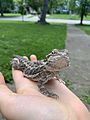
3-month-old bearded dragon
-
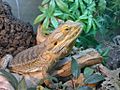
Male basking under a lamp
-
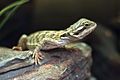
Pogona infant
-
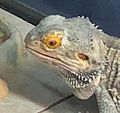
A male bearded dragon
-


_in_grass.jpg)
See also
 In Spanish: Pogona para niños
