
Sedum sarmentosum facts for kids
Quick facts for kids Sedum sarmentosum |
|
|---|---|
_(Sedum_sarmentosum)_flower.jpg) |
|
Scientific classification  |
|
| Kingdom: | Plantae |
| Clade: | Tracheophytes |
| Clade: | Angiosperms |
| Clade: | Eudicots |
| Order: | Saxifragales |
| Family: | Crassulaceae |
| Genus: | Sedum |
| Species: |
S. sarmentosum
|
| Binomial name | |
| Sedum sarmentosum Bunge
|
|
| Script error: The function "autoWithCaption" does not exist. | |
| Synonyms | |
|
Sedum angustifolium Z.B.Hu & X.L.Huang |
|
Script error: No such module "Check for conflicting parameters".
The Stringy Stonecrop (Sedum sarmentosum) is a cool flowering plant that grows year after year. It's also called gold moss stonecrop or graveyard moss. This plant comes from East Asia, like China and Korea, and also Southeast Asia, like Thailand. It has also spread to places like North America and Europe.
Contents
What Does Stringy Stonecrop Look Like?
The Stringy Stonecrop has special leaves that are thick and juicy, just like other succulents. These leaves stay green all year round. Its stems grow low to the ground and arch outwards. In the summer, you can see bright yellow flowers with five petals growing in clusters.
Growing Stringy Stonecrop
People often grow Stringy Stonecrop as a groundcover. This means it spreads out and covers the ground, like a living carpet. It's great for gardens in places with mild weather.
Easy to Grow
Like most succulents, this plant is super tough! It doesn't need much water and loves lots of sunshine. This makes it easy to care for, even if you forget to water it sometimes.
Special Uses in China
In China, people often grow Stringy Stonecrop in hanging pots. Its stems trail down, making it look beautiful. That's why it's sometimes called chui pen cao, which means "the herb that trails down the flowerpot."
Stringy Stonecrop in the Kitchen
In Korea, this plant is called dolnamul (돌나물). People eat it fresh as a type of vegetable called namul. It's a popular ingredient because of its fresh taste.
Making a Tasty Sauce
To enjoy dolnamul, Koreans often mix it with a special sauce. This sauce is usually spicy, sweet, and a little tangy. You can make it by mixing gochujang (Korean chili paste), vinegar (or lemon juice), sugar (or plum syrup), minced garlic, sesame oil, and toasted sesame seeds.
Other Korean Dishes
Dolnamul is also a common ingredient in bibimbap, which is a famous Korean mixed rice dish. Sometimes, it's even used in Korean-style western food, like a salad with roasted fruit and yuja dressing.
Images for kids
-
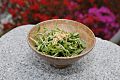
Dolnamul and peanut salad


