
Sergey Kramarenko (pilot) facts for kids
Quick facts for kids
Sergey Kramarenko
|
|
|---|---|
 |
|
| Birth name | Sergei Makarovich Kramarenko |
| Born | 10 April 1923 Kalynivka, Sumy Oblast, Ukrainian SSR |
| Died | 21 May 2020 (aged 97) Russia |
| Allegiance |  Soviet Union Soviet Union |
| Service/ |
Soviet Air Force |
| Years of service | 1941 — 1977 |
| Rank | Major General of Aviation |
| Commands held | 167th Guards Fighter Aviation Regiment |
| Battles/wars | World War II Korean War |
| Awards | Hero of the Soviet Union |
| Other work | Memoirs: Protiv Messerov i Seybrov. V Nebe Dvukh Voyn (Against Messerschmitts and Sabre Jets. In the Sky of Two Wars), 2006. |
Sergei Makarovich Kramarenko (Russian: Серге́й Макарович Крамаренко; 10 April 1923 – 21 May 2020) was a brave pilot and officer in the Soviet Air Force. He fought in two big wars: World War II and the Korean War. For his amazing flying skills and courage in Korea, he received the highest honor, the title of Hero of the Soviet Union.
Sergei Kramarenko held many important leadership roles in the Soviet Union. In the 1970s, he also worked as an Air Force advisor in countries like Iraq and Algeria. He retired in 1977 as a Major General. He was the last living Soviet "flying ace" from the Korean War. A flying ace is a military pilot who has shot down five or more enemy aircraft.
Contents
Becoming a Pilot: Sergei's Early Life
Sergei Kramarenko was born on April 10, 1923, in a small village called Kalynivka in Ukraine. He was the oldest of three brothers. When he was young, his parents divorced, and he moved with his mother and brothers to different places, including near the Volga river.
In the 1930s, Sergei heard exciting stories on the radio about famous Soviet pilots. These stories made him dream of becoming a pilot himself. In 1940, he started flying lessons at a special club. He did so well that he was chosen to become a military pilot. Sergei joined the military on April 1, 1941, to begin his flight training.
World War II: Fighting in the Sky
Sergei Kramarenko first flew in battle in November 1942, near Volgograd (then called Stalingrad). He was part of the 523rd Fighter Aviation Regiment, flying a LaGG-3 plane. Like many new pilots, he started as a "wingman." A wingman is a pilot who flies beside a more experienced leader to protect them and help in battle.
In early 1943, his unit got new planes, the Lavochkin La-5. These planes were much better and could match the German Fw 190 and Bf 109 fighters.
First Victory in the Air
On February 23, 1943, Sergei was flying as a wingman when his group attacked some German dive-bombers called Ju 87 Stukas. During this fight, Sergei shot down his first enemy plane, a German Fw 190.
Shot Down and Rescued
On March 19, 1944, Sergei's group of three La-5FNs fought against German bombers and their escort fighters. Sergei helped his leader by hitting an enemy plane. But then, another German fighter attacked him, setting his plane on fire. Sergei had to jump out of his burning plane. He suffered severe burns to his face and hands.
German soldiers quickly captured Sergei. He refused to answer their questions and was almost executed. Luckily, a German General stopped the execution at the last moment and sent him to a hospital. Two weeks later, Soviet troops rescued Sergei when they freed the hospital.
Flying with a Famous Ace
After recovering from his injuries, Sergei returned to his unit, which was now called the 176th Guards Fighter Aviation Regiment. He became the wingman for Major Aleksandr Kumanichkin, a highly skilled pilot who had already shot down 35 enemy planes. Together, they became a very strong team. Sergei helped Kumanichkin achieve many victories. On April 16, 1945, Sergei scored his second personal victory, shooting down another Fw 190. He was flying a Lavochkin La-7 that day, which belonged to the famous pilot Ivan Kozhedub, who had lent it to him.
Between the Wars
After World War II ended, Sergei's regiment moved to an airfield near Moscow. They were among the first units to receive new types of planes, including the jet-powered MiG-15. In 1950, Sergei, as a deputy commander, flew the MiG-15 in big air parades over the Kremlin and Red Square.
The Korean War: Jet Age Battles
In October 1950, Sergei's regiment was called to a special meeting. They learned about the difficult situation in North Korea, where American bombers were attacking cities. North Korea had asked the Soviet Union for help. All the pilots, including Sergei, volunteered to go. The Soviet Union's involvement in the Korean War was kept a secret for many years.
Sergei's unit traveled across Siberia to China. There, they were given Chinese uniforms and trained intensely on the MiG-15 jet fighters. They also helped train Chinese and Korean pilots.
First Jet Victories
In April 1951, Sergei's unit began fighting in Korea. At first, they faced challenges against the American planes, especially the F-86 Sabre jets. The Soviet pilots learned to use new tactics, like attacking from higher altitudes and with greater speed.
These new tactics worked well on April 12, 1951. Sergei's unit, with 44 MiG-15s, faced a large American force of 48 B-29 bombers and 96 jet fighters. Despite being outnumbered, the Soviet pilots shot down many enemy planes. Sergei's first victory in Korea was an American F-80C jet.
Facing Top Pilots
On June 17, 1951, Sergei and his wingmen almost fell into a trap set by American Sabre jets. They fought against eight Sabres, with three more waiting to ambush them from above. Sergei managed to shoot down an F-86A flown by Lt. Col. Glenn T. Eagleston, a famous American pilot from World War II.
Becoming a Hero of the Soviet Union
Sergei's unit fought continuously. After a month of rest, Sergei returned to battle and scored more victories. On November 10, 1951, he was awarded the Zolotaya Svezda (Golden Star), which came with the title of Geroy Sovietskogo Soyuza (Hero of the Soviet Union).
Even after receiving this high honor, Sergei continued to fight. On December 1, 1951, he shot down two Australian Gloster Meteor jets. He then saw a third Meteor pilot who didn't know Sergei was behind him. But Sergei, feeling the battle was already won, decided not to attack. He showed kindness by letting the pilot go.
Sergei scored his last confirmed victory on January 16, 1952, shooting down an F-86 Sabre.
Shot Down Again
On January 17, 1952, Sergei flew his last combat mission in Korea. He damaged an F-86, but then he was shot down himself. While he was hanging in his parachute, the enemy pilot even fired at him!
Luckily, Sergei landed safely and was found by a North Korean villager who helped him. Soon, a search party found him and brought him back to his base. After this, Sergei's unit was replaced by other divisions, and he returned to the Soviet Union.
Sergei's Victories
During World War II, Sergei Kramarenko officially shot down two enemy planes by himself and shared credit for ten more group victories. He also shot down a balloon.
In the Korean War, he flew 104 combat missions and fought against UN aircraft 42 times. He was officially credited with 13 victories. When comparing his claims with enemy records, it seems he shot down one German plane in World War II and at least eight or nine planes in Korea, while also seriously damaging three others.
Life After the Wars
After returning from Korea, Sergei studied at the Air Force Academy and graduated in 1954. Around that time, he met Yulya Alekseyevna, an art student in Moscow. They fell in love and married in 1957.
Sergei received many command assignments across the Soviet Union. He and Yulya had a son, Aleksandr, and a daughter, Nadezhda. In the 1970s, he worked as an advisor for the air forces of Iraq and Algeria, helping them learn to fly new Soviet jets.
In 1977, Sergei Kramarenko retired as a Major General of the Air Force. In 1981, he became the vice-president of the Russian Association of Heroes, a group for war veterans, many of whom were Heroes of the Soviet Union.
He wrote his autobiography, "Against the Messers and Sabres," in 2006, which was later translated into English. His wife Yulya passed away in 2019. Sergei Kramarenko lived his final years in Moscow and passed away on May 21, 2020, at the age of 97. He was buried next to his wife in Moscow.
Awards and Honors
Sergei Kramarenko received many awards for his bravery and service:
- Hero of the Soviet Union (1951)
- Order of Lenin (1951)
- Order of the Red Banner, twice (1945, 1951)
- Order of the Red Star (1956)
- Order of the Patriotic War 1st class (1985)
- Order "For Service to the Homeland in the Armed Forces of the USSR" 3rd class (1978)
- Medal "For Battle Merit" (1951)
- Medal of Zhukov (1994)
- Medal "For the Liberation of Warsaw" (1945)
- Medal "For the Capture of Berlin" (1945)
- Medal "For the Victory over Germany in the Great Patriotic War 1941–1945" (1945)
- Jubilee Medal "Twenty Years of Victory in the Great Patriotic War 1941–1945" (1965)
- Jubilee Medal "Thirty Years of Victory in the Great Patriotic War 1941–1945" (1975)
- Jubilee Medal "Forty Years of Victory in the Great Patriotic War 1941–1945" (1985)
- Jubilee Medal "50 Years of Victory in the Great Patriotic War 1941–1945" (1995)
- Jubilee Medal "60 Years of Victory in the Great Patriotic War 1941–1945" (2004)
- Jubilee Medal "65 Years of Victory in the Great Patriotic War 1941–1945" (2009)
- Jubilee Medal "70 Years of Victory in the Great Patriotic War 1941–1945" (2013)
- Jubilee Medal "75 Years of Victory in the Great Patriotic War 1941–1945" (2019)
- Jubilee Medal "In Commemoration of the 100th Anniversary since the Birth of Vladimir Il'ich Lenin" (1969)
- Jubilee Medal "30 Years of the Soviet Army and Navy" (1948)
- Jubilee Medal "40 Years of the Armed Forces of the USSR" (1957)
- Jubilee Medal "50 Years of the Armed Forces of the USSR" (1967)
- Jubilee Medal "60 Years of the Armed Forces of the USSR" (1978)
- Jubilee Medal "70 Years of the Armed Forces of the USSR" (1988)
- Medal "Veteran of the Armed Forces of the USSR" (1976)
- Medal "In Commemoration of the 850th Anniversary of Moscow" (1997)
- Medal "For Impeccable Service", First class
- Medal "For Service in the Air Force" (2004)
- Foreign Awards
- Medal of Sino-Soviet Friendship (China)
- Order "60 Years of Victory in the Patriotic War of Independence" (North Korea)
- Jubilee Medal "60 Years of Liberation of Ukraine from Fascist Invaders" (Ukraine)
- Jubilee Medal "20 Years of Independence of Ukraine" (Ukraine)
Images for kids
-
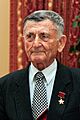
Portrait-photo of Sergei Kramarenko wearing his gold star medal in 2010.
