
Slender burnished brass facts for kids
Quick facts for kids Slender burnished brass |
|
|---|---|
 |
|
| Adult feeding on Salvia nectar | |
 |
|
| Mounted adult | |
| Scientific classification | |
| Kingdom: | |
| Phylum: | |
| Class: | |
| Order: | |
| Family: | |
| Genus: |
Thysanoplusia
|
| Species: |
T. orichalcea
|
| Binomial name | |
| Thysanoplusia orichalcea (Fabricius, 1775)
|
|
| Synonyms | |
|
|
The slender burnished brass (scientific name: Thysanoplusia orichalcea) is a type of moth. It belongs to a family of moths called Noctuidae. A scientist named Johan Christian Fabricius first described this moth in 1775.
This moth can eat many different kinds of plants. It started out in Indonesia. From there, it has spread to many parts of the world. You can now find it in Europe, South Asia, India, Sri Lanka, Africa, Australia, and New Zealand. In northern Europe, these moths often travel long distances, like migrating birds.
Contents
What Does It Look Like?
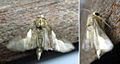
The slender burnished brass moth has a wingspan of about 36 to 44 millimeters (about 1.4 to 1.7 inches). Its head and the area behind its head are a reddish-orange color.
Wings and Body
The front wings are a pale reddish-brown. They have a special metallic golden shine that covers most of the wing. Only the edges and the top part of the wing are brown. You might see some faint, thin, whitish lines on the wings. These lines are wavy and not very clear. The hindwings are plain grey-brown. They are a bit darker near the edges.
The moth's body, called the thorax, is very furry. It also has some small tufts of hair. The moth has a long, tube-like mouthpart called a proboscis. It uses this to drink nectar from flowers.
Larva (Caterpillar)
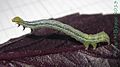
The larva, or caterpillar, of this moth is bluish-green. It has a few short hairs on its back. You can also see thin white lines running down its back. A clear white line runs along its side.
Life and Food
The slender burnished brass moth usually flies from August to October. The exact time depends on where it lives.
What Larvae Eat
The caterpillars of this moth eat many different kinds of plants. They especially like plants that grow in gardens and farms. Some of their favorite foods include sunflowers, Coreopsis plants, potatoes, and soybeans.
Controlling Moth Populations
Scientists have found a way to help control how many of these moths are around. They use a special smell called phenylacetaldehyde. This is a natural smell found in flowers, like the Canada thistle. This smell attracts many moths, especially the female slender burnished brass moths. Traps with this smell can help manage their numbers.
Gallery
-
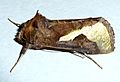
Strong golden wing iridescence as revealed in favourable illumination
-
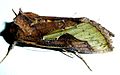
Illuminated from a different angle
-
-


-2.jpg)
.jpg)
Images for kids
-
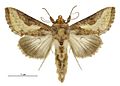
Male
-
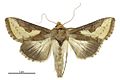
Female


