
Small leaf fuchsia facts for kids
Quick facts for kids Small leaf fuchsia |
|
|---|---|
 |
|
| Leaves and flowers of Fuchsia microphylla subsp. aprica | |
Scientific classification  |
|
| Kingdom: | Plantae |
| Clade: | Tracheophytes |
| Clade: | Angiosperms |
| Clade: | Eudicots |
| Clade: | Rosids |
| Order: | Myrtales |
| Family: | Onagraceae |
| Genus: | Fuchsia |
| Species: |
F. microphylla
|
| Binomial name | |
| Fuchsia microphylla Kunth, 1823
|
|
| Subspecies | |
|
|
| Script error: The function "autoWithCaption" does not exist. | |
| Synonyms | |
|
|
Script error: No such module "Check for conflicting parameters".
Fuchsia microphylla, also known as small leaf fuchsia or small-leaved fuchsia, is a beautiful flowering shrub. It belongs to the plant family Onagraceae. The name microphylla comes from two Greek words: micro, meaning small, and phylla, meaning leaves. This name perfectly describes the plant's tiny leaves.
Contents
Where Does It Grow?
Fuchsia microphylla is a plant that naturally grows in warm places. You can find it from southern Mexico all the way down to Panama in Central America.
What Does It Look Like?
This fuchsia is a shrub that can lose its leaves in winter (deciduous) or keep some all year (semi-evergreen). It can grow up to 1.8 meters (6 feet) tall. It also spreads out about 0.9 meters (3 feet) wide.
Flowers and Fruit
The plant has small, pink, tube-shaped flowers that hang down. They do not have a strong smell. These flowers bloom from September to October. They attract insects, which help the plant make seeds.
After the flowers, the plant grows small, dark, round fruits. These fruits are usually about 5 millimeters across. They can grow up to 1.5 centimeters. The fruit is safe to eat and tastes sweet, but it has a mild flavor.
Leaves and Stems
The leaves of Fuchsia microphylla are usually small, often much less than 4 centimeters long. They are often shaped like a spoon or an egg. Most leaves have small teeth along their edges. When new leaves grow, they often have a reddish color.
This plant usually grows upright, forming a bush. However, in shadier areas, its stems can grow longer, up to 500 centimeters (16.4 feet), and climb.
Growing Conditions
Fuchsia microphylla likes moist, well-drained soil. It can grow in many types of soil, including sandy, loamy, or clay soils. It also grows well in soils that are acidic, neutral, or basic.
This plant prefers places with some shade, like light shade or partial shade. In the wild, you might find it in oak and pine forests in Mexico. It also grows in rocky areas in Guatemala. It can be found at high elevations, from 1200 meters (3,937 feet) to 3800 meters (12,467 feet) above sea level.
It can handle some cold, but it doesn't like hard frosts. If you live in a cold area, it might need protection in winter.
How People Use It
People often grow Fuchsia microphylla in their gardens. It is a popular ornamental plant because of its pretty flowers. The berries are also collected and eaten by local people in the areas where it grows naturally.
Plant Problems and Pests
Like many plants, Fuchsia microphylla can sometimes get sick or be bothered by pests. Some common pests include:
- Whiteflies
- Aphids
- Red spider mites
- Fuchsia gall mite
- Fuchsia flea beetle
It can also get plant diseases like rust and gray mold. Luckily, it is strong against some problems, like honey fungus and rabbits.
Natural Hybrids
Sometimes, different types of fuchsia plants can mix together in nature. This creates a new plant called a natural hybrid. One example is Fuchsia × bacillaris. This plant is a natural mix between Fuchsia microphylla and another fuchsia called Fuchsia thymifolia. Scientists first wrote about this hybrid in 1832.
Images for kids
-
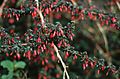
Branches of Fuchsia microphylla subsp. hemsleyana
-
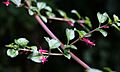
Leaves and flowers of Fuchsia microphylla subsp. hemsleyana
-
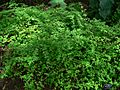
Fuchsia microphylla subsp. hidalgensis
-
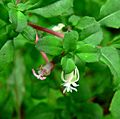
Flowers and leaves of Fuchsia microphylla subsp. hidalgensis
-
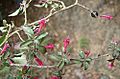
Fruiting branch of Fuchsia microphylla
-
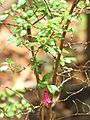
Erect Fuchsia microphylla plant
-
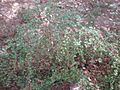
Fuchsia microphylla plant at the Botanical Garden of Bosque de Chapultepec, Mexico


.jpg)
.jpg)

