
Surveillance facts for kids

_(349115665).jpg)
Surveillance is the close monitoring and observation of people, places, or activities. The word comes from a French phrase that means "watching over." People use surveillance to collect information, prevent problems, and protect safety.
Governments and law enforcement agencies use surveillance to enforce rules and maintain national security. Private companies also use monitoring systems to protect buildings, stop theft, and study customer shopping habits. Surveillance relies on many modern tools, including video cameras, computer networks, and digital tracking.
While surveillance can help keep communities safe, it also raises questions about personal privacy. Democratic societies often pass laws to balance security with individual rights. As computers and smart devices become more advanced, the tools used to watch and record daily life continue to change.
Contents
How Surveillance Technology Works
Digital and Computer Surveillance

Computer surveillance involves monitoring digital data sent across the Internet. Whenever people send emails, search for information online, or use messaging apps, digital records are created.
Because billions of messages are sent every day, humans cannot read all of them manually. Instead, automated computer programs scan digital communications for specific keywords, unusual patterns, or suspicious activities. Agencies around the world use specialized data-analysis software to find relevant information quickly.
Personal computers and smartphones can also become targets of software tools called spyware. Once installed on a device, these programs can record keystrokes or access stored files. To protect their users, technology companies frequently release security updates and use encryption to make private messages unreadable to unauthorized observers.
Telephone and Network Monitoring

Telephone systems have long been monitored through a process known as wiretapping. Modern phone networks process millions of calls using automated systems.
Key methods of mobile network monitoring include:
- Automated speech recognition: Programs convert spoken words into text so computers can scan for specific terms.
- IMSI-catchers: Portable devices that act like fake cell phone towers to identify nearby mobile phones.
- Signal multilateration: Calculating the time signals take to reach different towers to find a phone's physical location.
Telecommunications companies follow legal rules about when and how to share call records with law enforcement. Many modern smartphones now use built-in security features that make it harder for third parties to track calls without proper authorization.
Video Cameras and Public Monitoring


Video surveillance uses cameras to watch public and private areas. These setups are often called closed-circuit television (CCTV) systems. In the past, human guards had to watch video screens constantly. Today, automated software helps organize and scan through hours of footage in seconds.
Many cities around the world have installed networks of cameras to monitor traffic and public safety. For example, large cities connect thousands of cameras to central control rooms. Motion sensors help save computer storage space by recording video only when movement occurs.
Modern security cameras often feature:
- High-definition video recording
- Night-vision and infrared sensors
- Automated motion detection
- Direct connections to computer networks
Biometric Identification Systems
.jpg)
Biometrics is the measurement and analysis of unique human physical characteristics. Because every person has distinct physical features, computers can use biometric data to identify individuals.
Common biometric tools include:
- Fingerprint scanning: Analyzing unique patterns of ridges on fingertips.
- Facial recognition: Measuring distances between facial features, such as eyes, nose, and mouth.
- Iris recognition: Scanning the unique colorful rings within human eyes.
- Voice analysis: Identifying unique tones and patterns in spoken words.
Biometric data is used for unlocking smartphones, passing through airport border security, and securing sensitive research facilities.
Aerial and Satellite Observation


Aerial surveillance gathers information from above the ground using aircraft, helicopters, and unmanned aerial vehicles (drones).
Modern drones carry high-resolution digital cameras and thermal imaging tools that can detect heat signatures from great distances. Drones help emergency responders track wildfires, assist police in search-and-rescue operations, and monitor large public gatherings.
High in orbit, satellites take detailed pictures of the Earth's surface. These satellite images help scientists monitor environmental changes, track weather patterns, and assist governments in planning disaster relief efforts.
Wireless Tracking and RFID

Radio-frequency identification (RFID) uses small electronic tags that respond to radio waves. These tags are inexpensive and can be read by scanners from several feet away without direct contact.
RFID chips are commonly used in:
- Electronic passports and student identification badges
- Library books to automate checkout systems
- Hospital bands to identify patients safely
- Microchips placed under the skin of household pets to help return lost animals
GPS technology is also widely used to track vehicles, delivery packages, and emergency service vehicles across cities.
Data Mining and Consumer Profiles
Data mining uses computer algorithms to discover patterns within large sets of electronic information. Every time people make digital purchases, browse websites, or use loyalty cards, electronic data is created.
Companies combine these individual pieces of information to build customer profiles. This practice helps businesses recommend products, display targeted advertisements, and improve user experiences. Privacy experts encourage consumers to check app permissions and manage privacy settings on their digital accounts.
Privacy, Law, and Public Debate
The Value of Personal Privacy
Privacy is the right of individuals to keep their personal life, thoughts, and communications protected from unwanted observation. Most democratic societies recognize privacy as an essential human right.
Privacy allows people to express ideas freely, practice their beliefs without interference, and maintain personal boundaries. When surveillance is overly broad, people may feel uncomfortable speaking openly or exploring new ideas.
Legal Rules and Regulations
To protect citizens, many countries have established strict laws regarding when surveillance can be used. In many legal systems, law enforcement officers must obtain a written permission slip from a judge, called a warrant, before tapping a phone or searching a home.
In the digital world, data protection regulations require companies to inform users about the information they collect and allow people to delete stored personal data.
Countermeasures and Sousveillance

As monitoring technology has expanded, new terms have emerged to describe how the public interacts with surveillance systems:
- Countersurveillance: Actions taken to prevent or avoid being monitored, such as using encrypted messaging tools or covering computer webcams.
- Sousveillance: The practice of regular citizens recording events or public officials, such as using smartphone cameras during public demonstrations to ensure accountability.
These practices help create a balance of transparency between citizens and institutions.
Images for kids
-
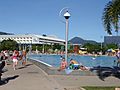
Surveillance camera mounted on a pole in Cairns, Australia
-
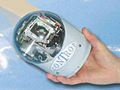
Specialized aerial camera used on aircraft
-

Identification card showing encoded number system
-
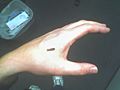
Medical demonstration showing miniature identification device


Related Pages
- Computer and network surveillance
- Mass surveillance
- Sousveillance
- Surveillance aircraft
- Trapwire
See also
 In Spanish: Vigilancia para niños
