
Trinidad euphonia facts for kids
Quick facts for kids Trinidad euphonia |
|
|---|---|
 |
|
| Conservation status | |
Scientific classification  |
|
| Kingdom: | Animalia |
| Phylum: | Chordata |
| Class: | Aves |
| Order: | Passeriformes |
| Family: | Fringillidae |
| Subfamily: | Euphoniinae |
| Genus: | Euphonia |
| Species: |
E. trinitatis
|
| Binomial name | |
| Euphonia trinitatis Strickland, 1851
|
|
 |
|
| Script error: The function "autoWithCaption" does not exist. | |
| Synonyms | |
|
Euphonia chlorotica trinitatis |
|

Script error: No such module "Check for conflicting parameters".
The Trinidad euphonia (Euphonia trinitatis) is a small, colorful bird. It belongs to the Fringillidae family, which includes finches. You can find this bird in northern Colombia and northern Venezuela. It is also found, though less often, on the Caribbean island of Trinidad.
Like other euphonias, it is a small, plump bird with a short tail. Males and females look different, which is called sexual dimorphism. The male has a shiny blue-black head, back, throat, and upper chest. He also has a bright yellow forehead and crown, and bright yellow underparts. The female is olive-green on top and yellow-olive underneath. She has a grayish patch on her chest and belly, and bright yellow feathers under her tail.
Trinidad euphonias make high-pitched, sad-sounding whistles. Two common calls are a double "pee pee" or "tee dee," or a rising "puwee" or "cooleee." Their song is a short, mixed-up tune of musical and non-musical sounds.
These birds mostly eat fruit, especially mistletoe berries. They also eat other fruits, some seeds, and small invertebrates like insects. Trinidad euphonias stay with the same partner all year round. Both parents help build a round nest from dried grass and stems. The female lays three to four cream-colored eggs with brown spots. She sits on the eggs to keep them warm. Both parents then feed the baby birds when they hatch. An English bird expert named Hugh Edwin Strickland first described this bird in 1851.
Contents
About the Trinidad Euphonia
The Trinidad euphonia was first described by an English bird expert, Hugh Edwin Strickland, in 1851. He found a specimen of the bird on the island of Trinidad. He gave it the name Euphonia trinitatis.
For a long time, euphonias were thought to be part of the tanager family. But studies of their DNA showed that they are actually more closely related to finches. Because of this, they were moved to the finch family, Fringillidae.
The name Euphonia comes from an Ancient Greek word meaning "good sound" or "excellence of tone." The species name trinitatis honors Trinidad, the island where the bird was first found.
What it Looks Like
The Trinidad euphonia is a small bird, about 9.7 to 11 centimeters (about 4 inches) long. It weighs between 8.8 and 14 grams (about 0.3 to 0.5 ounces). Males and females have different colors.
The male has a shiny blue-black head, back, chin, and throat. His forehead and the top of his head are bright yellow. His belly and chest are also bright yellow. When he flies, you can see a white stripe under his wings. He also has white spots on the underside of his tail feathers.
The female is olive-green on her back and yellow-olive underneath. She has a grayish patch in the middle of her chest and belly. The feathers under her tail are bright yellow. Both male and female birds have dark brown eyes and gray legs and feet. Their beak is black, with a white bottom part.
Bird Calls and Songs
The Trinidad euphonia is known for being very vocal. Its calls are high-pitched whistles that can be hard to find in the trees. The male often calls from the top of a tree, sometimes on a bare branch.
One common call sounds like "pee," "tee," or "dee." It is usually repeated twice, but sometimes 3 to 5 times, or even up to 20 times. These notes are all on the same pitch and can be heard from far away. Another common call sounds like "duu dee," "puwee," or "cooleee." This call is sung quickly on two different pitches, with the second note being higher. A third call is a sad "siu."
The bird's song is a short, mixed-up tune of musical and non-musical sounds. It often sings its song between calls. The female's calls are shorter and not as loud as the male's.
Birds That Look Similar

The Trinidad euphonia looks a lot like other euphonia species. The male Trinidad euphonia has a dark throat, which helps tell it apart from male thick-billed and violaceous euphonias, which have yellow throats.
You can tell the female Trinidad euphonia from female thick-billed and violaceous euphonias because she is smaller and has a smaller, thinner beak. The gray color on her chest and belly is also a good clue.
The male orange-bellied euphonia has a reddish-brown forehead instead of yellow. The female orange-bellied euphonia has a grayish neck. The purple-throated euphonia is very similar and a bit larger. Male purple-throated euphonias often have a purplish shine instead of bluish. Their yellow crown only goes to just behind their eyes. It is very hard to tell female and young Trinidad euphonias apart from purple-throated euphonias in the wild.
Where it Lives
The Trinidad euphonia lives in northern Colombia, northern Venezuela, and on the island of Trinidad. There was one sighting in Tobago, but it was likely a bird that escaped from a cage.
On Trinidad, these birds mostly live in areas where forests are growing back, or in hill forests near mistletoe plants. They also live in gardens with big trees. On the mainland, they live in warm areas up to 1,100 meters (about 3,600 feet) high. They are especially common in dry areas. Their homes include dry forests, the edges of wet forests, light woodlands, scrub areas, and cultivated lands. In wetter forests, the purple-throated euphonia usually takes its place.
How it Behaves

The Trinidad euphonia spends a lot of its time high up in the trees. You usually see them in pairs or in small groups of up to eight birds. They don't often join groups of different bird species. However, they will join other birds to bother snakes, owls, or other predators. These birds are known to travel widely.
Reproduction and Nesting
Trinidad euphonias are monogamous, meaning a pair stays together all year. In Trinidad, they breed from January to April. In Colombia and Venezuela, they usually breed in April.
During courtship, the male and female flick their wings and twitch from side to side. The male bows low to show off his bright yellow crown. Both the male and female build the nest. It is a round ball made of dried grass and stems, with a round entrance on the side. The inside is lined with softer materials. Nests can be found from 1.4 to 12 meters (about 4.5 to 39 feet) off the ground. They build nests in many different places, sometimes hidden in large bromeliad plants or hanging from the end of a branch. One nest was even found in a hollow tree stump.
The female lays 3 to 4 eggs. The eggs are white or cream-colored with irregular dark brown spots. They are about 17.7 x 12.9 millimeters (about 0.7 x 0.5 inches) in size. Only the female sits on the eggs to keep them warm. But both parents feed the young birds once they hatch.
What it Eats
Like all euphonias, the Trinidad euphonia mainly eats fruit. They especially love small berries, particularly mistletoe berries. Unlike some other euphonias, they also eat insects. They find insects on spiderwebs and under small twigs. They also eat other small invertebrates and seeds.
The Trinidad euphonia has a special stomach that lacks the strong, muscular part called a gizzard that most birds have. This might help them digest mistletoe berries, as other euphonia species that eat a lot of mistletoe also have this stomach change. They look for food noisily and actively, either alone or in small groups. They usually search for food in the middle and upper parts of trees, but they will go lower at the edges of forests.
How We Protect Them
The International Union for Conservation of Nature (IUCN) says the Trinidad euphonia is a species of least concern. This means they are not currently in danger. This is because they live in a very large area, and their numbers seem to be steady. Even though we don't know exactly how many there are, they are common in most places they live.
However, on Trinidad, they are rare and found only in certain spots. This is because too many birds have been caught for the caged bird trade. Birds caught for pets often do not live long because their owners may not know how to care for them properly.
Images for kids
-
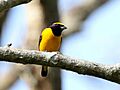
Small bird with a black throat and a yellow belly and crown, perched on a branch
-
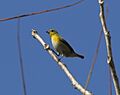
Female Trinidad euphonias have a grayish patch on their belly and abdomen.
-
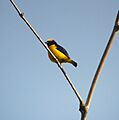
The male's yellow crown extends back behind his eyes.
