
Truman Doctrine facts for kids
The Truman Doctrine was a big idea in U.S. foreign policy. It promised American help to countries that were trying to stay free from authoritarian threats. This policy started mainly to stop the spread of the Soviet bloc during the Cold War. President Harry S. Truman announced it to the U.S. Congress on March 12, 1947. He later promised to help stop communist groups fighting in Greece and to resist Soviet demands on Turkey. The Truman Doctrine meant the U.S. would support other nations facing threats from Moscow. It also led to the creation of NATO in 1949. Many historians see Truman's speech as the start of the Cold War.
Truman told Congress that the U.S. must "support free peoples who are resisting attempted subjugation by armed minorities or by outside pressures." He believed that governments controlling people's lives threatened world peace and U.S. safety. Truman argued that if Greece and Turkey did not get help, they might fall under communist control. This could have serious effects on other countries in the region.
The Truman Doctrine became a key part of American Cold War policy. It changed how the U.S. dealt with the Soviet Union. Instead of being wartime allies, the U.S. focused on "containment" to stop Soviet expansion. This idea was strongly supported by diplomat George F. Kennan.
Contents
Protecting Important Waterways
After World War II, the Soviet Union wanted to control the Turkish straits. These waterways connect the Black Sea to the Mediterranean Sea. This would allow Soviet ships to move freely between these seas. Turkey did not agree to these demands. This caused a lot of tension in the area. The Soviet Union even showed off its naval power near the Straits.
Britain had been helping Turkey, but their aid ended in 1947. So, the United States stepped in. The U.S. sent military aid to make sure Turkey kept control of these important passages. Turkey received $100 million in aid. The U.S. Navy also sent the aircraft carrier USS Franklin D. Roosevelt to the region.
Helping Greece in a Time of Conflict

In October 1944, British and Greek forces arrived in Greece. This happened after Axis forces slowly left the country. There was an agreement that all Greek resistance groups would join a new Greek Army. However, one large group, ELAS, was told to give up its weapons. ELAS protested this order with a rally in Athens on December 3, 1944. Greek security forces fired on the protestors, and 28 people died.
This event led to clashes between ELAS and the Greek government, supported by the British. ELAS was defeated and disarmed. After this, there was a period of conflict and challenges for Greek leftists. This contributed to the start of the Greek Civil War in 1946.
During the civil war, communist fighters rebelled against the Greek government. This government was formed after elections in 1946. The British learned that these communist fighters were getting money from Josip Broz Tito in nearby Yugoslavia. Even though Joseph Stalin (the Soviet leader) did not want them to, Yugoslavia helped the Greek communists.
By late 1946, Britain told the U.S. that its own economy was struggling. Britain could no longer afford to give military and economic help to the Greek government.

Between 1946 and 1947, the U.S. and the Soviet Union became rivals instead of allies. Growing problems in Germany made these tensions worse. President Truman worried that the unrest in Greece was part of a larger plan. He thought it might threaten the oil-rich Middle East and important ports in the Mediterranean.
In February 1946, George F. Kennan, a U.S. diplomat in Moscow, sent a famous message. It said that the Soviets would only respond to strength. He suggested a long-term plan called "containment." This meant stopping their geographical expansion.
After Britain said it could no longer help Greece, the Greek Prime Minister, Konstantinos Tsaldaris, visited Washington, D.C. in December 1946 to ask for aid. The U.S. State Department then created a plan. It decided to give aid to both Greece and Turkey. This would help calm their old rivalry and strengthen them.
American leaders understood how unstable the region was. They feared that if Greece became communist, Turkey would soon follow. And if Turkey gave in to Soviet demands, Greece would be in danger. This idea, like a "domino effect," guided the U.S. decision. Greece and Turkey were also important for their location. If Greece fell, it would put the Soviets in a strong position against Turkey. It would also make it easier for the Soviet Union to cut off allied supply lines in a war.
President Truman's Important Speech
To get his plan approved, President Truman needed support from the Republicans. They controlled both parts of Congress. Senator Arthur Vandenberg, a key Republican, strongly supported Truman. He helped convince other Republicans who wanted the U.S. to stay out of world affairs.
Truman prepared for his request by meeting with important congressional leaders. He met with Secretary of State George C. Marshall and Undersecretary of State Dean Acheson. Acheson explained the "domino theory" very clearly. He compared a communist state to a rotten apple that could infect a whole barrel. Vandenberg was impressed. He advised Truman to speak to Congress and "make the American people understand the serious danger." On March 7, Acheson warned Truman that communists in Greece could win within weeks without outside help.
When a draft of Truman's speech was shared, some, like Marshall and Kennan, thought it was too dramatic. Truman replied that, as Vandenberg suggested, he needed to emphasize the threat to get approval.
On March 12, 1947, Truman spoke to a joint session of Congress. In his eighteen-minute speech, he said:
I believe it must be the policy of the United States to support free peoples who are resisting attempted subjugation by armed minorities or by outside pressures.
I believe that we must assist free peoples to work out their own destinies in their own way.
I believe that our help should be primarily through economic and financial aid which is essential to economic stability and orderly political processes.
.jpg)
.jpg)
Most people in the U.S. reacted positively to Truman's speech. Anti-communists from both political parties supported his aid plan and the ideas behind it. One magazine called it a "popularity jackpot" for the President.
However, some people were doubtful. Influential writer Walter Lippmann questioned how open-ended Truman's promise was. He felt strongly about it. Others argued that the Greek monarchy Truman wanted to defend was not truly democratic. It was a government that limited people's freedoms.
Despite these concerns, the fear of a growing communist threat helped ensure the bill passed. In May 1947, Congress approved $400 million in military and economic aid for Greece and Turkey. This was two months after Truman's request. This increased American aid helped the Greek government defeat the communist fighters. The Truman Doctrine was the first of several steps by the U.S. to contain communism. It was followed by the Marshall Plan to rebuild Western Europe. Then came the creation of NATO in 1949 for military defense.
How the Doctrine Shaped the Future
Historian Eric Foner explained that the doctrine "set a precedent for American assistance to anticommunist regimes throughout the world." This was true even if those governments were not democratic. It also led to the creation of global military alliances against the Soviet Union.
The Truman Doctrine became the foundation of American Cold War policy. This was true in Europe and around the world. Historian James T. Patterson noted:
The Truman Doctrine was a highly publicized commitment of a sort the administration had not previously undertaken. Its sweeping rhetoric, promising that the United States should aid all 'free people' being subjugated, set the stage for innumerable later ventures that led to globalisation commitments. It was in these ways a major step.
Historian Dennis Merill suggests the doctrine lasted because it addressed wider worries about modern life. It helped calm fears about communism spreading like a "domino effect." It also allowed the doctrine to be presented in a way that gained support from both political parties. It used American economic power to stabilize unstable regions without direct military action. This brought nation-building and modernization programs to the forefront of foreign policy.
The Truman Doctrine became a symbol for giving aid to stop a nation from falling under communist influence. Truman used words like "disease" to show the danger of communism spreading. He wanted to create an image of protecting non-communist countries worldwide. This echoed President Franklin D. Roosevelt's "Quarantine Speech" from 1937. Roosevelt had used the idea of "quarantine" (like public health officials handle a disease) to contain German and Japanese expansion. This medical comparison, along with ideas of fire and flood, made it easier for the U.S. to get involved in later conflicts. These included the Korean War and the Vietnam War. By describing these differences as life-or-death situations, Truman gained support for his policy to contain communism.
Related pages
Images for kids
-
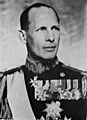
King George II of Greece (r. 1922–24, 1935–47), whose rule was opposed by a communist insurgency in the Greek Civil War
-
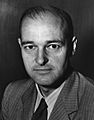
George F. Kennan (1904–2005) proposed the doctrine of containment in 1946.
-
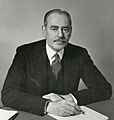
Dean Acheson (1893–1971), who helped craft Truman's doctrine, was named his secretary of state the following year.


See also
 In Spanish: Doctrina Truman para niños
- Containment
- Eisenhower Doctrine
- Foreign policy of the Harry S. Truman administration
- Free World
- Greece–United States relations
- Liberal internationalism
- Reverse Course
- Turkey–United States relations
- Fulton Speech
