
Violet copper facts for kids
Quick facts for kids Violet copper |
|
|---|---|
 |
|
| Male | |
 |
|
| Female | |
Scientific classification  |
|
| Kingdom: | Animalia |
| Phylum: | Arthropoda |
| Class: | Insecta |
| Order: | Lepidoptera |
| Family: | Lycaenidae |
| Genus: | Lycaena |
| Species: |
L. helle
|
| Binomial name | |
| Lycaena helle Denis & Schiffermüller, 1775
|
|
| Script error: The function "autoWithCaption" does not exist. | |
Script error: No such module "Check for conflicting parameters".
The violet copper (scientific name: Lycaena helle) is a beautiful type of butterfly. It belongs to the Lycaenidae family, which includes many small to medium-sized butterflies. You can find these butterflies across a wide area, from the Pyrenees mountains in Europe all the way to northern Norway. They also live across Belgium and eastward through Asia, including Siberia and Amur.
Contents
About the Violet Copper
The violet copper butterfly is known for its pretty colors. It has a wingspan of about 24 to 26 millimeters, which is roughly the size of a large coin. These butterflies are usually seen flying from May to July, but the exact time depends on where they live.
What Does It Look Like?
The top side of the violet copper's wings is generally a dark brown color. If you look closely, especially in the sun, you might see a lovely sky-blue shine on both wings. This blue color is very strong on live butterflies.
Female butterflies, especially those that hatch in the spring, often have a reddish-yellow patch on the front part of their forewings. The underside of their hindwings has a clear bluish-white band with black dots. This band sometimes continues onto the forewing in females.
Butterflies that hatch later in the summer, called the obscura form, tend to be darker on top and more yellow underneath. The exact shade of blue or violet on their wings can also vary depending on the area they come from.
Where Do They Live?
Violet copper butterflies live in many parts of Central and Northern Europe. You can find them from Belgium, Baden, and Switzerland, stretching eastward to Amurland in Asia, and northward to Scandinavia and Lapland. They are not found everywhere in these areas, but rather in specific spots.
They especially like damp meadows. In the northern parts of their range, they are often found in flat areas. However, in the southern parts, they prefer mountains, living at heights of up to 6,000 feet (about 1,800 meters).
Life Cycle
The violet copper butterfly goes through a complete metamorphosis.
Egg Stage
The eggs are flat and white, with a darker spot on top.
Larva Stage
The larva, or caterpillar, is quite long and light green. It has a dark line down its back with pale edges and a light yellow stripe along its side. Caterpillars are usually found in June and autumn. They mostly eat a plant called Polygonum bistorta, but they might also eat Rumex plants.
Pupa Stage
After growing, the caterpillar turns into a pupa, also known as a chrysalis. The pupa is yellowish-brown with irregular dark markings. The back of its abdomen is a dirty white color.
Adult Stage
The adult butterflies are active in May, and then again in July and August. They are often found in large numbers where they fly. Spring butterflies particularly enjoy the flowers of Cardamine pratensis. At night, these butterflies rest under the leaves of Alnus (alder) and Salix (willow) trees. Sometimes, several butterflies will gather together to sleep on the same leaf.
Images for kids
-
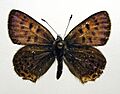
Dorsal view
-
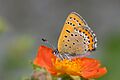
Ventral view
-
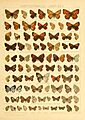
Seitz as amphidamas


