
Vyšší Brod (Hohenfurth) cycle facts for kids
The Vyšší Brod (Hohenfurth) cycle is a super important collection of nine panel paintings from the Gothic period in Europe. These paintings show different scenes from the life of Jesus, including his childhood, his suffering and death, and his return to life.
These amazing artworks were created between 1345 and 1350 in a workshop that was probably located in Prague. The main artist is known as the Master of Vyšší Brod. The paintings were likely made for a large altar in a church or perhaps hung on a screen that separated parts of the church at the Cistercian Abbey in Vyšší Brod.
It seems that Petr I of Rosenberg, a powerful noble in the Bohemian Kingdom, ordered these paintings. He was a big supporter of the abbey. Today, after being returned to the Cistercian Abbey, these paintings are on display at the National Gallery in Prague, where many people can see them.


Contents
What the Paintings Show
The paintings are about 99 x 92 centimeters in size. Each one is made from three sycamore wood boards joined together. The artists first drew their designs with charcoal on a white base, then painted them using a type of paint called tempera. They also used gold and silver leaf to make parts of the paintings shine.
The nine paintings are arranged in three groups of three. The most important painting, the Crucifixion, is in the middle. These paintings were made to help people think about important church holidays. The artist used many symbols in the paintings that tell stories from the Gospels and other old texts.
The Bottom Row: Jesus' Childhood
The paintings in the bottom row show scenes from Jesus' childhood. They relate to holidays like Advent and Christmas. These paintings use bright colors and lots of gold.
The Annunciation to the Virgin Mary
.jpg)
This painting shows the Angel Gabriel telling the Virgin Mary that she will have a baby, Jesus. Mary is holding an open book. You can see symbols like a lily and a veil, which stand for purity. Peacocks in the painting represent new life and forever.
The angel in the painting looks like a fancy courtier, or a noble person, bringing a message from a ruler. The lily on the angel's cloak was a symbol used by French kings. Mary is shown as a queen with a crown, not just a simple girl. Some people think this scene might be connected to the crowning of Charles IV and Blanche of Valois as King and Queen of Bohemia in 1347.
The Nativity of Jesus
.jpg)
This painting shows three scenes at once. In the middle, Mary is with baby Jesus in a simple stable. In the background, you can see animals. In the front, Joseph is preparing a bath for the baby with a midwife. In the distance, an angel is telling shepherds the good news.
It was unusual for Joseph to be so involved in caring for the baby in paintings from this time. But it shows how much respect for Saint Joseph grew later on. Mary is shown kissing baby Jesus, which connects to her special role as Christ's bride. The baby's nakedness shows his human side. Mary is lying on a fancy bed, showing she is the Queen of Heaven.
In the bottom right corner, you can see a person kneeling. This is the "donor," the person who paid for the painting. His family symbol, a five-petaled rose, shows he is from the Rosenberg family. He is holding a model of a church, probably the abbey church at Vyšší Brod.
The Adoration of the Magi
.jpg)
This painting shows the three wise men, or Magi, visiting baby Jesus. Mary is again shown as a queen on a throne. The wise men represent different ages of man. One of the kings, who is older, is shown kissing the hand of the small child. This was a rare way to show respect for Jesus at the time.
Mary is placed in a way that she seems to be a strong support, like a pillar, for the Christian Church.
The Middle Row: Jesus' Suffering
The paintings in the middle row show events from Easter, focusing on Jesus' suffering and his return to life. These paintings use darker colors and less decoration.
Christ on the Mount of Olives
This painting shows Jesus praying on the Mount of Olives, while three of his followers, Peter, John, and James, are sleeping. You can see three birds: a goldfinch, a bullfinch, and a crested lark. These birds have special meanings. The goldfinch is often linked to Jesus' suffering because it eats thistle seeds, which remind people of Jesus' crown of thorns. The bullfinch's red chest is said to represent drops of Jesus' blood.
The Crucifixion
This painting shows Jesus on the cross with a group of people around him. Some parts of this scene, like Mary fainting and Mary Magdalene hugging the cross, come from Italian art.
Below the cross, you can see Longinus with a spear, Joseph of Arimathea, and a Roman soldier. This soldier has a strange face on his shield, which was meant to scare away evil.
The painting highlights the importance of Jesus' wounds and blood. For example, Mary's cloak is spattered with blood, and Longinus is miraculously cured of his blindness by Jesus' blood. These symbols might have been important to Charles IV, who collected holy items like a piece of Mary's bloodied robe and the tip of Longinus's spear.
The Lamentation
.jpg)
After Jesus died on the cross, this scene shows his followers mourning over his body. This scene is not in the Gospels and was not often shown separately in older art.
In this painting, Mary holds Jesus in her lap, which was a new way to show this scene at the time. This type of image is called a Pietà. Mary is shown as a grieving mother. Other people in the painting include Saint John, Saint Mary Magdalene, other women named Mary, and Nicodemus.
The Top Row: Jesus' Triumph
.jpg)
The Resurrection
This painting combines two events: Jesus coming back to life and the three Marys visiting his empty tomb. The main scene shows Jesus rising from his tomb, with surprised soldiers guarding it. Jesus is shown larger to emphasize his importance. He holds a banner, which is a symbol of his victory over death.
The last two paintings show Jesus going up to heaven and the Holy Spirit coming down to his followers. These mysterious events are shown with brighter and more contrasting colors.
The Ascension
.jpg)
This painting shows Jesus going up to heaven forty days after he came back to life. The artist shows only Jesus' lower legs as he disappears into the clouds. In the background, you can see a green landscape with Jesus' footprints. His followers, the apostles, are shown with different hand gestures.
Descent of the Holy Spirit
,_N%C3%A1rodn%C3%AD_galerie_v_Praze.jpg)
This scene, also known as Pentecost, shows the Virgin Mary sitting with an open book. Around her are the twelve apostles. The Holy Spirit came down to them as tongues of fire, giving them the ability to speak all languages. This helped them spread the Christian message around the world. One apostle is shown with his finger to his mouth, a symbol of quiet obedience.
The Artists Behind the Work
The main artist, the Master of Vyšší Brod, painted most of these works. He had a unique style. His figures look solid and real, and their movements are believable. Their faces also look different from each other. It's thought that three other painters also helped with the series. The paintings have been repaired and cleaned many times over the years, most recently between 1993 and 2007.
How the Paintings Influenced Other Art
The style of the Master of Vyšší Brod combined ideas from Italian art, which had some Byzantine influences, with Western European Gothic styles from France. The way the artist showed rocky landscapes was common in the 1340s. Italian influences can be seen in the painting techniques, the more realistic figures, and the way landscapes and buildings are shown.
Many ideas and symbols from the Vyšší Brod cycle were later used in other Bohemian artworks, especially in illustrated books. The motif of Mary's bloodied robe, for example, was mostly found in Bohemian art and continued to appear in paintings for many years.
The Story of the Artwork
The altarpiece was most likely made for the Cistercian Abbey in Vyšší Brod. The person who probably paid for it was Petr I of Rosenberg, a very important official. He might have wanted to help his son's soul, who died in a battle. Petr of Rosenberg supported the abbey from 1332 and was buried there in 1347. His son, Jošt of Rosenberg, likely made sure the paintings were finished. The paintings were made in a workshop in Prague.
In 1938, before World War II, the altarpiece was moved to the National Gallery in Prague. But during the war, the Nazis stole it and stored it in the Vyšší Brod Abbey. Adolf Hitler wanted to put them in a museum he planned to build. At the end of the war, the American army found the altarpiece in a salt mine in Austria. It was returned to the National Gallery in Prague in 1947. In 2014, it was given back to the Cistercian Abbey in Vyšší Brod, but it is still on long-term loan to the National Gallery in Prague so everyone can see it.
Images for kids
-
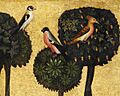
Christ on the Mountain of Olives (detail with birds)
-
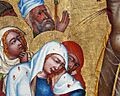
Crucifixion (detail with Christ’s blood)
-
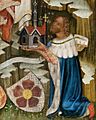
Nativity, (detail with donor portrait)
-
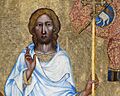
Resurrection (detail of Christ and his banner)
-
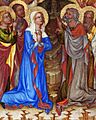
Ascension (detail of Virgin Mary)
-
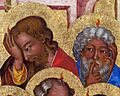
Descent of the Holy Spirit (detail of Apostles and tongues of fire)
-
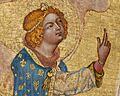
Annunciation (detail of Angel)
-
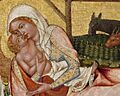
Nativity (detail of Mary and Child)
-
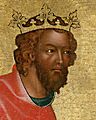
Adoration of the Magi (head of second King)
-
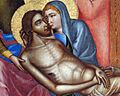
Lamentation (detail of Pietá)
.jpg)
.jpg)
.jpg)
Other Works by the Master of Vyšší Brod
The workshop of the Master of Vyšší Brod also created other beautiful artworks. Here are a few:
- Madonna and Child Enthroned, now at the Metropolitan Museum of Art in New York.
- Madonna of Kłodzko
- Madonna of Veveri (1344-1350)
- Rome Madonna (1350-1355), National Gallery in Prague
- Strahov Madona, Strahov Monastery
- Kaufmann Crucifixion
-
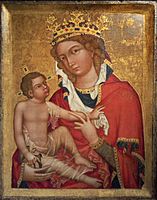
Madonna of Veveri (1344-1350)
-
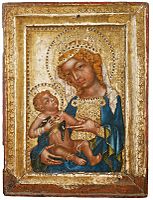
Rome Madonna (1350-1355), National Gallery in Prague
-
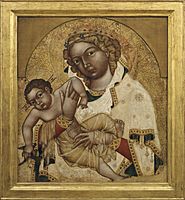
Strahov Madona, Strahov Monastery
-
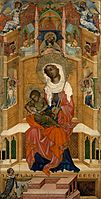
Madonna of Kłodzko, Bohemian Master (1343–44) - Google Art Project
-
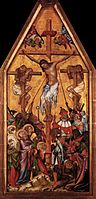
Kaufmann Crucifixion


_-_Google_Art_Project.jpg)

