
5th (Huntingdonshire) Battalion, Northamptonshire Regiment facts for kids
Quick facts for kids Huntingdonshire Cyclist Battalion5th (Huntingdonshire) Battalion, Northamptonshire Regiment |
|
|---|---|
| Active | 27 February 1914 – 1 May 1961 |
| Country |  United Kingdom United Kingdom |
| Branch |  British Army British Army |
| Type | Bicycle infantry Infantry |
| Size | 1–3 battalions |
| Part of | Eastern Command 162nd (East Midland) Brigade 143rd (Warwickshire) Infantry Brigade 11th Infantry Brigade 162nd Independent Infantry Brigade |
| Garrison/HQ | Huntingdon (to 1919) Peterborough (from 1920) |
| Service | First World War Second World War |
| Commanders | |
| Honorary Colonels | Col. The Rt. Hon. Edward Montagu, 8th Earl of Sandwich KCVO DSO Lt.-Gen. Sir A.G. Hunter-Weston KCB DSO |
| Notable commanders |
William Edward Green |
The Huntingdonshire Cyclist Battalion was a special group of soldiers in the British Army. They were known as bicycle infantry because they used bicycles to move around quickly. This group was first formed in February 1914. During the First World War, they stayed in the United Kingdom.
After the war, in 1920, they changed from bicycle soldiers to regular infantry. They were renamed the 5th (Huntingdonshire) Battalion, Northamptonshire Regiment. This battalion played a big part in the Second World War. They fought in France in 1940, then in Tunisia from 1942 to 1943. Later, they fought in Sicily and Italy from 1943 to 1945. The war ended for them in May 1945 in Austria. They continued to serve until May 1961. At that time, they joined with another group, the 4th Battalion, Northamptonshire Regiment, to form a new unit.
Contents
History of the Battalion
Early Beginnings: Volunteer Soldiers
Around 1859, there was a worry that France might invade Britain. The regular British Army was busy elsewhere, so many people volunteered to form local defense groups. These groups were called the Volunteer Force.
The first volunteer group in Huntingdonshire started in 1860. It was called the 1st Huntingdonshire Rifle Volunteer Corps. Over time, this group changed and became part of other larger units.
Forming a New Battalion
In 1900, a new group was created: the 4th Volunteer Battalion, Bedfordshire Regiment. Its main office was in Huntingdon. In 1901, it was renamed the 4th (Huntingdonshire) Volunteer Battalion, Bedfordshire Regiment.
Later, in 1908, the Volunteer Force was reorganized into the Territorial Force. This battalion joined with another group to become the 5th Battalion, Bedfordshire Regiment. Only two companies from Huntingdonshire were part of this new unit.
The Huntingdonshire Cyclist Battalion is Born

Huntingdonshire was one of the few areas without its own special army battalion. After many talks, it was decided in March 1913 that the Huntingdonshire Cyclist Battalion could be formed. This new battalion officially started on 27 February 1914. It was the very last battalion of the Territorial Force to be created before the First World War began.
Soldiers from the two Huntingdonshire companies of the 5th Battalion, Bedfordshire Regiment, were allowed to join this new cyclist battalion, and most of them did. The battalion's main office was in Huntingdon. It had several companies, each based in different towns like Huntingdon, St Ives, St Neots, Ramsey, and Fletton. This battalion was meant to be a fast-moving infantry unit. They would use their bicycles for scouting, sending messages, and other quick tasks.
The First World War (1914-1918)
When the First World War started on 4 August 1914, the Territorial Force was mainly for defending Britain. However, many soldiers volunteered to serve overseas. Because of this, the units were split into different "lines."
1st Line: 1/1st Huntingdonshire Cyclist Battalion
This battalion was called into action on 4 August 1914. They moved to Grimsby and stayed in England throughout the entire war. They were stationed in places like Scarborough and Whitby. In July 1916, many of their soldiers were sent to fight on the Western Front with another regiment. The battalion was officially ended on 14 April 1919.
2nd Line: 2/1st Huntingdonshire Cyclist Battalion
The 2nd Line battalion was formed in October 1914. They spent most of the war defending the coast in Lincolnshire. They were stationed in towns like Sutton-le-Marsh, Alford, Chapel St Leonards, and Skegness. This battalion was disbanded on 12 December 1919.
3rd Line: 3/1st Huntingdonshire Cyclist Battalion
The 3rd Line battalion was created in 1915. Its job was to train new soldiers to replace those in the 1st and 2nd Line battalions. This group was disbanded in March 1916. Its soldiers were sent to the other two battalions or to the Machine Gun Corps.
Between the World Wars (1918-1939)
After the First World War, the Territorial Force was reorganized and renamed the Territorial Army in 1921. A big change was that bicycle units were no longer needed. They were either disbanded or changed into other types of units.
The Huntingdonshire Battalion became a regular infantry unit. On 7 February 1920, it was renamed the 5th (Huntingdonshire) Battalion, Northamptonshire Regiment. Its main office moved to Peterborough. This battalion joined the 162nd (East Midland) Infantry Brigade.
In the 1930s, there was a growing need to defend against air attacks. Many Territorial Army units were changed to anti-aircraft roles. In 1938, the battalion moved to the 143rd (Warwickshire) Infantry Brigade.
By 1939, it was clear that another war was coming. The Territorial Army was doubled in size. The 5th (Huntingdonshire) Battalion helped form a new group, the 4th Battalion, Northamptonshire Regiment.
The Second World War (1939-1945)
5th (Huntingdonshire) Battalion, Northamptonshire Regiment
The 5th (Huntingdonshire) Battalion was called to action on 1 September 1939, when Germany invaded Poland. Two days later, Britain declared war. The battalion joined the British Expeditionary Force (BEF) in France on 5 January 1940. They were the first Territorial Army division to go to France.
When the Germans invaded France on 10 May 1940, the BEF moved to defend Belgium. The battalion fought in the Battle of the Ypres-Comines Canal. But the Germans advanced very quickly, forcing the BEF to retreat to Dunkirk. The battalion was safely brought back to England on 1 June 1940. They spent the next two years in the UK, preparing for a possible German invasion.

In June 1942, the battalion joined the 78th "Battleaxe" Infantry Division. They left the UK on 16 October 1942 and went to North Africa. They landed in Algeria on 9 November 1942 as part of Operation Torch. They fought in several battles during the Tunisia Campaign, including the Tebourba Gap and the final battle for Tunis.
Next, they fought in the Allied invasion of Sicily, landing on 25 July 1943. They took part in the Battle for Adrano. On 22 September, they left Sicily for Italy. They served on the Italian Front for the rest of the war, except for a short break in Egypt.
The battalion landed in Taranto, Italy, and moved up the Adriatic coast. They fought in battles like the crossing of The Sangro and the Battle of Monte Cassino. They also advanced through the Liri Valley and fought for the Trasimene Line.

They returned to Italy on 16 September after a rest in Egypt. They took part in the final attack in Italy, called Operation Grapeshot. This included crossing The Senio and fighting in the Battle of the Argenta Gap. The battalion entered Austria on 8 May 1945, after German forces in Italy surrendered. They stayed in Austria on duty until 15 September 1946.
4th Battalion, Northamptonshire Regiment
This new 4th Battalion was formed on 1 June 1939. It was assigned to the 183rd Infantry Brigade. This brigade was part of the 61st Infantry Division. The battalion stayed with this brigade in the United Kingdom for most of the war. They spent a long time in Northern Ireland from June 1940 to February 1943.
On 28 August 1944, the battalion moved to the 115th Infantry Brigade. This group was planning to free the Channel Islands, but the plan didn't happen. On 12 February 1945, the battalion moved to North West Europe. They stayed there until the end of the war. The 4th Battalion was officially ended in Germany on 4 February 1946. On 1 January 1947, it joined with the 5th (Huntingdonshire) Battalion.
After the War (1945-1961)
The Territorial Army units were reactivated on 1 January 1947. The battalion was formally restarted in Peterborough. It also absorbed the 4th Battalion at the same time. The battalion was assigned to the 162nd Independent Infantry Brigade.
On 1 May 1961, the battalion joined with another unit to form the 4th/5th Battalion, Northamptonshire Regiment. This marked the end of the Huntingdonshire Cyclist Battalion as a separate unit.
See also
- Army Cyclist Corps
- Arthur Mellows, a British army colonel and later Mayor of Peterborough who served with the Cyclist Battalion during the First World War
Images for kids
-
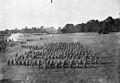
A bicycle company in Bury St Edmunds, Suffolk, around 1910.
-
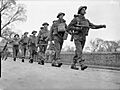
Soldiers from the 5th (Huntingdonshire) Battalion, Northamptonshire Regiment, during an exercise near Christchurch, Dorset, 12 March 1941.
-
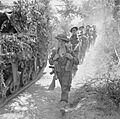
Soldiers from the 5th (Huntingdonshire) Battalion, Northamptonshire Regiment, marching near Coldragone, Italy, 25 May 1944.
