
61st Carnarvon and Denbigh (Yeomanry) Medium Regiment, Royal Artillery facts for kids
Quick facts for kids 61st Carnarvon & Denbigh (Yeomanry) Medium Brigade, RGA61st (Carnarvon & Denbigh Yeomanry) Medium Regiment, RA |
|
|---|---|

Royal Artillery cap badge
|
|
| Active | 1 March 1922–13 March 1946 |
| Country |  United Kingdom United Kingdom |
| Branch |  Territorial Army Territorial Army |
| Type | Yeomanry |
| Role | Medium Artillery |
| Size | 2–4 Batteries |
| Part of | 2nd Infantry Division I Corps 8th Army Group Royal Artillery |
| Garrison/HQ | Colwyn Bay |
| Engagements | Battle of France Operation Jupiter Operation Greenline Operation Goodwood Operation Spring Operation Bluecoat Operation Guildford Operation Plunder |
The 61st Carnarvon and Denbigh (Yeomanry) Medium Regiment, Royal Artillery was a special Welsh army unit. It was part of Britain's part-time army, called the Territorial Army (TA). This unit was created after World War I by combining older artillery and cavalry groups.
During World War II, the regiment fought in the Battle of France. They had to be rescued from Dunkirk when the situation became very dangerous. Later, in June 1944, they returned to North-West Europe. They took part in important battles in the Orne valley and the countryside near Caumont. They helped break out from the Normandy beachhead. The regiment also helped push towards the River Maas and cross the Rhine river in an operation called Operation Plunder.
After the war, the regiment continued in the TA. Today, a similar unit still exists in the Army Reserve.
Contents
How the Regiment Began
The 61st Regiment was formed from two older units: the Welsh (Carnarvonshire) Heavy Battery, Royal Garrison Artillery (RGA) and the Denbighshire Hussars. Both had served in World War I.
In 1920, the Welsh RGA unit was first called the 12th (Carnarvon and Denbigh) Medium Brigade, RGA. It was planned to have its main base in Colwyn Bay. The next year, when the army changed its name to the Territorial Army (TA), the unit became the 61st Medium Brigade, RGA.
The Denbighshire Hussars were a cavalry unit, meaning they fought on horseback. But after World War I, the army realized it had too many horse units. So, most of these units were changed to other roles. On March 1, 1922, the Denbighshire Hussars became an artillery unit. They joined with the new medium brigade to form the 61st Carnarvon and Denbigh (Yeomanry) Medium Brigade, RGA.
This new unit had its main office in Colwyn Bay. It included several artillery batteries (groups of guns):
- 241st (Carnarvon) Medium Battery in Bangor.
- 242nd (Carnarvon) Medium Battery (Howitzer) in Llandudno.
- 243rd (Denbigh) Medium Battery (Howitzer) in Colwyn Bay.
- 244th (Denbigh) Medium Battery (Howitzer) in Wrexham.

In 1924, the RGA became part of the Royal Artillery (RA). The unit's name was updated. A medium brigade usually had four batteries, each with four guns. Some used 60-pounder guns, and others used 6-inch howitzers. These were older guns from World War I. By 1937, they were updated with rubber tires, making them easier to move.
In 1938, the RA changed its names again. A commander's unit became a 'regiment' instead of a 'brigade'. The TA also grew bigger after the Munich Crisis. So, in 1939, the 61st (C&DY) Medium Regiment split into two parts:
61st (Carnarvon & Denbighshire) Medium Regiment
- Main office in Colwyn Bay
- 242 (Carnarvon) Medium Battery in Llandudno
- 243 (Denbigh) Medium Battery in Colwyn Bay
69th Medium Regiment
- Main office in Bangor
- 241 (Carnarvon) Medium Battery in Bangor
- 244 (Denbigh) Medium Battery in Wrexham
Each battery had two groups of four guns.
The Regiment in World War II
Getting Ready for War
When the TA was called into action on September 1, 1939, just before World War II began, the 61st Regiment gathered in Colwyn Bay. Led by Lieutenant-Colonel G.E. Fitzhugh, the regiment went to France to join the British Expeditionary Force (BEF). Even though they were considered 'Army Troops', they worked closely with the 2nd Infantry Division.
Fighting in France
The quiet period of the 'Phoney War' ended when Germany invaded on May 10. The BEF moved into Belgium. The 61st Regiment was placed near the River Dyle. They fired their first shots of the war on May 13, helping the 4th Brigade.
However, German forces broke through French lines elsewhere, putting the BEF in danger. The regiment had to pull back. They fought all day on May 16. The BEF then began to retreat towards the River Escaut. The 61st Regiment moved under difficult conditions and fought near Ere, firing many rounds. On May 21, they faced heavy shelling and had 17 soldiers injured.
Even though the British held their line, the Germans reached the English Channel. The BEF was cut off. The 2nd Division, with the 61st Regiment, was sent to guard a canal line. They recaptured St Venant but soon had to withdraw to Dunkirk for evacuation. It was vital for the 2nd Division to hold their positions so other British and French forces could retreat. They faced intense attacks from German tanks but held their ground with the help of the 61st Regiment. On May 31, the division was evacuated from Dunkirk, but they had to destroy all their guns and equipment.
Defending the Home Front
Back in the UK, the BEF units were reorganized. It took many months to get new, modern guns. Eventually, the medium regiments received the new 5.5-inch gun and special tractors to pull them.
By December 1940, the 61st Regiment was stationed in Northern England. In 1941, they were again linked with the 2nd Division until that division left for India. By 1942, the regiment had its own repair team from the Royal Electrical and Mechanical Engineers (REME).
During the Battle of France, it became clear that a better way to organize medium and heavy artillery was needed. This led to the idea of the Army Group Royal Artillery (AGRA). AGRAs were powerful groups of artillery, usually with three or four medium regiments and one heavy regiment. They could move quickly and had enough power to destroy enemy artillery.
The 61st (C&DY) Medium Regiment joined 8th AGRA when it formed on May 1, 1943. This AGRA was part of the 21st Army Group, which was preparing for the invasion of Normandy (Operation Overlord).
Normandy Landings
D-Day, the start of Operation Overlord, was on June 6, 1944. The 8th AGRA headquarters landed on June 18. The 61st (C&DY) Medium Regiment arrived on July 2. They were placed near St Manvieu.
They arrived in time for Operation Jupiter. This attack aimed to capture Hill 112 and nearby villages, opening the way to the River Orne. The 8th AGRA's job was to fire at enemy artillery, anti-aircraft guns, and mortars. The 61st Regiment directly supported the Royal Scots Greys. On July 10, the artillery began firing. The 43rd (Wessex) Infantry Division captured some villages, but Hill 112 remained a tough fight. The 61st (C&DY) Medium Regiment fired 1877 rounds that day, their highest total of the campaign.

Next, 8th AGRA took part in Operation Greenline, a fake attack to distract the enemy. On July 14, the 61st Regiment fired at targets on Hill 112 to make it look like an attack was coming from that direction. The next day, they fired to defend the 43rd Division. Villages like Gavrus and Bougy were captured with the regiment's help.
Even before Greenline, the 8th AGRA regiments prepared for Operation Goodwood. The 61st Regiment moved near Saint-Contest. They had 350 rounds of ammunition per gun ready. Goodwood was a large tank attack, supported by many artillery guns and bombers. The medium regiments had forward observers with the tank brigades. The artillery opened fire at 6:05 AM, hitting enemy artillery and other targets. The Germans were surprised but recovered quickly. The attack did not go as far as planned, and there were many casualties. The 8th AGRA continued to fire, helping capture Bras and Hubert-Folie. When British tanks got into trouble, the medium guns were called in, and their shells helped destroy German tanks.
8th AGRA also helped in Operation Spring on July 25, firing to help the Canadian advance. Then, the 8th AGRA moved to attack on the right side of the army in Operation Bluecoat. This move was kept secret. The 8th AGRA moved 30 miles, then another 16 miles, to deploy near Caumont. There was no time to test the guns before the attack, which helped with surprise. The 61st (C&DY) Medium Regiment supported the 15th (Scottish) Division. The attack began on July 30. The tanks pushed forward, but the infantry fell behind. The battle continued on August 1, with the 8th AGRA and Royal Air Force planes bombing German tanks. By August 2, the German front was broken, and units were chasing them.
On August 5, the 8th AGRA regiments followed the advance to Le Bény-Bocage. German resistance grew stronger. The next day, the 8th AGRA fired to break up counter-attacks. The 61st (C&DY) Medium Regiment noticed that a large amount of ammunition was being stored, suggesting a big battle was coming. On August 7, another attack by the 3rd Division, supported by the 61st Regiment, was not successful.

The VIII Corps attacked again on August 11 in Operation Grouse. The 61st (C&DY) Medium Regiment moved close to the enemy. The 8th AGRA fired at anti-aircraft guns and then at targets identified by forward observers. As the advance continued towards Tinchebray, the 8th AGRA supported the 3rd Division. On August 16, the 3rd Division entered Flers. By August 17, the 8th AGRA's guns were out of range. On August 21, the whole AGRA gathered for maintenance and training.
Operation Guildford
After breaking out of Normandy, the VIII Corps helped other units by providing transport and fuel. They played a small part in Operation Market Garden. Then, they moved towards the River Maas in the autumn. This included clearing the Venlo 'Pocket', which took from October to December.
By December 3, the 15th (Scottish) Division was ready to take the last German stronghold west of the Maas, at Blerick. Operation Guildford was a very successful operation. It used the army's strong air power, engineering, and artillery to overcome difficult minefields and defenses with few casualties. The 8th AGRA was one of three artillery groups supporting this attack.
Crossing the Rhine River

The 8th AGRA was not involved in the fighting in the Reichswald in early 1945. After that, the army was ready to cross the Rhine river in Operation Plunder. The 8th AGRA was assigned to support the XII Corps. The 15th (Scottish) Division was chosen for the main assault. Preparations were made behind a huge smokescreen, and guns were placed as close to the river as possible.
The artillery was organized into special groups. The 61st (C&DY) Medium Regiment remained under 8th AGRA. They were heavily involved in the initial artillery barrage on the evening of March 23. This 'softening' bombardment came before the assault crossings by the 15th (Scottish) Division at 1:00 AM on March 24. The sound of 700 guns firing was described as 'earth-shaking'. The next morning, the medium guns switched to bombing and anti-aircraft tasks to support the airborne landings.
The 15th (Scottish) Division's assault was mostly successful. German counter-attacks came during the night. The medium guns were used for defensive fire close to the Scottish positions. The enemy was finally driven out of the riverside villages by the next morning. The 15th (Scottish) Division then moved inland.
Once the Rhine was crossed, the army advanced quickly across northern Germany. There were few big battles, and less need for medium or heavy artillery. As Victory in Europe (VE Day) approached, British units began to act as occupation forces. After the German surrender, this became the role for the whole army while soldiers waited to go home.
The regiment slowly stopped operating in the British Army of the Rhine starting March 1, 1946, and was fully closed down by March 13.
After the War
When the Territorial Army was reformed on January 1, 1947, the regiment was re-established in Colwyn Bay. It was renamed 361 (Carnarvon, and Denbigh Yeomanry) Medium Regiment.
In 1956, the regiment combined with another unit to form the 372nd (Flintshire and Denbighshire Yeomanry) Field Regiment. After several more mergers, the unit became an infantry (foot soldier) unit. However, the history of the Denbighshire Hussars was brought back in 2013. A new transport squadron, called 398 (Flintshire & Denbighshire Yeomanry) Transport Squadron, was formed in the Army Reserve.
Images for kids
-
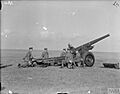
A 60-pounder gun on a pneumatic carriage during a training exercise before World War II.

