
71st (Forth) Heavy Anti-Aircraft Regiment, Royal Artillery facts for kids
Quick facts for kids 71st (Forth) Heavy Anti-Aircraft Regiment, RA |
|
|---|---|

Cap Badge of the Royal Artillery (pre-1953)
|
|
| Active | 1 November 1938–1 May 1961 |
| Country |  United Kingdom United Kingdom |
| Branch |  Territorial Army Territorial Army |
| Type | Heavy Anti-Aircraft Regiment |
| Role | Air Defence |
| Part of | 3rd AA Division Allied Forces Headquarters Eighth Army French XIX Corps US IV Corps 3 AA Group |
| Garrison/HQ | Dunfermline |
| Engagements | The Blitz North African Campaign Italian Campaign |
| Commanders | |
| Honorary Colonel | 10th Earl of Elgin and Kincardine |
The 71st (Forth) Heavy Anti-Aircraft Regiment, Royal Artillery was a special army unit in Britain. It was part of the Territorial Army (TA), which is like a reserve force. This unit was created in Scotland just before World War II.
Its main job was to defend against enemy aircraft. During the war, it served in important battles in North Africa and Italy. Today, parts of this unit still exist in the Army Reserve, as part of the Royal Logistic Corps.
Contents
How the Regiment Started
The 71st (Forth) Anti-Aircraft Regiment was formed on 1 November 1938. This happened because Britain needed more defences against planes. The new unit was made up of three existing anti-aircraft (AA) batteries. A battery is a group of soldiers and their guns.
- Regimental Headquarters (RHQ) was in Dunfermline.
- 227 (Fife) AA Battery came from an older unit.
- 228 (Edinburgh) AA Battery was new, formed on 1 February 1938.
- 229 (Forth) AA Battery was also new, formed on 1 February 1938.
Many of the leaders were experienced soldiers. For example, the Commanding Officer, Lt-Col A.R. Black, and senior Major, Sir Eric Hutchison, had fought in World War I. The Honorary Colonel was the 10th Earl of Elgin and Kincardine.
The regiment became part of the 36th (Scottish) Anti-Aircraft Brigade. This brigade was based in Edinburgh. Its job was to protect Edinburgh and the Firth of Forth from air attacks. Later, this brigade joined the 3rd Anti-Aircraft Division. This division looked after all anti-aircraft units in Scotland.
In April 1939, 228 Battery moved to help start a new regiment. This new unit was the 94th AA Regiment.
The Regiment in World War II
Getting Ready for War
Britain's anti-aircraft units, including the 71st, got ready for war on 23 September 1938. This was during a time of high tension called the Munich Crisis. Soldiers quickly went to their defence positions. They were ready within 24 hours, even if they didn't have all their equipment or soldiers. This alert lasted three weeks.
In February 1939, a new group called Anti-Aircraft Command took charge of all air defences. By August, as war seemed certain, all anti-aircraft units were fully ready at their war stations.
Defending Britain
The 71st Heavy Anti-Aircraft Regiment was often busy, even during the quiet start of the war (called the Phoney War). Their first real action happened on 16 October 1939. Nine enemy planes suddenly attacked warships near Rosyth Dockyard. This was close to the Forth Bridge.
The soldiers of 71st HAA Regiment were practicing with their guns. They quickly loaded them and fired. They shot down one enemy plane. Other British fighter planes got two more. This is believed to be the first time British guns fired at the enemy in World War II.
As the war continued, Anti-Aircraft Command grew. From June 1940, these units were called 'Heavy AA' (HAA). This helped tell them apart from newer 'Light AA' (LAA) units. The 71st HAA Regiment kept defending Edinburgh and the Firth of Forth during The Blitz. The Blitz was a time when German planes bombed British cities.
The regiment also helped form new batteries. For example, they created 325 AA Battery in July 1940. They also sent soldiers to help start 382 HAA Battery. This new battery joined the regiment in February 1941.
In June 1941, 382 Battery went to defend the Orkney and Shetland Islands. Another battery, 317 Bty, joined the 71st in its place. The regiment also helped form 455 (Mixed) HAA Battery.
By October 1941, the 71st HAA Regiment was ready for service abroad. It moved south to defend Birmingham and Coventry. Then, in January 1942, it moved to Kent. In May, the regiment left Britain's home defence and became a mobile unit. This meant it could move and fight wherever it was needed. It also got its own workshop team from the Royal Electrical and Mechanical Engineers (REME).
Fighting in North Africa

In November 1942, the regiment sailed to North Africa. They had mobile 3-inch anti-aircraft guns. They landed in December, after a big operation called Operation Torch. They joined 52 AA Brigade in Algeria.
By January 1943, the regiment was in the Philippeville area. They protected airfields and ports. For example, one battery was at Djidjelli airfield. Another part was at Philippeville port and airfield. A third part was at Ain Beida airfield. Later, they guarded the headquarters of the French XIX Corps. In the last part of the North African campaign, they protected Tunisian airfields.
The Italian Campaign
In September 1943, the 71st HAA Regiment moved to Italy. They served under the Eighth Army. In January 1944, they helped defend the Salerno area. Later, they also took over the defence of the Anzio area.
By June 1944, the regiment was supporting US IV Corps. This American unit was advancing towards the Arno River. The 71st HAA Regiment still used its guns for air defence. But because there were few German planes left, their powerful 3.7-inch guns were also used for ground support. They fired at enemy positions like regular artillery.
When the Germans tried to retake Leghorn, the 71st HAA Regiment fired 1840 rounds to help. In January 1945, the regiment left Italy and returned to the UK. It was then disbanded.
After the War
The Territorial Army was restarted on 1 January 1947. The 71st HAA Regiment was reformed in Dunfermline. It was now called 471st (Forth) Heavy Anti-Aircraft Regiment, RA (TA). This new unit was 'Mixed', meaning it included women from the Women's Royal Army Corps.
In 1954, the regiment joined with another unit, 494 (City of Edinburgh) HAA Regiment. This 494 Regiment was the same unit that the 71st had helped start back in 1939.
However, in 1955, many anti-aircraft units were reduced. The 471 HAA Regiment changed its role. It joined with another unit, 531 Light AA/Searchlight Regiment. Together, they formed 433rd Light Anti-Aircraft Regiment, RA (TA).
- RHQ (Headquarters) stayed in Dunfermline.
- P (Forth) Battery
- Q (Forth) Battery
- R (Alloa) Battery
- S (Perth) Battery
In 1961, the army changed again. The regiment became a transport unit. It was called 433 (Fife) Transport Column of the Royal Army Service Corps. This unit later became 433 (Forth) Regiment of the Royal Corps of Transport. Today, it is part of the Scottish Transport Regiment of the Royal Logistic Corps. This means the legacy of the 71st Regiment continues today.
Honorary Colonel
- Colonel Edward Bruce, 10th Earl of Elgin and Kincardine, was the Honorary Colonel. He was appointed on 28 January 1939.
Images for kids
-
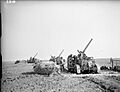
3-inch AA guns on cruciform travelling carriages.
Online Sources
- British Army units from 1945 on
- British Artillery in World War 2
- Orders of Battle at Patriot Files
- Royal Artillery 1939–1945
- Graham Watson, The Territorial Army 1947
- WW2 Talk
