
Airbus A380 facts for kids
Quick facts for kids Airbus A380 |
|
|---|---|
 |
|
_(cropped).jpg)
An Airbus A380 flown by Emirates
|
|
| General information | |
| Role | Wide-body airliner |
| National origin | Multi-national |
| Manufacturer | Airbus |
| Status | In service |
| Primary users | Emirates |
| Number built | 254 |
| History | |
| Manufactured | 2003–2021 |
| Introduction date | 25 October 2007, with Singapore Airlines |
| First flight | 27 April 2005 |
The Airbus A380 is a gigantic wide-body airliner built by the European aerospace company Airbus. People often call it the "Superjumbo" because of its unbelievable size. It is the largest passenger plane ever built in aviation history. Unlike other big passenger planes, it has two complete passenger decks stretching from nose to tail. This special double-deck shape lets it hold hundreds of travelers on long journeys across oceans.
Airbus began imagining this super-sized jetliner in 1988 to rival the famous Boeing 747. The project officially started in December 2000. Engineers constructed the very first test airplane in Toulouse, France. That plane completed its exciting first journey through the air on 27 April 2005. Both the European Aviation Safety Agency and the US Federal Aviation Administration certified it for safe travel in 2006.
Passenger service started on 25 October 2007 with the carrier Singapore Airlines. The A380 quickly became a favorite for many travelers because its huge interior feels very smooth and quiet. In total, 254 of these giant planes were manufactured before production ended in late 2021. Today, many major airlines fly the Superjumbo across the globe every day.
Contents
- The Amazing Story of How Engineers Created the Airbus A380
- How Airbus Built and Transported the Giant Airplane Parts
- Advanced Engineering and Flight Deck Technology
- Luxury and Passenger Life Aboard the Double-Decker Plane
- Airport Operations and Ground Handling Around the World
- Service History with Major World Airlines
- Interesting Aircraft Variants That Were Never Built
- Why Airbus Decided to Conclude A380 Production
- Where You Can See Real A380s in Museums Today
- Specifications for the Airbus A380-800
- See Also
The Amazing Story of How Engineers Created the Airbus A380

During the 1980s, an American jet called the Boeing 747 dominated the world of long-haul flights. Airbus wanted to build an even bigger plane to compete directly against it. An engineering leader named Jean Roeder secretly directed early studies for an ultra-high-capacity airliner. Airbus also watched concepts like the MD-12 design fail to find airline buyers. In 1990, Airbus officially announced the bold idea at the famous Farnborough Airshow.
Creating such a massive machine was a true megaproject. Four partner aerospace companies joined together: Aérospatiale, British Aerospace, Deutsche Aerospace AG, and CASA. They studied unusual shapes, including an idea to weld two fuselages from an Airbus A340 side-by-side. Eventually, they settled on an oval fuselage with two full passenger levels.
At first, Airbus and Boeing studied building a very large transport plane together. That shared plan ended in 1995 when Boeing decided small aircraft were better suited for future air routes. Boeing believed airlines would favor point-to-point travel with twin-engine planes like the Boeing 777. Airbus strongly believed in the traditional hub-and-spoke network. In that model, huge planes carry crowds between giant central hub airports.
On 19 December 2000, the company supervisory board approved funding for the A3XX project. They renamed the aircraft the A380. The number eight was chosen because its shape looks like two stacked airplane decks. Eight is also considered a lucky number across many Asian countries where Airbus hoped to sell airplanes. Wing manufacturing began in January 2002, marking the physical birth of the giant jet.
Big Construction Challenges and Factory Delays
.jpg)
Building such a massive, complicated airliner led to unexpected manufacturing hurdles. Each airplane contains more than 530 kilometers (about 330 miles) of complex electrical wiring. There are over 98,000 separate wires and 40,000 connectors tucked inside every single jet.
Different European design offices used conflicting versions of design software called CATIA. The German and Spanish teams used an older computer program. Meanwhile, British and French engineers worked on a newer program version. Because of this software gap, the delicate wire bundles did not fit together inside the aluminum frame. Fixing the wiring mistakes delayed aircraft deliveries by nearly two full years.
These delays cost Airbus billions of euros and caused leaders like Christian Streiff to reorganise production lines. Some shipping companies, including FedEx and United Parcel Service, cancelled plans for cargo models. However, passenger airlines like Qantas, Air France, and Emirates decided to wait patiently for their planes. Engineers solved the wiring issues by improving computer designs and using light aluminum wire to save extra weight.
Flight Testing the Superjumbo in Tough Conditions

Airbus built five test planes to make sure the A380 was safe and reliable. The very first prototype was unveiled in Toulouse in January 2005. Its crew included chief test pilot Jacques Rosay. Rosay joked that flying the gigantic Superjumbo felt surprisingly light, "like handling a bicycle."
Test pilots pushed the A380 to extreme limits to verify structural safety. In shallow dives, the aircraft safely achieved its maximum speed of Mach 0.96. It completed hot-weather and high-altitude tests at Addis Ababa Bole International Airport in Ethiopia and El Dorado International Airport in Colombia. To test extreme cold, crews flew it to Iqaluit in Canada during freezing winter weather.
During severe structural tests on frame MSN5000, engineers bent the wings until they cracked. Airbus quickly added 30 kilograms of extra metal to guarantee incredible strength. Next came the emergency evacuation test in Hamburg, Germany. In total darkness with half the doors blocked, 853 people safely escaped the cabin in 78 seconds. That was well below the strict 90-second safety limit set by regulators. Both the European Aviation Safety Agency and Federal Aviation Administration granted official approvals in December 2006.
How Airbus Built and Transported the Giant Airplane Parts

Because the A380 was so gigantic, no single factory could build the entire jet. Components were crafted across France, Germany, Spain, and the UK. Transporting these massive pieces required an extraordinary transportation system called the Itinéraire à Grand Gabarit.
Airbus built custom roll-on/roll-off cargo ships to move heavy airplane pieces across oceans. The huge wings were constructed in Broughton, Wales. From there, workers floated them on a river barge down to the sea docks at Mostyn. Fuselage parts traveled from Hamburg in Germany and Cádiz in Spain.
All parts converged near Bordeaux, France, and continued along rivers to the town of Langon. From Langon, giant road convoys carried the parts slowly through country villages at night. Roads were widened and special signs were built to clear the oversized loads. Finally, components arrived at the modern Jean-Luc Lagardère plant in Toulouse for final assembly. Specially designed cargo planes, like the A300-600ST Beluga, flew smaller pieces directly between European factories.
Advanced Engineering and Flight Deck Technology

The A380 features brilliant modern aerospace technology that makes flying such a heavy craft surprisingly easy. While most of the main body uses strong aluminum, over 20% uses advanced composite material. These parts use carbon-fibre reinforced plastic and glass-fibre reinforced plastic. Even the central wing box is made of ultra-tough carbon materials.
Airbus also introduced a special material named GLARE on the upper fuselage skin. GLARE combines thin layers of aluminum with tough fibreglass cloth. It is lighter than standard metal, resists impacts, and does not crack easily. Technicians joined metal sheets using modern laser beam welding rather than thousands of heavy metal rivets. This clever choice saved thousands of pounds in empty weight.
The pilots fly the Superjumbo from a high-tech glass cockpit using side-mounted side-sticks. Eight matching screens show flight data, maps, engine numbers, and system warnings. Pilots use standard QWERTY computer keyboards and trackballs to operate their digital maps. The computer system eliminates bulky paper books, allowing pilots to fly with fully digital charts and checklists.
Modern Jet Engines and Wing Innovations
.JPG)
Airbus offered two powerful engine choices for airlines buying the Superjumbo. Customers could choose the Rolls-Royce Trent 900 or the Engine Alliance GP7200. Each engine provides tens of thousands of pounds of thrust to lift the plane into the sky. Amazingly, these modern turbofan engines are much quieter than older jet engines. The aircraft easily met strict nighttime noise rules at busy airports like Heathrow Airport in London and Narita International Airport in Tokyo.
The engines feature unique thrust reversers on the two inner engines only. The outer engines do not have reversers, which keeps dirt and loose rocks off airport runways. The jet relies on powerful brakes and huge wing spoilers to stop quickly after touching the ground.
The wings were specially sculpted to provide massive lift. Because airport taxiways have width limits, engineers capped the wingspan at 80 meters (262 feet). To compensate, the wing was made very wide from front to back. The wingtips feature distinctive upright fins called wingtip fences. These clever fins reduce induced drag and limit powerful swirling air currents known as wake turbulence. Singapore Airlines pilots often praised the plane for having an impressively gentle and slow landing speed.
Onboard Electric and Hydraulic Power Systems

Lifting and steering a 570-tonne machine takes enormous physical power. The A380 became the first passenger jet to use extra-high-pressure hydraulic lines operating at 5,000 pounds per square inch. These strong pipes are made from light, durable titanium metal. Higher pressure allows the fluid tubes and motors to be smaller, saving valuable weight.
Airbus engineers also installed advanced power-by-wire backups. If hydraulic systems lose pressure, smart electro-hydrostatic actuator motors use electricity to move the wing controls. In the tail, an Auxiliary Power Unit called the PW 980A runs on the ground to provide electricity and air conditioning. If engines fail in flight, a tiny pop-out propeller called a ram air turbine generates emergency electricity from passing wind.
The landing gear is another engineering wonder. The jet rests on four main landing gear legs and one steerable nose gear. In total, the plane uses 22 large wheels to distribute its immense weight smoothly. Because its weight is spread out across so many tires, the Superjumbo exerts low ground pressure. This prevents the heavy aircraft from cracking normal airport concrete.
Luxury and Passenger Life Aboard the Double-Decker Plane

Inside, the Airbus A380 offers more cabin floor space than any other passenger airliner in history. The aircraft provides 550 square metres (5,920 sq ft) of usable deck space. That is about 40% more room than the rival Boeing 747-8. Wide curved staircases at the front and rear let passengers and flight attendants move easily between floors.
Because the cabin has so much room, airlines designed creative luxury spaces. Singapore Airlines introduced private first-class suites featuring separate luxury chairs and full-sized flat beds. The airline Emirates famously installed hot-water showers for first-class guests and an upstairs lounge bar. Other airlines installed snack bars, art galleries, and comfortable premium economy sections.
Airbus also focused on making long journeys comfortable for travelers in economy class. The cabin is pressurized to feel like a low mountain height, which helps prevent headaches and jet lag. Advanced air filters change all the cabin air every few minutes. Beautiful LED lights change colors smoothly to match sunrise, daytime, and starry night skies. In typical three-class layouts, the jet carries 525 passengers, but it is certified to carry up to 853 people.
-
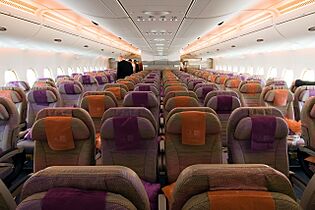
Ten-abreast economy seating on the main deck of an Emirates A380
-
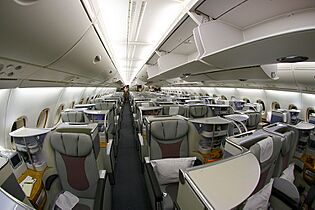
Business class seating aboard an Emirates A380
-
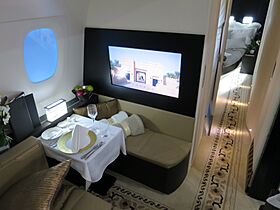
The Residence private luxury suite designed by Etihad Airways
-
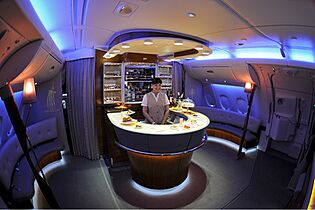
Onboard lounge and bar area for long-distance flights
-
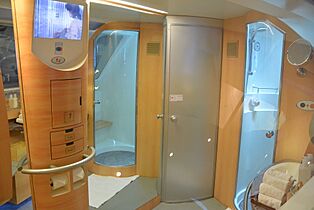
An inflight shower spa installed for first-class passengers


.JPG)


Airport Operations and Ground Handling Around the World

Because the Superjumbo was so massive, airports had to make major changes before the plane could land. International aviation groups agreed on an "80-meter box" rule for gate areas. Many world airports had to widen taxiways and build larger concrete parking spots. Runways received wider paved shoulders to keep engine blast from sucking up loose dirt and causing foreign object damage.
Airports also installed special double-decker jetway bridges. These enclosed walkways connect directly to upper and lower doors at the same time. Using multiple bridges, airlines can board hundreds of eager passengers in about 35 minutes. Specialized high-lift trucks carry food carts directly up to the high top-deck galley doors. Heavy-duty tug tractors push the giant airplane backward away from the gate.
Because the jet is so heavy, its wings churn up powerful spinning air vortexes. Air traffic controllers placed the A380 into a special wake turbulence category named "Super." Smaller planes must wait several minutes behind a departing A380 before taking off. This safety gap prevents lighter planes from hitting the giant wake trails left in the sky.
Service History with Major World Airlines
_landing_at_Singapore_Changi_Airport_(3).jpg)
The Superjumbo made its official commercial airline debut on 25 October 2007. Singapore Airlines operated the first passenger flight from Singapore to Sydney Airport in Australia. People bought seats through charity internet auctions to be part of aviation history. Soon after, airlines like Emirates, Qantas, Lufthansa, and Air France started regular routes.
Airlines quickly discovered that passengers loved flying on the quiet, spacious aircraft. By 2015, more than 100 million passengers had flown aboard the Superjumbo worldwide. Many carriers flew the jet between busy world cities like London, New York, Tokyo, and Dubai. The biggest customer by far was Emirates, which eventually purchased 123 of the aircraft. Emirates turned its hub at Dubai International Airport into the Superjumbo capital of the world.
Other major airlines flew the A380 across long transoceanic routes. British Airways used the jet on busy flights between London and the United States. All Nippon Airways bought three Superjumbos painted to look like giant Hawaiian sea turtles. ANA used these cheerful planes specifically for vacation flights from Tokyo to Honolulu.
The Outstanding Safety Record of the Superjumbo
The Airbus A380 has achieved one of the safest operating records in modern aviation. Over millions of flight hours, the aircraft has suffered zero passenger deaths and zero hull losses. Even when rare mechanical problems occurred, the strong airframe brought everybody home safely.
In November 2010, an engine on Qantas Flight 32 failed over Indonesia after leaving Singapore. Hot engine pieces punctured the wing and damaged electrical control wires. Despite the heavy damage, the experienced flight crew safely turned back and landed at Singapore Changi Airport. Nobody on the plane or on the ground was injured. In 2017, Air France Flight 66 experienced engine damage over Greenland and landed safely at CFB Goose Bay in Canada. Safety teams praised the strong design of the wings and redundant computer systems.
Interesting Aircraft Variants That Were Never Built

Airbus envisioned several different models of the Superjumbo that never ended up flying. Early on, Airbus marketed a dedicated cargo carrier called the A380F. This freight plane was designed to carry 150 t (330,000 lb) of heavy shipping boxes. However, the plane was too heavy compared to dedicated cargo planes like the Boeing 747-8F. When passenger delivery delays happened, cargo companies canceled their orders, so Airbus dropped the model.
Airbus also explored a stretched version called the A380-900. This longer design would have carried over 650 passengers on busy international routes. Sales executive John Leahy discussed the idea with various international airlines. However, airlines worried the plane would simply be too large to fill with passengers every day.
In 2015, airlines asked for an updated model named the A380neo with new fuel-saving engines from Rolls-Royce. Later at the 2017 Paris Air Show, Airbus showed off a model called the A380plus. It featured large winglet tips to reduce drag and save fuel. Neither project entered production because airlines preferred buying smaller twin-engine jets instead.
-
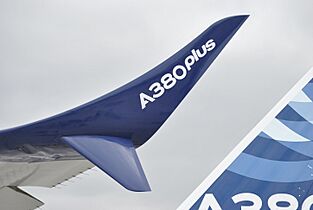
Mockup of the improved winglet designed for the proposed A380plus
-
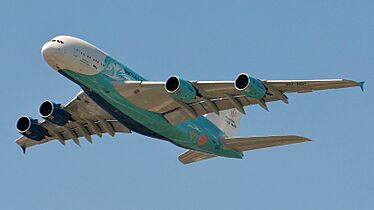
A used A380 operated by charter company Hi Fly at an airshow
-
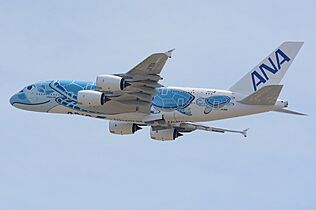
An All Nippon Airways A380 featuring the bright sea turtle paint scheme
-
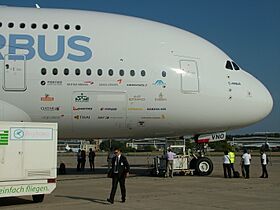
A colorful display of international customer airline logos on an A380 nose
-
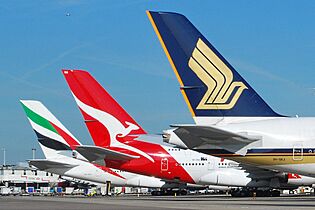
Tails of Emirates, Qantas, and Singapore Airlines A380s lined up at Heathrow

.jpg)
_@_NRT,_April_2019.jpg)


Why Airbus Decided to Conclude A380 Production

During the 2010s, the global airline industry began changing rapidly. New twin-engine widebody airplanes, such as the Airbus A350 and Boeing 787 Dreamliner, became available. These planes used two engines instead of four, burning far less fuel per flight. They could fly nonstop between smaller regional cities without stopping at crowded hub airports.
Airlines discovered that filling 500 seats every day on an A380 was difficult outside peak holidays. If an airplane flew with empty seats, the airline lost money on expensive jet fuel. Because smaller planes carried fewer risks, airlines stopped placing new orders for huge quad-engine jets. Airbus had to deliver many planes every year just to reach financial break-even.
In February 2019, key customer Emirates decided to reduce its final Superjumbo orders in favor of smaller A350-900 airliners. Company chief executive Tom Enders announced that Superjumbo production would finish once the remaining orders were completed. On 16 December 2021, Airbus delivered the 251st and final A380 to Emirates in Hamburg. Although no new Superjumbos are being built, the existing fleet will keep flying worldwide for many years.
Where You Can See Real A380s in Museums Today
If you want to see a historic Superjumbo up close, two early test aircraft are preserved for visitors to explore:
- The fourth test plane (MSN4) was retired to the famous Musée de l'air et de l'espace at Le Bourget airport near Paris. Visitors can admire it standing right beside an original Boeing 747-100, displaying two generations of jumbo jets together.
- The second test plane (MSN2) rests at the Aeroscopia aviation museum located near Toulouse-Blagnac Airport in southern France. It sits alongside other legendary Airbus planes, including an original Airbus A320 and Airbus A340.
Specifications for the Airbus A380-800
| Feature | Measurement / Details |
|---|---|
| Cockpit Flight Crew | Two pilots |
| Typical Seating | 525 passengers (up to 853 maximum) |
| Overall Length | 72.72 m (239 ft) |
| Wing Span | 79.75 meters (261.8 feet) |
| Wing Surface Area | 845 m2 (9,100 sq ft) |
| Airplane Height | 24.09 m (79 ft) |
| Maximum Takeoff Weight (MTOW) | 575 t (1,268,000 lb) |
| Fuel Capacity | 253,983 kg (559,937 lb) |
| Engines (4 turbofans) | Rolls-Royce Trent 900 or Engine Alliance GP7200 |
| Cruising Speed | Mach 0.85 (about 903 km/h or 561 mph) |
| Maximum Flight Range | 14,800 km (9,196 mi; 7,991 nmi) |
| Service Flight Ceiling | 43,100 feet (13,100 meters) |
See Also
 In Spanish: Airbus A380 para niños
- Airbus A330
- Airbus A350
- Boeing 747-8
- Boeing 777X
- Boeing 787 Dreamliner
