
Al-Aqsa Mosque facts for kids
Quick facts for kids Al-Aqsa Mosque |
|
|---|---|
|
جامع الأقصى (Jāmiʿ al-Aqṣā)
المصلى القبلي (al-Muṣallā al-Qiblī) المسجد الاقصى (al-Masjid al-'Aqṣā, disputed) |
|
.jpg) |
|
| Religion | |
| Affiliation | Islam |
| Leadership | Muhammad Ahmad Hussein (Grand Mufti of Jerusalem) |
| Location | |
| Location | Temple Mount (East Jerusalem) |

 Location in Jerusalem

Location in Jerusalem
|
|
| Administration | Jerusalem Islamic Waqf |
| Architecture | |
| Architectural type | Mosque |
| Architectural style | Early Islamic |
| Date established | 7th–8th centuries |
| Specifications | |
| Direction of façade | North–northwest |
| Capacity | 5,000+ |
| Materials | Limestone (external walls, façade), lead and concrete (dome), white marble (interior columns) and mosaic |
The Al-Aqsa Mosque, also called the Qibli Mosque, is an important prayer hall in the Al-Aqsa mosque area in the Old City of Jerusalem. Sometimes, the name al-Masjid al-Aqṣā refers to the entire large area where the mosque stands. This area is also known as "Al-Aqsa" or "Haram al-Sharif".
Islamic tradition says a small prayer area, which later became the Al-Aqsa Mosque, was built by Umar. He was the second leader of the Rashidun Caliphate. Later, during the time of Caliph Mu'awiyah I (around 661 AD), a larger mosque for 3,000 people was built in the area. The mosque we see today was first built by the Umayyad leaders Abd al-Malik or al-Walid I in the late 600s or early 700s. It was built near the Dome of the Rock. Earthquakes damaged the mosque several times. It was rebuilt by the Abbasid leaders al-Mansur in 758 and al-Mahdi in 780. Another earthquake in 1033 caused more damage. The Fatimid leader al-Zahir rebuilt it between 1034 and 1036. He made it smaller but added beautiful mosaics inside. The mosque's design today still largely follows this 11th-century plan.
Over many years, different Islamic rulers added parts to the mosque. These included its dome, front, minarets, and a special pulpit called a minbar. When the Crusaders took Jerusalem in 1099, they used the mosque as a palace. It also became the main base for the Knights Templar. In 1187, Saladin took the area back, and the building became a mosque again. Later, the Ayyubids, Mamluks, and Ottomans also made repairs and additions. Today, the mosque is managed by the Jerusalem Islamic Waqf. This is an independent group that oversees Islamic holy sites in Jerusalem.
Contents
The Al-Aqsa Mosque: A Historic Prayer Hall
What is the Al-Aqsa Mosque?
The name "Al-Aqsa Mosque" can mean two things. It can refer to the specific silver-domed building where people pray. Or, it can mean the entire large area, also known as the Temple Mount or Haram al-Sharif. This wider area includes the Dome of the Rock, fountains, and several minarets.
In ancient texts like the Quran, the name al-Masjid al-Aqṣā often referred to this whole sacred compound. This is because many of the buildings we see today were not yet built when the Quran was written. Writers from long ago, like al-Muqaddasi and Nasir Khusraw, also used the name to describe the entire area. They sometimes called the specific prayer building "the covered part" or Maqsurah.
The building is also called the Qibli Mosque or Qibli Chapel. This name comes from its location on the southern side of the compound. It points towards the qibla, which is the direction Muslims face for prayer. The Jerusalem Islamic Waqf, which manages the site, uses the name "Qibli" in its official documents. Many international groups, like UNESCO, also use this name.
.jpg)
A Look at Its Long History
Early Beginnings and Rebuilds
The mosque stands on the southern part of the Temple Mount. This area was made larger by King Herod the Great around 20 BCE. He was rebuilding the Second Temple. Engineers built arches to create a flat platform for the mosque. Before the mosque, a large building called the Royal Stoa stood here. It was destroyed by the Romans in 70 CE during the siege of Jerusalem.
For a time, people thought a church built by Emperor Justinian in 543 stood where the mosque is now. This church was called the Nea Church. But in 1973, parts of the Nea Church were found in a different area of Jerusalem.
During repairs in the 1930s, workers found old wooden beams in the mosque. These beams were made from Lebanese cedar and cypress trees. Scientists studied the wood and found some pieces were very old. Some wood dated back to the 9th century BCE, meaning it was likely reused from even older buildings. Later studies in the 2010s dated the beams to the Byzantine period.
-Aerial-Jerusalem-Temple_Mount-Temple_Mount_(south_exposure).jpg)
Umayyad Builders and Earthquakes
A wooden mosque for 3,000 worshippers was present on the Temple Mount around 679–682. Its exact spot is not fully known. Some historians believe it was close to the current mosque. Others think it was where the Dome of the Rock now stands.
There is some debate about who built the current Al-Aqsa Mosque. It was either the Umayyad leader Abd al-Malik (685–705) or his son al-Walid I (705–715). Many historians believe Abd al-Malik started the project, and al-Walid finished or expanded it. Both the Al-Aqsa Mosque and the Dome of the Rock were built around the same time. They were designed to be part of one large, beautiful complex.
In 713–714, earthquakes damaged the mosque. Al-Walid ordered its repair. He used gold from the Dome of the Rock to pay for the work. The Umayyad mosque was decorated with mosaics, marble, and carved wood. In 746, another earthquake ruined the mosque. The Umayyad rule ended shortly after this.

Abbasid and Fatimid Restorations
The new Abbasid leaders did not focus much on Jerusalem at first. However, they did work on the mosque. In 758, the Abbasid leader al-Mansur visited Jerusalem. He saw the mosque was in ruins from the 746 earthquake. Local Muslims asked him to help rebuild it. He used gold and silver from the mosque's doors to fund the repairs.
Another earthquake damaged most of al-Mansur's work. In 780, his successor, al-Mahdi, ordered a new reconstruction. He asked his governors to help pay for it. The mosque was rebuilt to be stronger and more beautiful. It had fifteen aisles and a large dome.
In 970, the Fatimid Caliphate took control of Palestine. In 1033, another earthquake badly damaged the mosque. The Fatimid leader al-Zahir rebuilt it between 1034 and 1036. The new mosque was smaller, with seven aisles instead of fifteen. This might have been because fewer people lived in the city then.
A special feature of this new mosque was its rich mosaic decorations. These were on the dome and the arch in front of the prayer niche. The mosaics showed beautiful gardens and patterns. An inscription above the prayer niche connected the mosque to Muhammad's Night Journey. This showed the Fatimids wanted to highlight the site's importance. The mosque's design today largely keeps al-Zahir's plan.

Crusaders, Ayyubids, and Mamluks
In 1099, the Crusaders captured Jerusalem. They called the mosque Templum Solomonis (Solomon's Temple). They used it as a royal palace and a stable for horses. In 1119, the Knights Templar made it their headquarters. During this time, the mosque had some changes, including an expanded front porch. New buildings were also added nearby.
After Saladin and the Ayyubids took Jerusalem back in 1187, the mosque was restored for prayer. Saladin quickly had the Crusader additions removed. He covered the floors with carpets and scented the air with rosewater. A new minbar (pulpit) made of ivory and wood was installed. This minbar was ordered by Saladin's predecessor, Nur al-Din. Later, in 1218, Saladin's nephew, al-Mu'azzam, built the northern porch with three gates. The Mamluks also added two naves and two gates to the eastern side in 1345.

Modern Era Changes and Events
The Ottomans took control in 1517. They made some additions to the wider Haram area, like the Fountain of Qasim Pasha. However, they did not make major changes to the mosque itself. In 1816, the mosque was restored by Sulayman Pasha al-Adil.
In the 20th century, major renovations began in 1922. The Supreme Muslim Council hired architects and engineers to restore the mosque. These renovations included strengthening the foundations and replacing old beams. They also uncovered Fatimid-era mosaics that had been hidden.
Earthquakes in 1837 and 1927 caused severe damage. The 1927 earthquake and a tremor in 1937 caused the roof to collapse. Repairs were made between 1938 and 1942. The north wall was rebuilt, and the interior roof was refaced.

The site came under Israeli control on June 7, 1967, during the Six Day War.

How the Mosque Looks: Architecture
The Al-Aqsa Mosque is a rectangular building. It covers about 0.46 hectares (1.1 acres) and can hold over 5,000 worshippers. It is 83 meters (272 feet) long and 56 meters (184 feet) wide. Unlike the Dome of the Rock, which looks more like Byzantine buildings, the Al-Aqsa Mosque shows early Islamic architecture.
The Dome
Nothing remains of the first dome built by Abd al-Malik. The current dome looks like the one built by al-Zahir. That dome was made of wood covered with lead. The 1969 fire destroyed it. Today, the dome is made of concrete with lead sheeting.
The Al-Aqsa dome is one of the few domes built in front of the mihrab (prayer niche) during the Umayyad and Abbasid times. The inside of the dome has 14th-century decorations. After the 1969 fire, these paintings were carefully restored using a special technique.
.jpg)
The Front and Entrance
The front of the mosque was built in 1065 CE by the Fatimid leader al-Mustansir Billah. It had a decorative railing with arches and small columns. The Crusaders damaged this front, but the Ayyubids later restored it. They added tiles to the facade. The arches of the facade use some carved stones from Crusader buildings.
The facade has fourteen stone arches, mostly in a Romanesque style. The Mamluks added outer arches that follow a similar design. The main entrance to the mosque is through the central arch of this facade.
.jpg)
Inside the Mosque
The Al-Aqsa Mosque has seven main aisles for prayer. It also has several smaller halls on the west and east sides. There are 121 stained glass windows from the Abbasid and Fatimid periods. About a quarter of these were restored in 1924. Some mosaic decorations and inscriptions from the Fatimid period can be seen above the main entrance.
The mosque's interior is supported by 45 columns. Thirty-three of these are white marble, and 12 are stone. The columns in the central aisles are thick and short. The other rows of columns are more balanced. The tops of the columns (capitals) have four different designs. Some are simple, others are in the Corinthian order, and some are shaped like baskets.
Much of the mosque's walls are covered with whitewash. However, the dome and the walls directly below it are decorated with mosaics and marble. Some paintings by an Italian artist were added during repairs after an earthquake in 1927. The ceiling of the mosque was painted with money from King Farouk of Egypt.
The Minbar (Pulpit)
The minbar (pulpit) of the mosque was built by a craftsman from Aleppo. It was ordered by the Zengid leader Nur al-Din. He intended it as a gift for the mosque when he would capture Jerusalem. It took six years to build (1168–74). Nur al-Din died before it was installed. But in 1187, Saladin captured the city and had the minbar placed in the mosque. It was made of ivory and carefully carved wood. It had Arabic calligraphy, geometric, and floral designs.
After it was destroyed by fire in 1969, a simpler minbar replaced it. In February 2007, a new minbar was installed. Its design was an exact copy of the original Saladin Minbar. It was built in Jordan using old woodworking methods, joining pieces with pegs instead of nails.
Managing and Visiting the Mosque Today
Who Manages the Site?
The Jerusalem Waqf is the group that manages the entire Al-Aqsa Mosque compound. This group is part of the Jordanian government. The Waqf handles all the day-to-day tasks for the site. The religious leader for the site is the Grand Mufti of Jerusalem. The government of the State of Palestine appoints this leader.
After the 1969 fire, the Waqf hired experts to do regular maintenance. Some groups have also worked to increase Muslim involvement in managing the site. This is to help preserve it and respond to changes in the area.
The ownership of the Al-Aqsa Mosque is a complex issue in the Israel-Palestinian conflict. During peace talks in 2000, Palestinians asked for full ownership of the mosque and other holy sites in East Jerusalem.
Who Can Visit?
Muslims who live in Israel or visit the country can usually enter the Temple Mount and pray at Al-Aqsa Mosque without problems. Palestinians living in East Jerusalem also have access. However, for security reasons, the Israeli government sometimes limits access for certain groups of Muslims. These restrictions can change. For example, sometimes men under a certain age or women under a certain age are not allowed to enter. These limits are often put in place during Friday prayers or for longer periods.
Before 2000, non-Muslim visitors could enter the Al-Aqsa Mosque building by getting a ticket from the Waqf. This practice stopped when the Second Intifada began. The Waqf hopes that talks between Israel and Jordan will allow visitors to enter the building again in the future.

Discovering History: Excavations
After the 1967 War, several excavations took place outside the Temple Mount walls. In 1970, Israeli authorities began digging near the mosque on the southern and western sides. Some people worried that tunnels were being dug under the mosque. Israeli officials said the closest digging was about 70 meters (230 feet) south of the mosque.
In February 2007, a new excavation began. This was to prepare for rebuilding a collapsed pedestrian bridge. This bridge leads to the Mughrabi Gate, which is the only entrance for non-Muslims to the Temple Mount. This site was 60 meters (200 feet) away from the mosque. These excavations caused concern in the Islamic world. Some accused Israel of trying to harm the mosque's foundations. Israel denied these claims.
Images for kids
-
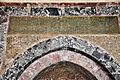
Caliph al-Zahir's inscription above the mihrab
-
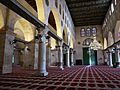
View of the hypostyle prayer hall
-
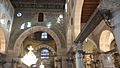
Decorated wall above mihrab near central dome facing main entrance
-
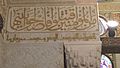
Inscription showing Quran's aayat & contributors name to restore dome of Aqsa after 1969 burning
-
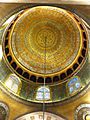
Interior decoration of Aqsa main dome
-
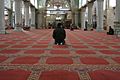
A man prays in the mosque in 2008

.jpg)


.jpg)
_Mosque._Cedar_pulpit_%26_mihrab_LOC_matpc.03246.jpg)
.jpg)
See also
 In Spanish: Mezquita de Al-Aqsa para niños
- Islam in Israel
- List of mosques in Israel
- List of the oldest mosques in the world
- Islam in Palestine
- Al-Juʽranah in Saudi Arabia, alternative location for Quranic "al-Aqsa mosque"
- Palestinian nationalism
- Religious significance of the Syrian region
