
Amélie of Leuchtenberg facts for kids
Quick facts for kids Amélie of Leuchtenberg |
|||||
|---|---|---|---|---|---|
| Duchess of Braganza | |||||

Portrait by Friedrich Dürck, 1839
|
|||||
| Empress consort of Brazil | |||||
| Tenure | 2 August 1829 – 7 April 1831 | ||||
| Born | 31 July 1812 Milan, Kingdom of Italy |
||||
| Died | 26 January 1873 (aged 60) Lisbon, Kingdom of Portugal |
||||
| Burial | 1873 Pantheon of the House of Braganza, Lisbon 1984 Monument to the Independence of Brazil, São Paulo |
||||
| Spouse | |||||
| Issue | Princess Maria Amélia of Brazil | ||||
|
|||||
| House | Beauharnais | ||||
| Father | Eugène, Duke of Leuchtenberg | ||||
| Mother | Princess Augusta of Bavaria | ||||
| Signature |  |
||||
Amélie of Leuchtenberg (born July 31, 1812, died January 26, 1873) was an important historical figure. She became the Empress of Brazil. This happened when she married Pedro I of Brazil.
Amélie came from a famous European family. Her grandmother was Josephine de Beauharnais, who was Empress of France. Amélie's father, Eugène de Beauharnais, was Josephine's son. He became the stepson of Napoleon Bonaparte when Napoleon married his mother. Amélie's mother was Princess Augusta of Bavaria, daughter of King Maximilian I Joseph of Bavaria.
Contents
Early Life and Royal Connections
Amélie was the fourth child of Eugène de Beauharnais, Duke of Leuchtenberg and Princess Augusta of Bavaria. Her father was the son of Joséphine de Beauharnais and her first husband. After Joséphine married Napoleon Bonaparte, Eugène was adopted by Napoleon. He then became the viceroy of the Kingdom of Italy. Amélie's mother was the daughter of King Maximilian I Joseph of Bavaria.
Amélie had several royal siblings. Her sister, Josephine of Leuchtenberg, became the queen of Sweden. Her brother, Auguste de Beauharnais, 2nd Duke of Leuchtenberg, married Amélie's stepdaughter, Queen Maria II of Portugal. Napoleon III, a future French emperor, was Amélie's cousin.
After Napoleon's defeat in 1814, Amélie's father, Eugène, moved to Munich. He received the title Duke of Leuchtenberg. Amélie's mother, Augusta, saw a chance for Amélie to marry the Emperor of Brazil. This marriage would help their family keep its royal status.
Finding a New Empress
_-_Friedrich_Wilhelm_Spohr.png)
In December 1826, Emperor Pedro I of Brazil lost his first wife, Maria Leopoldina. He then sent an ambassador, the Marquis of Barbacena, to Europe. The ambassador's mission was to find a new wife for the Emperor.
Finding a suitable princess was difficult. Dom Pedro had specific wishes: his new wife needed to be from a good family, beautiful, virtuous, and cultured. However, Dom Pedro had a complicated reputation in Europe. Many princesses were not eager to marry a widower with five children. Also, Dom Pedro's former father-in-law, the Emperor of Austria, did not approve of him. He tried to prevent a new marriage.
After many princesses declined, the ambassador lowered his expectations. He began looking for a wife who was simply "good and virtuous." Amélie became a strong candidate. She came from a respected royal family on her mother's side, the Wittelsbachs. Her father, however, was an exile after Napoleon's fall. This was her only minor disadvantage.
Amélie was described as tall, very beautiful, and graceful. She had blue eyes and brownish-golden hair. She was also well-educated and kind. A newspaper at the time called her one of the best-prepared princesses in Germany.
The marriage contract was signed in England on May 29, 1829. Amélie's mother approved it in Munich on June 30. On July 30, a marriage treaty was announced in Brazil. To show his commitment, Dom Pedro created the Order of the Rose. Its motto was "Love and Fidelity."
A simple wedding ceremony took place on August 2 in Munich. Amélie chose to donate the money meant for a grand celebration to an orphanage. Dom Pedro was represented by his ambassador. Amélie was only seventeen years old, while Dom Pedro was thirty.
Amélie's mother prepared her daughter carefully for her new role. She gave Amélie much advice. She told her to show her feelings and be loving to her stepchildren. Most importantly, she advised Amélie to always be loyal to the people of Brazil. A scientist, Carl Friedrich Philipp von Martius, traveled with her to teach her about Brazil. A court official, Ana Romana de Aragão Calmon, taught her about Brazilian customs and the Portuguese language.
Life as Empress of Brazil

Amélie sailed to Brazil from the Netherlands. She traveled on the frigate Imperatriz. With her was Maria II of Portugal, Dom Pedro's daughter from his first marriage. Maria was only 10 years old.
They arrived in Rio de Janeiro on October 15, 1829. Dom Pedro was very excited to meet his new wife. He went out on a tugboat to greet her ship. The next day, Amélie disembarked in a solemn procession. She and Dom Pedro then went to the Imperial Chapel for their wedding blessing. Everyone was impressed by her beauty. She wore a long white gown and a silver-embroidered robe.

In January 1830, the new empress was formally introduced at court. A dance was held where all the ladies wore pink, Amélie's favorite color. The next day, the couple began their honeymoon. They spent six weeks at a ranch in Serra da Estrela. This area later became the city of Petrópolis.
Upon their return, Amélie helped bring order to the court. She ensured that Dom Pedro's daughter, Isabel Maria, was sent to school in Switzerland. Amélie also made changes to the imperial palace, the Paço de São Cristóvão. She set French as the court language. She updated the palace's style, food, and fashion. Her elegance became famous internationally.
Amélie and Dom Pedro had a happy marriage. She also had a good relationship with her stepchildren. Her kindness won their affection. She made sure they had a loving home and a good education. Young Prince Pedro de Alcântara, the heir to the throne, soon called her "mommy." Amélie always showed affection for him. They corresponded until the end of her life. Dom Pedro II visited her in Lisbon in 1871.
Amélie's presence helped her husband regain some popularity. However, Brazil faced economic problems and political unrest. On April 7, 1831, Dom Pedro decided to step down from the throne. He gave the crown to his young son.
A New Chapter in Europe
.jpg)
After Dom Pedro I gave up his crown, Amélie went with him back to Europe. They were now known as the Duke and Duchess of Braganza. Amélie was three months pregnant during the sea voyage.
They arrived in Cherbourg, France, on June 10, 1831. They received a grand welcome. The city offered them a palace to stay in. Ten days later, Dom Pedro left for London. Amélie stayed behind and was reunited with Maria da Glória.
Amélie soon settled in Paris. She lived with Maria da Glória and Dom Pedro's daughter, Isabel Maria. Amélie adopted Isabel Maria as her own. On November 30, 1831, Amélie gave birth to Princess Maria Amélia of Brazil. She was their only child. Dom Pedro wrote to his son, Pedro II, expressing his joy. He said God had given him a daughter and Pedro II another sister.
Meanwhile, Dom Pedro I, as Duke of Braganza, fought for the Portuguese crown. He fought against his brother, Dom Miguel I of Portugal, on behalf of his daughter Maria da Glória. After Dom Pedro won, Amélie, her daughter, and stepdaughter moved to Portugal. They arrived in Lisbon on September 22, 1833. The family settled in the Queluz Palace.
Later Years and Lasting Legacy

Dom Pedro's active life had weakened his health. He developed tuberculosis and passed away on September 24, 1834. Amélie respected his will. Dom Pedro had made sure all his children, including his other daughters, were provided for.
Amélie never remarried. She moved to the Palácio das Janelas Verdes in Lisbon. She dedicated her life to charity and her daughter's education. Maria Amélia was very intelligent and a talented musician. Amélie and her daughter sometimes visited Bavaria.
Initially, Amélie and Maria Amélia were not fully recognized as part of the Brazilian imperial family. The Brazilian government was cautious. However, when Dom Pedro II became an adult, relations improved. On July 5, 1841, Amélie and Maria Amélia were officially recognized as members of the Brazilian imperial family. Maria Amélia was confirmed as a Brazilian princess.

Princess Maria Amélia became engaged to Archduke Maximilian of Austria in 1852. Sadly, she soon showed symptoms of tuberculosis. To find healthier air, she and her mother moved to Funchal, on Madeira Island. They arrived on August 31, 1852. However, the princess died there on February 4, 1853, at age 22.
Her daughter's death deeply affected Amélie. She visited Maria Amélia's tomb every year. She also funded the building of a hospital in Funchal, named "Princesa Dona Maria Amélia." She left her properties in Bavaria to Archduke Maximilian. She said she would have been happy to have him as a son-in-law. After Maria Amélia's death, Amélie returned to Lisbon.
Health, Passing, and Resting Place
Amélie suffered from angina pectoris since 1834. By 1871, her health was very poor. She had fever, bronchitis symptoms, and breathing problems. She was given her last rites. Her health improved when she learned her sister, Queen Josephine of Sweden, and her stepson, Pedro II, would visit. By 1872, she had edema and dyspnea.
Amélie passed away on January 26, 1873, at the age of 60. She died from congestive heart failure. Her body was embalmed shortly after her death. A statement on January 29 confirmed the embalming. It mentioned that her body was shown to family and servants before being placed in a lead coffin.
Amélie was first buried in the Royal Pantheon of the House of Braganza in Lisbon. In her will, she left many documents about Pedro I to Brazil. These are now in the Historic Archive of the Imperial Museum of Brazil in Petrópolis. In 1982, her remains were moved to the Imperial Crypt and Chapel. This is located in the Monument to the Independence of Brazil in São Paulo.
A Look into the Past: Exhumation
Between February and September 2012, researchers from the University of São Paulo in Brazil studied Amélie's remains. They also studied the remains of Pedro I and his first wife, Maria Leopoldina. They were surprised to find that Amélie's body had been mummified. Her skin, hair, and internal organs were preserved.
Examinations at the Hospital das Clínicas da Universidade de São Paulo showed an incision in her jugular vein. Aromatics like camphor and myrrh were injected during the embalming. A forensic archaeologist, Valdirene Ambiel, noted this helped prevent decomposition. The casket was also sealed very tightly, keeping out micro-organisms. Before reburial, scientists re-embalmed her remains using a similar method.
Royal Symbols
| Styles of Empress Amélia of Brazil |
|
|---|---|
 |
|
| Reference style | Her Imperial Majesty |
| Spoken style | Your Imperial Majesty |
| Alternative style | Madam |
-
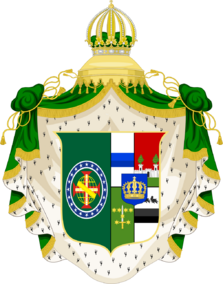
Coat of Arms of Amélie of Leuchtenberg as Empress of Brazil

Family Tree
| Ancestors of Amélie of Leuchtenberg | |||||||||||||||||||||||||||||||||||||||||||||||||||||||||||||||||||||||||||||||||||||||||||||||||||||||||||||||||||||||||||||||||||||||||||||||||||||||||||||||||||||||||||||||||||||||||||||||||||||||||||||||||||||||||||||||||||||||||||||||||||||||||||||||||||||||||||||||||||||||||
|---|---|---|---|---|---|---|---|---|---|---|---|---|---|---|---|---|---|---|---|---|---|---|---|---|---|---|---|---|---|---|---|---|---|---|---|---|---|---|---|---|---|---|---|---|---|---|---|---|---|---|---|---|---|---|---|---|---|---|---|---|---|---|---|---|---|---|---|---|---|---|---|---|---|---|---|---|---|---|---|---|---|---|---|---|---|---|---|---|---|---|---|---|---|---|---|---|---|---|---|---|---|---|---|---|---|---|---|---|---|---|---|---|---|---|---|---|---|---|---|---|---|---|---|---|---|---|---|---|---|---|---|---|---|---|---|---|---|---|---|---|---|---|---|---|---|---|---|---|---|---|---|---|---|---|---|---|---|---|---|---|---|---|---|---|---|---|---|---|---|---|---|---|---|---|---|---|---|---|---|---|---|---|---|---|---|---|---|---|---|---|---|---|---|---|---|---|---|---|---|---|---|---|---|---|---|---|---|---|---|---|---|---|---|---|---|---|---|---|---|---|---|---|---|---|---|---|---|---|---|---|---|---|---|---|---|---|---|---|---|---|---|---|---|---|---|---|---|---|---|---|---|---|---|---|---|---|---|---|---|---|---|---|---|---|---|---|---|---|---|---|---|---|---|---|---|---|---|---|---|---|---|
|
|||||||||||||||||||||||||||||||||||||||||||||||||||||||||||||||||||||||||||||||||||||||||||||||||||||||||||||||||||||||||||||||||||||||||||||||||||||||||||||||||||||||||||||||||||||||||||||||||||||||||||||||||||||||||||||||||||||||||||||||||||||||||||||||||||||||||||||||||||||||||
Children
With Dom Pedro I of Brazil, formerly also Pedro IV of Portugal:
- Princess Maria Amélia of Brazil (December 1, 1831 – February 4, 1853)
Amélie in Books and Films
Amélie of Leuchtenberg is the main character in a novel by Ivanir Calado. It is called Imperatriz no Fim do Mundo: Memórias Dúbias de Amélia de Leuchtenberg (1997). She has also been portrayed in films and television by:
- Maria Cláudia, in the film "Independência ou Morte" (1972)
- Cida Marques, in the miniseries "Entre o Amor e a Espada" (2001)
- Cláudia Abreu, in the miniseries "O Quinto dos Infernos" (2002)
