
Black-billed sicklebill facts for kids
Quick facts for kids Black-billed sicklebill |
|
|---|---|
 |
|
| Illustration of male (above) and female (below) | |
| Conservation status | |
Scientific classification  |
|
| Kingdom: | Animalia |
| Phylum: | Chordata |
| Class: | Aves |
| Order: | Passeriformes |
| Family: | Paradisaeidae |
| Genus: | Drepanornis |
| Species: |
D. albertisi
|
| Binomial name | |
| Drepanornis albertisi (Sclater, PL, 1873)
|
|
| Script error: The function "autoWithCaption" does not exist. | |
| Synonyms | |
|
|

Script error: No such module "Check for conflicting parameters".
The black-billed sicklebill (Drepanornis albertisi) is a special type of bird-of-paradise. It is also sometimes called the buff-tailed sicklebill. This can be a bit confusing because there's also a hummingbird with a similar name! This bird and its close relative, the pale-billed sicklebill, are the only two birds in the Drepanornis group.
Contents
What's in a Name?
The name Drepanornis comes from two old words. "Drepane" means "sickle" and "ornis" means "bird". So, the name literally means "sickle bird". This is because of their cool, curved, sickle-shaped bill. The second part of its scientific name, albertisi, honors an Italian scientist named Luigi Maria d'Albertis. He was the first to discover this bird in 1872.
Some of the different types of this bird also have special names. For example, cervinicauda means "stag-colored tail". "Stag" is another word for a male deer. Another name, geisleri, honors a German bird expert named Bruno Geisler. The name inversus means "overturned".
Different Types of Black-billed Sicklebills
Even though they look similar, the Drepanornis sicklebills are not closely related to other birds called Epimachus sicklebills. They are actually more like the twelve-wired and standardwing birds-of-paradise.
Scientists agree on two main types, or subspecies, of the black-billed sicklebill:
There are also two other types, geisleri and inversus, that live in different parts of New Guinea. Scientists are still studying them to see if they are truly separate subspecies.

What Do They Look Like?
The black-billed sicklebill is a medium-sized bird. It is about 35 centimeters (14 inches) long and mostly brown.
The male bird is quite fancy! It has bare, maroon-grey skin around its eyes. Its tail is a buff color, and its eyes are dark brown. It has a yellow mouth and a black, curved, sickle-like bill. Males also have special dark, horn-like feathers on their forehead. They have shiny, bronze feathers on their neck that can stand up like a fan. Plus, they have long, purple-tipped feathers on their sides.
The female bird is smaller and less colorful than the male. She is mostly brown and has dark stripes on her belly. Her bill is also longer than the male's.
Where Do They Live?
The black-billed sicklebill lives in the mountains of New Guinea. You can find them in different areas across the western, central, and eastern parts of the island. They mostly live in tropical mountain forests. These forests are usually found at heights of 1,100 to 1,900 meters (about 3,600 to 6,200 feet) above sea level.
Sometimes, their home areas overlap a little with the pale-billed sicklebill (Drepanornis brujini). But so far, scientists have not seen these two types of sicklebills have babies together.
What Do They Eat?
These birds mainly eat fruit. They also enjoy eating arthropods, which are small creatures like insects and spiders.
Eggs and Babies
When it's time to lay eggs, the female black-billed sicklebill usually lays one or two eggs. These eggs are a pale cream color and have brown and grey spots.
Conservation Status
The black-billed sicklebill is found in many places and has a large area where it lives. Because of this, scientists consider it a species of "least concern". This means it is not currently in danger of disappearing. It is also listed on Appendix II of CITES. This is an international agreement that helps control the trade of wild animals and plants.
Gallery
-
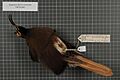
A male cervinicauda specimen at the Naturalis Biodiversity Center.
-
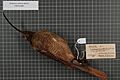
A female specimen of the main type.
-
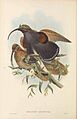
An early drawing of Drepanornis albertisi. The male is in front, and the female is on the left.
-
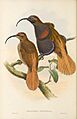
Another early drawing of Drepanornis albertisi.
-
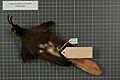
A male cervinicauda specimen with some chest feathers spread out.

_-_Paradisaeidae_-_bird_skin_specimen.jpeg)


