
Colugo facts for kids
Quick facts for kids Colugos |
|
|---|---|
,_Central_Catchment_Area,_Singapore_-_20060618.jpg) |
|
| Sunda flying lemur | |
Scientific classification  |
|
| Kingdom: | Animalia |
| Phylum: | Chordata |
| Class: | Mammalia |
| Superorder: | Euarchontoglires |
| Grandordo-mb: | Euarchonta |
| Mirordo-mb: | Primatomorpha |
| Order: | Dermoptera Illiger, 1811 |
| Family: | Cynocephalidae Simpson, 1945 |
| Type genus | |
| Cynocephalus Boddaert, 1768
|
|
| Genera | |
|
|
 |
|
| Synonyms | |
|
|
Colugos, also known as flying lemurs, are amazing animals from Southeast Asia. They spend their lives in trees and can glide through the air. Even though they are called "flying lemurs," they are not actually lemurs. Their closest living relatives are primates, like monkeys and humans.
There are only two types of colugos left in the world today. These are the Sunda flying lemur (Galeopterus variegatus) and the Philippine flying lemur (Cynocephalus volans). Both species belong to a special animal group called Dermoptera. This name comes from ancient Greek words meaning "skin wing," which describes their unique gliding ability.
Contents
Discover the Amazing Colugo: Flying Lemurs
Colugos are mammals that live in trees. They are active at night, which means they are nocturnal. During the day, they rest. They are famous for their incredible ability to glide from tree to tree.
What Do Colugos Look Like?
Colugos are about 35 to 40 centimeters long. They weigh between 1 and 2 kilograms. They have long, thin arms and legs, and a tail that is not too long. Their bodies are quite light. Their heads are small, with big eyes that face forward. This gives them great depth perception for seeing at night. They also have small, round ears.
Colugos have very special teeth. Their front teeth, called incisors, look like tiny combs. Each tooth can have up to 20 small points. These comb-like teeth help them groom themselves. They also have a unique feature: their second upper incisors have two roots. This is rare among mammals.

How Colugos Soar Through the Trees
Colugos are amazing gliders. They are better at gliding than any other mammal that glides. They can glide up to 70 meters between trees. One Sunda flying lemur was even seen gliding about 150 meters in a single trip!
This incredible gliding is possible because of a special skin membrane. This membrane is called a patagium. It stretches from their shoulders to their front paws. It also goes from their fingertips to their toes, and from their back legs to the tip of their tail. Special muscles help them control this membrane. These muscles adjust the patagium's shape. This gives them better control and balance while they are flying. Their fingers and toes are also webbed, like a duck's foot. Because of this, people once thought colugos were related to bats. But now, scientists know they are more closely related to primates.

Even though they are great gliders, colugos are not very good climbers. They don't have opposable thumbs. They climb trees slowly, using their small, sharp claws to grip the bark. They rest during the day. At night, they use their gliding skills to find food or to find other colugos.
Colugo Habits and What They Eat
Colugos are shy animals that live alone. They live in the tropical forests of Southeast Asia. Since they are nocturnal and shy, we don't know a lot about their daily lives. They are herbivores, meaning they only eat plants. Their diet includes leaves, young shoots, flowers, tree sap, and fruit. They have strong stomachs and long intestines. These help them get all the nutrients from tough plant materials.
Over time, colugos developed excellent night vision to help them see in the dark. They spend their days resting in tree holes. At night, they become active and can travel about 1.7 kilometers. Colugos might also be territorial, meaning they protect their living space.
The Colugo Life Cycle: From Baby to Adult
Colugo mothers care for their babies in a special way. Even though they are placental mammals, they raise their young much like marsupials do. Newborn colugos are very tiny, weighing only about 35 grams. They are not fully developed when they are born.
For the first six months, baby colugos cling to their mother's belly. The mother uses her tail and her gliding membrane, the patagium, to create a cozy pouch. This "pouch" keeps her baby safe and warm. It also helps her carry the baby as she moves. Young colugos grow up slowly. They become adults when they are two to three years old. In zoos, colugos can live for up to 15 years. We don't know exactly how long they live in the wild.
Protecting Colugos: Their Conservation Status
Both types of colugos face threats in the wild. Their biggest problem is habitat destruction, which means their forest homes are being cut down. The Philippine flying lemur was once considered "vulnerable" by the IUCN. The IUCN is a group that tracks how endangered animals are. In 1996, they listed it as vulnerable because its forest homes were disappearing. People also hunted them.
By 2008, its status improved to "least concern." However, it still faces the same dangers today. Its rainforest home is still being cleared. People also hunt colugos for their meat and fur. They are also a main food source for the critically endangered Philippine eagle. Some research shows that colugos make up 90% of the eagle's diet.
Naming Colugos: What's in a Name?
The family name for colugos is Cynocephalidae. This name comes from two Ancient Greek words. "Kúon" means "dog," and "kephalḗ" means "head." Scientists chose this name because colugos have broad heads with short snouts, a bit like dogs.
Meet the Two Types of Colugos
| Common name | Binomial name | Population | Status | Trend | Notes | Image |
|---|---|---|---|---|---|---|
| Sunda flying lemur | Galeopterus variegatus | unknown |  |
 |
||
| Philippine flying lemur | Cynocephalus volans | unknown |  |
 |
Colugo Family Tree: Where They Fit In
Scientists believe that colugos' ancestors separated from other mammals about 80 million years ago. This long history led to the colugos we see today. We know about some ancient mammals that might be related to colugos. For example, fossils of a mammal called Mixodectes show it lived in trees. However, it did not have the ability to glide. The oldest clear colugo fossils are from the Dermotherium genus. These fossils are from the Eocene and Oligocene periods.
Modern studies of animal genetics show us how colugos are related to other animals. Colugos are part of a larger group called Primatomorpha. This group also includes primates, like monkeys and humans. Another group, called Scandentia (treeshrews), are often thought to be close relatives of Primatomorpha.
Here's a simplified look at their family tree:
| Euarchontoglires |
|
||||||||||||||||||||||||||||||
- Order Dermoptera
- Family Cynocephalidae
- Cynocephalus
- Philippine flying lemur, Cynocephalus volans
- Galeopterus
- Sunda flying lemur, Galeopterus variegatus
- †Dermotherium
- †Dermotherium major
- †Dermotherium chimaera
- Cynocephalus
- Family Cynocephalidae
More Colugo Pictures
-
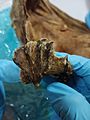
Claw of a Sunda flying lemur
-
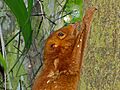
A "red" colored colugo (Cynocephalus variegatus)
-
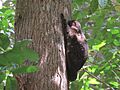
Black colored Sunda flying colugo (Cynocephalus variegatus)
-
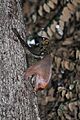
Colugo resting in a tree (Cynocephalus variegatus)

_%22_red_%22_morph_(8064072543).jpg)


See also
 In Spanish: Dermópteros para niños
