
Conus biliosus facts for kids
Quick facts for kids Conus biliosus |
|
|---|---|
 |
|
| Conservation status | |
Scientific classification  |
|
| Kingdom: | Animalia |
| Phylum: | Mollusca |
| Class: | Gastropoda |
| Subclass: | Caenogastropoda |
| Order: | Neogastropoda |
| Superfamily: | Conoidea |
| Family: | Conidae |
| Genus: | Conus |
| Species: |
C. biliosus
|
| Binomial name | |
| Conus biliosus (Röding, 1798)
|
|
| Script error: The function "autoWithCaption" does not exist. | |
| Synonyms | |
|
|
Script error: No such module "Check for conflicting parameters".
The bilious cone (scientific name: Conus biliosus) is a type of sea snail. It is a marine gastropod mollusk from the Conidae family, also known as cone snails.
Like all cone snails, the bilious cone is a predatory animal. This means it hunts other creatures for food. It is also venomous, so it can "sting" humans. Because of this, it's very important not to touch live bilious cones.
About the Bilious Cone
What Does It Look Like?
The shell of an adult bilious cone can be between 25 mm (about 1 inch) and 64 mm (about 2.5 inches) long. The shell is smooth and has lines near the bottom.
Its color is usually yellowish-white. It often has rows of square-shaped chestnut (brownish) spots. Sometimes these spots can blend together, forming bands of brown clouds on the shell. The top part of the shell, called the spire, also has spots.
Where Do They Live?
You can find the bilious cone in different parts of the world's oceans.
- In the Western Indian Ocean, they live from South Africa all the way to Somalia.
- They are also found off the coasts of India and Sri Lanka.
- In the Pacific Ocean, they live from Indonesia to the Philippines and Papua New Guinea.
- They are also present near the Solomon Islands and in Queensland and the Northern Territory of Australia.

Images for kids
-
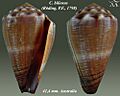
Conus biliosus
-
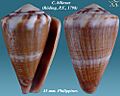
Conus biliosus
-
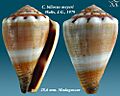
Conus biliosus meyeri
-
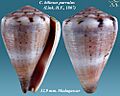
Conus biliosus parvulus


