
Early Middle Ages facts for kids
| c. 5th century – 10th century | |

The jewelled cover of the Codex Aureus of St. Emmeram, c. 870, a Carolingian Gospel Book
|
|
| Preceded by | Late antiquity |
|---|---|
| Followed by | High Middle Ages |
The Early Middle Ages was a time in European history from the late 400s to the 900s. It came after the Roman Empire became weaker and before the High Middle Ages. Some people used to call this time the Dark Ages. This was because there weren't many written records or new artworks from this period. However, historians today don't use that term much anymore.
During these centuries, Europe saw big changes. Fewer people lived in cities, trade slowed down, and many groups of people moved across the continent. The Eastern Roman Empire, also known as the Byzantine Empire, continued to thrive. But in the 600s, new empires like the Rashidun Caliphate and Umayyad Caliphate took over some southern Roman lands.
Later in this period, things started to improve. In the year 800, a powerful leader named Charlemagne became Emperor in Western Europe. His Carolingian Empire brought many changes to how people lived, to art, and to culture. Farming methods improved with new ideas like the three-field system and better ploughs. While many groups settled down, the Viking expansion brought new challenges and changes to Northern Europe.
Contents
- Exploring Early Medieval History
- Learning and Knowledge in the Early Middle Ages
- Christianity in the West and East
- Europe in 1000 CE
- Middle East: The Rise and Spread of Islam
- Timeline of Key Events
- Images for kids
- See also
Exploring Early Medieval History
The Fall of the Western Roman Empire
The Roman Empire was once very powerful. But starting in the 200s, it began to face many problems. Cities became smaller, trade decreased, and the population dropped. Some historians think a colder climate during this time made farming harder, which also led to fewer people.

Around the 200s, Germanic peoples from Scandinavia moved south. They formed strong groups near the Black Sea, like the Goths. These groups often clashed with the Romans.
Then, in the late 300s, the Huns arrived from Central Asia. They were skilled horse riders and archers. The Huns pushed the Goths into Roman lands. The Goths asked for safety, but many brought their weapons with them, causing trouble.
The Roman army was famous for its strength. But over time, it became harder for the Empire to pay and train its soldiers. This made it difficult to defend against new threats. The Roman government's income from farming and trade was shrinking.

In 378, the Goths fought the Roman army at the Battle of Adrianople. The Romans suffered a huge defeat. Their army was largely destroyed, and Emperor Valens was killed. This allowed the Goths to move freely through the Balkans.
The Western Roman Empire struggled to rebuild its army. It had to rely on other groups to fight for it. In 406, the Vandals, Suebi, and Alans crossed the Rhine River. They moved into Roman Gaul (modern-day France).
In 410, the Visigoths, led by Alaric I, captured the city of Rome. The city was looted, and many valuable items were taken. This event showed how weak the Western Roman Empire had become.
The Migration Period: New Peoples and Cultures


After the fall of the Western Roman Empire, many different groups of people moved into Western Europe. Some of these groups, like the Goths and Vandals, had been in contact with Roman culture. Others were less familiar with Roman ways.
These migrations, sometimes called the Völkerwanderung (wandering of the peoples), changed society. Roman culture in some areas, like north of the Po River in Italy, almost disappeared. In other places, like France and Spain, people continued to speak forms of Vulgar Latin, which later became the Romance languages.

The Roman Empire had provided safe conditions for trade and education. With its decline, local leaders took over. Travel became dangerous, and long-distance trade greatly decreased. Industries that relied on trade, like large-scale pottery making, vanished in many places.
Education and government services also declined. Many people, even leaders, became less literate. The population of Europe continued to fall. The Plague of Justinian, starting in 541, killed millions of people. Rome, once a huge city, shrank from 450,000 people to just 20,000 during this time.
The Eastern Roman Empire: Byzantium's Enduring Legacy

- Under Emperor Justinian I (ruled 527–565), the Byzantines regained some Roman lands in Italy and North Africa.
- Justinian's conquests
- Eastern Empire
When the Roman Empire split in 395, the Eastern part continued to thrive. It became known as the Byzantine Empire, with its capital at Constantinople. Its people still saw themselves as Romans. Historians call it "Byzantine" after Constantinople's original name, Byzantium.
The Byzantine Empire controlled important trade routes between Europe and Asia. This made it very wealthy. They had a strong army and clever diplomats. This helped them defend against invaders.
Emperor Justinian I (ruled 527–565) was a famous Byzantine leader. He managed to take back some western Roman territories, including parts of Italy. He also organized Roman law into a system called the Corpus Juris Civilis. This law code was used in Europe for many centuries. Justinian also built the magnificent Hagia Sophia church. However, a terrible disease, the Plague of Justinian, also struck during his reign, killing many people.

Later emperors, like Heraclius, fought against invaders such as the Avars and Slavs. Constantinople itself survived a major siege in 626. Heraclius also fought a successful war against the Persians. However, soon after, Muslim armies conquered many Byzantine lands, including Syria, Egypt, and North Africa.

Constantinople remained a huge and wealthy city. It was one of the largest Christian cities in the world. The Byzantines also made advances in farming technology. They used iron tools and water mills, and grew protein-rich beans.
The Macedonian dynasty (starting in 867) brought a new golden age to Byzantium. Generals expanded the empire's borders. Emperors like Leo the Wise and Constantine VII supported a cultural revival, known as the Macedonian Renaissance. They saw Western European rulers as less educated.
The Byzantine Empire's culture and traditions attracted its neighbors. Slavs, Bulgars, and Khazars came to Constantinople for trade or knowledge. The movement of Germanic tribes led to a large migration of Slavs. They spread across Central, Eastern, and Southern Europe, settling in new lands.
The Rise of Islam and its Impact

Starting in the 600s, the rise of Islam greatly changed history. Muslim armies began to expand from the Arabian Peninsula. They conquered lands that were once part of the Roman and Persian Empires.
Under the first Caliphs, Muslim forces quickly took over Roman Syria, Mesopotamia, Roman Palestine, and Roman Egypt. They also conquered all of the Persian Empire. This expansion continued under the Umayyad Caliphate. They took control of North Africa and most of the Iberian Peninsula (modern-day Spain and Portugal).
The Muslim conquest of Hispania began in 711. Moorish armies, led by Tariq ibn Ziyad, landed at Gibraltar. They quickly moved north, bringing most of the peninsula under Muslim rule. This new territory was called Al-Andalus.
Muslim expansion into Europe was eventually stopped. The second siege of Constantinople (717-718) failed. In Western Europe, the Frankish leader Charles Martel defeated Muslim forces at the Battle of Tours in 732. This battle is often seen as a key moment that prevented further Muslim expansion into Western Europe.
Later, a new Muslim dynasty, the Abbasid Caliphate, took power. A surviving Umayyad prince, Abd-ar-rahman I, escaped to Spain. He founded a new Umayyad kingdom there, the Emirate of Cordoba.
The Birth of the Latin West

After the Western Roman Empire ended, new ways of life began in Europe. Between the 400s and 700s, new political and social systems developed. These were often influenced by Germanic traditions and Christianity.
Christian missionaries spread Christianity throughout northern Europe. Monasteries became important centers of learning and religion. They were often independent from local rulers. This allowed them to offer spiritual help and education.
A new social system called feudalism began to take shape. It was based on people owing loyalty and service to those above them. In return, they received protection. This system helped maintain some order when central governments were weak.
Italy: Lombards and Franks

The Lombards were a Germanic people who entered Italy in 568. They established a kingdom in the north, with its capital at Pavia. They spent centuries trying to conquer more land from the Byzantine Empire.
The Lombard kingdom was quite organized. It had a written law code, the Edictum Rothari, based on their oral traditions. However, the kingdom was eventually conquered by Charlemagne in 774. This began a period of Frankish rule in Italy.
In southern Italy, things were more chaotic. The Duchy of Benevento remained independent. In the 800s, Muslims conquered Sicily. Later, in the 1000s, the Normans arrived and took control of the entire south.
Britain: Anglo-Saxons and Vikings

After the Romans left Britain around 400 CE, the island faced many changes. Germanic peoples, known as Anglo-Saxons, began to settle there. By the 500s, Britain was divided into many small kingdoms.
Christianity spread among the Anglo-Saxons in the late 500s. Meanwhile, western Britain (Wales) and Scotland continued their own development. The Welsh and Scots had been Christian since Roman times or converted soon after.
The Kingdom of Northumbria and later Mercia became powerful in England. Eventually, Wessex grew strong, uniting many southern kingdoms.
Around 800, Vikings began raiding Britain. These raids grew larger and more destructive. In 865, a large Danish Viking army tried to conquer England. Only Wessex, led by Alfred the Great, managed to survive. Alfred and his descendants eventually fought back and created the Kingdom of England.
The Vikings also had a big impact on Scotland. Their defeat of the Picts led to the formation of the Kingdom of Alba, which became the Kingdom of Scotland.
The Frankish Empire: Charlemagne's Legacy


The Merovingian dynasty established the Frankish Empire in Gaul (modern-day France). Clovis I converted to Christianity in 496. The Frankish kingdom grew through conquests and alliances.
Frankish custom meant that land was divided equally among a dead ruler's sons. This often weakened the king's power as his kingdom grew. Nobles could build their own power bases.
Charles Martel, a powerful official, greatly expanded Frankish influence. He famously defeated invading Muslims at the Battle of Tours in 732. His son, Pepin the Short, became king with the help of Pope Zachary. This ended the Merovingian line and started the Carolingian dynasty.
Pepin's son, Charlemagne, continued to expand the Frankish kingdom. His reign also saw a cultural revival called the Carolingian Renaissance. In 800, Pope Leo III crowned Charlemagne "Roman Emperor." His empire united much of France, western Germany, and northern Italy.
After Charlemagne's death, his empire was divided among his sons. This led to instability and eventually split into West Francia (which became France) and East Francia (which became Germany).
Feudalism and Farming Innovations
Around 800 CE, farming methods improved with the open field system. Fields were divided into strips, and families received land to farm. The three-field system of crop rotation was developed. This meant one field grew wheat, another grew nitrogen-fixing crops (like beans), and the third was left fallow.
This system allowed for more land to be farmed and two harvests a year. This reduced the risk of famine. It also created a surplus of oats, which could feed horses. Horses eventually replaced oxen for ploughing after the invention of the padded horse collar.
The return to systematic agriculture happened alongside a new social system called feudalism. In this system, people had duties to their superiors in exchange for protection. This helped provide safety when central governments were weak.
Manors became mostly self-sufficient. Long-distance trade decreased, but it never completely stopped. Roman roads fell into disrepair, and water transport became more important for trade.
The Viking Age: Explorers and Traders

- 8th century homeland
- 9th century expansion
- 10th century expansion
Viking raiding regions
The Viking Age lasted from the late 700s to the mid-1000s. During this time, Vikings, who were Scandinavian warriors and traders, explored much of Europe. They also reached parts of Asia, North Africa, and even North America.
With their advanced longships, Vikings traveled across oceans and rivers. They set up important trading posts in cities like Dublin, York, and Birka. They developed wide trading networks.
Viking expeditions also involved warfare and taking people captive. These actions contributed to the development of feudal systems in Europe, as communities sought protection from raids.
Eastern Europe: New States and Cultures

In the Early Middle Ages, Slavic tribes expanded into Central and Southeastern Europe. Early Slavic states included Samo's Empire, Great Moravia, and the Duchy of Croatia.
Magyars invaded the Pannonian Basin around 896, taking over Great Moravia. Christian missionaries from Constantinople and Rome competed to convert the Slavs. Many West and South Slavic lands became Roman Catholic. However, Bulgaria and Kievan Rus' adopted Eastern Orthodox Christianity from Byzantium.
This period saw the start of cultural differences between Western and Eastern Europe. The Byzantine Empire influenced Eastern Europe's Christianity and culture. This included the spread of the Cyrillic alphabet.

Magyar region
Other groups, like the Khazars and Magyars, also shaped Eastern Europe. The Khazars were a nomadic Turkic people. They built a trading empire that controlled routes between Europe and Central Asia. They allied with Constantinople against Arab expansion.
Islam spread into Eastern Europe in the 920s. Volga Bulgaria adopted Islam, using the decline of Khazar power.
Bulgaria: A Powerful Slavic State

In 632, the Bulgars formed Old Great Bulgaria. Later, they established the First Bulgarian Empire in 681. This was a powerful state in Southeastern Europe. The Bulgars became Slavicized and accepted Christianity from the Byzantine Empire.
Missionaries like Cyril and Methodius helped spread the Glagolitic and later the Cyrillic alphabet. Old Bulgarian became the language for books and church services among Orthodox Slavs.
After adopting Christianity in 864, Bulgaria became a cultural center for the Eastern Orthodox Slavic world. Under Simeon I (893–927), Bulgaria was one of Europe's largest and most powerful states. It often challenged the Byzantine Empire. However, Bulgaria later declined and was conquered by Byzantium in 1018.
Kievan Rus': A Northern Power
The Kievan Rus' was a state led by a Varangian (Viking) dynasty. It controlled trade routes connecting Northern Europe to Byzantium and Asia. Prince Oleg (ruled 882–912) expanded control along the Dnieper River. He moved the capital to Kiev.
Sviatoslav I of Kiev (died 972) greatly expanded Kievan Rus' territory. He fought against the Khazar Empire and Bulgaria. The Rus' later converted to Orthodox Christianity around 988 under Vladimir I of Kiev. Vladimir I married a Byzantine princess, showing the importance of their ties to Constantinople.
Learning and Knowledge in the Early Middle Ages

After the Western Roman Empire fell, learning and literacy decreased in the West. Education moved from cities to monasteries and cathedral schools. The main focus was on studying the Bible. In Italy, Spain, and southern Gaul, Roman influences lasted longer, so education continued more steadily.
In the 600s, learning grew in Ireland and other Celtic lands. Latin was a new language there, and people eagerly studied Latin texts. The Carolingian Renaissance in the 700s brought a renewed interest in classical education in the Frankish Empire.
The Eastern Roman Empire (Byzantium) kept a higher level of learning. Their education system focused on grammar, Latin, Greek, and rhetoric. Students read classic works and wrote essays. This system became Christianized by the 300s.
Studying the Natural World
In ancient times, Greek was the main language for studying nature. As knowledge of Greek declined in the Latin West, people became cut off from much of this learning. The period from the 300s to 700s saw "Latin Encyclopedists." One famous work was Etymologiae by Isidore of Seville. It was a huge collection of knowledge on many subjects, including science.
People studied nature for practical reasons. Monks needed to know the stars' movements to pray at the right times. Calculating the date of Easter required knowledge of mathematics and the Sun and Moon's movements.
The Carolingian Renaissance: A Revival of Learning
In the late 700s, Charlemagne led a reform in education. This was part of the Carolingian Renaissance. The English monk Alcuin helped create study programs based on the seven liberal arts. These included grammar, rhetoric, logic, arithmetic, geometry, astronomy, and music.
New schools were set up in monasteries, cathedrals, and noble courts. The study of logic led to more deep thinking about ideas. Many of these schools later became universities in the 1100s and 1200s.
Byzantium's Golden Age of Knowledge

Byzantium in the 900s experienced a wide-scale cultural revival.
Byzantium's greatest intellectual achievement was the Corpus Juris Civilis. This was a huge collection of Roman law created under Justinian I. It organized Roman legal principles so they could be applied to many situations.
Literacy was much higher in the Byzantine Empire than in the West. Elementary education was widely available. Secondary schools still taught classics like the Iliad. The University of Constantinople was refounded in 849. Under the Macedonian dynasty, Byzantium saw a golden age of classical learning. Scholars created many lexicons, anthologies, and encyclopedias.
Islamic Learning: New Ideas and Translations
In the 1000s, Islamic scientific knowledge began to reach Western Europe, especially through Islamic Spain. Works by Euclid and Archimedes, which were lost in the West, were translated from Arabic to Latin.
The modern Hindu–Arabic numeral system, including the idea of zero, came from Hindu mathematicians. Muslim mathematicians learned it and added decimal fractions. Around 1000, Pope Sylvester II used an abacus with Arabic numerals. A book by Al-Khwārizmī on these numerals was translated into Latin in the 1100s.
Monasteries: Centers of Books and Learning
Monasteries were very important for preserving books and learning. They often had libraries and scriptoriums where monks copied manuscripts. These copies included religious works, classical texts, and scientific writings.
Monasteries were sometimes targeted by Vikings because they stored valuable objects. In the Byzantine world, monasteries often received book donations from wealthy people. Scholars traveled between monasteries to study texts. The monastery of Bobbio in Italy, founded in 614, had a large collection of manuscripts by the 800s.
Christianity in the West and East


Early medieval Christians inherited a church with shared beliefs and a stable Bible. The church in the West was mainly made up of monasteries. Local rulers often controlled church offices. Monasteries were important because they were independent.
The papacy (the Pope's office) was relatively weak at first. Its power was mostly in central Italy. Pope Gregory I expanded the church's missionary work to the British Isles. He helped set up monastic orders.
During this time, the differences between Eastern and Western Christianity grew. This eventually led to the East-West Schism in the 1000s. In the West, the power of the Bishop of Rome (the Pope) increased.
The Spread of Christianity in the West
The Roman Church was the only major institution to survive the fall of the Western Roman Empire. It helped unite cultures, preserve Latin learning, and maintain writing skills. It also established formal marriage rules.
The Christianization of Germanic tribes began in the 300s. Missionaries from Ireland and England played a big role. Saint Boniface, known as the "Apostle of the Germans," spread Christianity in the Frankish Empire in the 700s. He helped shape Western Christianity and many dioceses he proposed still exist today. By 1000, most of Europe, including Iceland, had become Christian.
Europe in 1000 CE
By the year 1000, Western Europe was still developing. It was less advanced than the Islamic world or China. Constantinople had a population of about 300,000. Rome had only 35,000, and Paris 20,000. In contrast, Córdoba in Islamic Spain was the world's largest city, with 450,000 people.

England was recovering from Viking raids. Christianization helped stabilize Scandinavia. Denmark became Christian in the 900s, Norway in the 1000s, and Sweden in the 1100s. Kievan Rus', recently converted to Orthodox Christianity, became the largest state in Europe. Iceland, Greenland, and Hungary also became Christian around 1000.
Stone buildings began to replace timber structures in important places. Cities started to grow again. London, which had been abandoned, became England's main economic center by 1000. Trade fairs began in places like Bruges and Ghent.
After 1000, new features marked the end of the Early Middle Ages. These included the rise of city communities, the growth of cities, and the start of the burgher class. The first universities were founded, and Roman law was rediscovered. New literature in local languages also began to appear.
The papacy gained more independence and prestige. The Cluniac movement led to church reforms. In Eastern Europe, Stephen I was crowned the first king of Hungary in 1000. This helped stabilize the country and made it an important partner for the Holy Roman Empire.
Middle East: The Rise and Spread of Islam


- Area I : Muhammad
- Area II : Abu Bakr
- Area III : Omar
- Area IV : Uthman
The rise of Islam began around 622 CE. This was when Muhammad and his followers moved from Mecca to Medina. Muhammad spent his last ten years leading battles to unite the Arabian region.
After Muhammad's death, the Rashidun Caliphate expanded. Under Umar, the Muslim army conquered Iraq, Syria, Mesopotamia, Palestine, and Egypt. They also took over the entire Persian Empire.
Islamic Expansion and Caliphates

- Muhammad's conquests, 622–632
- Rashidun Caliphate, 632–661
- Umayyad Caliphate, 661–750
The Umayyad Caliphate continued the expansion. They conquered North Africa and most of the Iberian Peninsula (Spain). The Muslim conquest of Hispania began in 711. They also expanded into parts of Asia Minor and the Caucasus region.

This rapid expansion of the Islamic Caliphate ended around 750. It reshaped the Middle East and controlled key areas of the Mediterranean. Later, the Abbasid Caliphate took over from the Umayyads. They built their capital in Baghdad.
Under the Abbasids, there was an Islamic Golden Age. Scholars made huge contributions to science, philosophy, and technology. Islamic civilization grew strong through its merchant economy. However, the Abbasids eventually declined as local rulers gained more power.
Timeline of Key Events
Beginning Years

- Dates
- 410: Visigoths under Alaric I capture Rome
- 430: Death of Saint Augustine
- 476: Odoacer removes the last Western Roman Emperor
- 496: Battle of Tolbiac, Clovis I converts to Christianity
- 527–565: Reign of Justinian I
- 541–542: Plague of Justinian in Constantinople
- 590–604: Papacy of Pope Gregory I
- c. 570: Birth of Muhammad
- 626: Joint Persian-Avar-Slav Siege of Constantinople
- 632: Death of Muhammad
- 681: First Bulgarian Empire established
Ending Years

- Dates
- 711–718: Umayyad conquest of Hispania
- 717: Second Arab siege of Constantinople
- 732: Battle of Poitiers
- 751: Pepin the Short founds the Carolingian dynasty
- 768–814: Reign of Charlemagne
- 793: Viking raid on Lindisfarne; Viking Age begins
- 800: Charlemagne crowned "emperor of the Romans"
- 843: Treaty of Verdun divides Charlemagne's empire
- 871–899: Reign of Alfred the Great
- 882: Kievan Rus' established
- 955: Battle of Lechfeld
- 962: Otto I crowned Holy Roman Emperor
- 988: Christianization of Kievan Rus'
- 1000: Stephen I crowned first king of Hungary
Images for kids
-
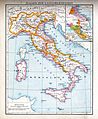
The Lombard possessions in Italy: The Lombard Kingdom (Neustria, Austria and Tuscia) and the Lombard Duchies of Spoleto and Benevento
See also
 In Spanish: Alta Edad Media para niños
