
Ferruginous partridge facts for kids
Quick facts for kids Ferruginous partridge |
|
|---|---|
 |
|
| Conservation status | |
Scientific classification  |
|
| Kingdom: | Animalia |
| Phylum: | Chordata |
| Class: | Aves |
| Order: | Galliformes |
| Family: | Phasianidae |
| Subfamily: | Rollulinae |
| Genus: | Caloperdix Blyth, 1861 |
| Species: |
C. oculeus
|
| Binomial name | |
| Caloperdix oculeus (Temminck, 1815)
|
|
| Script error: The function "autoWithCaption" does not exist. | |
Script error: No such module "Check for conflicting parameters".
The ferruginous partridge (Caloperdix oculeus) is a beautiful bird that lives in parts of Asia. It's a type of partridge, which is a ground-dwelling bird, similar to a small chicken. You can find this bird in countries like Indonesia, Malaysia, Myanmar, and Thailand. It's the only species in its special group, called Caloperdix.
Contents
About the Ferruginous Partridge
What's in a Name?
Scientists give every living thing a special two-part name. This helps everyone know exactly which animal they are talking about. The ferruginous partridge was first described by a scientist named Coenraad Jacob Temminck in 1815. He called it Perdix oculea.
The word oculea comes from the Latin word oculus, which means "eye." This name was chosen because the bird has many colored spots, like eyes. Later, in 1861, another scientist, Edward Blyth, moved the bird to its own unique group, Caloperdix. The name Caloperdix comes from Ancient Greek words: kalos means "beautiful," and perdikos means "partridge." So, its name means "beautiful partridge with eye-like spots"!
Different Types of Ferruginous Partridges
Just like there are different types of dogs, there are also different types of ferruginous partridges. Scientists call these "subspecies." There are three known subspecies:
- C. o. borneensis (Ogilvie-Grant, 1892)
- C. o. ocellatus (Raffles, 1822)
- C. o. oculeus (Temminck, 1815)
Where They Live
Habitat and Location
The ferruginous partridge lives in various places. You can find it in warm, wet forests, including both dry and moist lowland forests. It also likes areas with new plant growth, like secondary scrub and bamboo patches. These birds can live anywhere from sea level up to about 3,900 feet (1,200 meters) high.
Their home range stretches from southern Myanmar, through the Kra Isthmus, and into the Malay Peninsula. They also live on the islands of Borneo and Sumatra.
What They Look Like
The ferruginous partridge is a medium-sized bird. It measures about 10.5 to 12.5 inches (27 to 32 centimeters) long. It weighs between 6.7 and 8.1 ounces (191 to 230 grams).
This bird has very unique and colorful plumage (feathers). Its head, chest, and belly are a reddish-brown color, which is called rufous. Its upper back and the sides of its chest have black feathers with white scales, making them look patterned. Its wings are brown with black spots. The rest of its back is black with reddish-brown scales.
Male and female ferruginous partridges look quite similar. However, males usually have two spurs (sharp points) on their legs, while females only have one.
Behaviour and Life Cycle
What They Eat
Ferruginous partridges usually search for food alone or in small pairs. They like to eat seeds, fruits, grasses, and insects. They find their food on the ground.
Reproduction
Scientists don't know a lot about how these birds raise their young. What we do know is that a female ferruginous partridge lays about 8 to 10 eggs. These eggs are pure white. The eggs are laid in a special nest that is shaped like a dome.
Status and Conservation
Why They Need Our Help
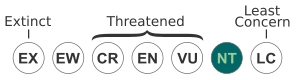
Sadly, the number of ferruginous partridges is decreasing across the areas where they live. This is mainly because of habitat loss. Their forest homes are being cut down or changed. Because of this, the ferruginous partridge is considered "near threatened" with extinction. This means they could be in danger of disappearing if we don't protect their habitats.
