
Blue sea dragon facts for kids
The Blue sea dragon (Glaucus atlanticus), often called the sea swallow or blue angel, is a fascinating sea slug. These small, beautiful creatures are a type of sea slug that lives in the open ocean. They are known for their striking blue and silver colors and their amazing ability to float upside down.
Quick facts for kids Blue sea dragon |
|
|---|---|
 |
|
Scientific classification  |
|
| Unrecognized taxon (fix): | Glaucus |
| Species: |
Template:Taxonomy/GlaucusG. atlanticus
|
| Binomial name | |
| Template:Taxonomy/GlaucusGlaucus atlanticus Forster, 1777
|
|
| Script error: The function "autoWithCaption" does not exist. | |
| Synonyms | |
|
|
Script error: No such module "Check for conflicting parameters".
These sea slugs live in the pelagic zone, which is the open ocean far from the coast. They float upside-down on the water's surface. They use the surface tension of the water and a special gas bubble in their stomach to stay afloat. Winds and ocean currents carry them across the seas. The blue sea dragon uses a clever trick called countershading to hide. Its blue side faces up, blending with the ocean's blue. Its silver or grey side faces down, making it hard for predators below to spot it against the sunlight.
G. atlanticus eats other creatures that float in the open ocean. This includes the Portuguese man o' war, which is very venomous. The blue sea dragon can store the stinging cells, called nematocysts, from its prey in its own body. This gives it a powerful defense against its own predators. If a human touches a blue sea dragon, they might get a very painful sting.
Contents
Meet the Blue Sea Dragon!
The blue sea dragon is a unique and beautiful creature of the ocean. It's known by many names, like the blue angel or dragon slug. It belongs to a family of sea slugs called Glaucidae.
What Does a Blue Sea Dragon Look Like?
When fully grown, a blue sea dragon is usually about 3 centimeters (about 1.2 inches) long. Some have been found to be even larger! They can live for up to a year if conditions are right. Their body is silvery-grey on top and dark and pale blue underneath. They have dark blue stripes on their head.
Their body is flat and tapers to a point. They have six special arm-like parts called cerata. These cerata branch out into many finger-like rays. These creatures are often found in warm, tropical, and subtropical parts of the ocean. They float on the surface, helped by the air they swallow and store in their stomach.
How Does it Float and Hide?
The blue sea dragon has a gas-filled sac in its stomach. This sac helps it float right at the ocean's surface. Because of where this gas sac is, the slug floats upside down! The part that faces up is actually its foot, which is usually on the underside of other slugs. This "upper" surface is blue or blue-white. The true back of the slug, which faces downwards, is silver-grey.
This special coloring is called countershading. It helps the blue sea dragon hide from predators. If a bird looks down from above, the blue blends with the ocean. If a fish looks up from below, the silver-grey blends with the bright sunlight filtering through the water. The blue color also helps protect it from strong ultraviolet sunlight.
Where Do Blue Sea Dragons Live?

.jpg)
These amazing sea slugs live in the open ocean all around the world. They prefer temperate and tropical waters. They have been seen off the coasts of South Africa, Europe, Australia, and Mozambique. In 2015 and 2016, people noticed that they were appearing further north in the Gulf of California than before.
Blue sea dragons have also been reported near the Azores since the mid-1800s. More recently, they were found in Peru in 2013 and off India in 2012. These sightings fit with their love for warm climates. They sometimes wash up onto beaches by accident. For example, in April 2022, specimens were found along the Texas coast in the Gulf of Mexico. In August 2023 and July 2024, blue sea slugs were seen on Karon Beach in Phuket, Thailand. In July and August 2024, they were also spotted on beaches in Lanzarote and Guardamar del Segura and La Mata in Torrevieja, Spain. These sightings sometimes led to beach closures for safety.
What Do Blue Sea Dragons Eat?
The blue sea dragon is a hunter of other creatures that float in the open ocean. It can move slowly towards its prey or a mate using its feather-like cerata. They are known to eat the very venomous Portuguese man o' war (Physalia physalis). They also prey on the by-the-wind-sailor (Velella velella), the blue button (Porpita porpita), and the violet snail, Janthina janthina. Sometimes, if kept together, they might even eat each other!
Amazing Defense: Storing Venom!
The blue sea dragon is immune to the venom of the Portuguese man o' war. It eats parts of these venomous creatures and carefully chooses and stores their most powerful stinging cells, called nematocysts. This process is called kleptocnidy. The slug keeps these stinging cells in special sacs at the tips of its cerata. Because the blue sea dragon concentrates this venom, its sting can be even more powerful and dangerous than the man o' war it ate!
Life Cycle and Reproduction
Like many sea slugs, blue dragons are hermaphrodites. This means each individual has both male and female reproductive parts. They mate by joining their undersides. After mating, both individuals can lay eggs. They can release up to 20 eggs at a time, often laying them on pieces of wood or dead animals floating in the ocean. A single blue sea dragon can lay many egg strings in an hour.
What to Do if You See One
If you ever see a blue sea dragon, it's best to admire it from a distance. Remember, they can deliver a very painful sting! This sting is similar to what you might get from a Portuguese man o' war. Symptoms can include pain, nausea, vomiting, and skin irritation like redness or bumps. If you are stung, tell an adult right away.
Images for kids
-
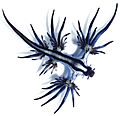
A blue sea dragon, showing its unique colors and shape.
