
Grandidier's trident bat facts for kids
Quick facts for kids Grandidier's trident bat |
|
|---|---|
| Conservation status | |
Scientific classification  |
|
| Kingdom: | Animalia |
| Phylum: | Chordata |
| Class: | Mammalia |
| Order: | Chiroptera |
| Family: | Rhinonycteridae |
| Genus: | Paratriaenops |
| Species: |
P. auritus
|
| Binomial name | |
| Paratriaenops auritus (Grandidier, 1912)
|
|
 |
|
| Distribution of P. auritus (blue), P. furcula (red) and P. pauliani (green) | |
| Script error: The function "autoWithCaption" does not exist. | |
| Synonyms | |
|
|
Script error: No such module "Check for conflicting parameters".
The Grandidier's trident bat (Paratriaenops auritus) is a special type of bat that lives only on the island of Madagascar. It's known for its unique nose and large ears. Scientists used to think it belonged to a different group of bats called Triaenops, but now they've placed it in its own group, Paratriaenops. This bat is considered "Vulnerable," meaning it needs our help to survive in the wild.
Contents
How Scientists Name and Group Animals
Scientists use a system called taxonomy to name and group living things. This helps them understand how different species are related. The Grandidier's trident bat has had a few name changes over the years.
Early Discoveries and Names
In 1912, a scientist named Guillaume Grandidier first described this bat. He called it Triaenops aurita. He found only one not-so-perfect specimen in northern Madagascar. For many years, other scientists thought this bat was the same as another species, Triaenops furcula, which lives in western Madagascar.
A New Species and a New Name
In 1995, a team of scientists led by R.L. Peterson studied bats from Madagascar. They decided that Triaenops aurita was indeed a separate species. They also changed its name to auritus to match the Triaenops genus name better.
Later, in 2006, Julie Ranivo and Steven Goodman looked closely at these bats again. They confirmed that T. auritus from northern Madagascar and T. furculus from western Madagascar were different. These two types of bats live in different areas and don't overlap. They also found a third related species, Triaenops pauliani, on an island called Aldabra.
Moving to a New Genus
In 2009, scientists Petr Benda and Peter Villa decided that the T. furculus group was quite different from other Triaenops bats. So, they created a brand new genus (a larger group of species) called Paratriaenops. This is why the bat is now called Paratriaenops auritus. Other bats like Triaenops menamena and an extinct species called Triaenops goodmani are still in the Triaenops genus.
What the Grandidier's Trident Bat Looks Like
The Grandidier's trident bat is easy to spot because of its large ears and short tail.
Fur and Size
Its fur is a beautiful reddish-gold color. It's usually darker on its back and lighter on its belly. These bats are also bigger than their close relatives, P. furcula, both males and females.
Unique Noseleaf
One of the most interesting features of this bat is its noseleaf. This is a special flap of skin on its face. It has three pointed parts, called lancets, at the back. These three lancets are straight and about the same length in Paratriaenops bats. In other Triaenops bats, the middle lancet is longer, and the two outer ones are curved. This difference helps scientists tell them apart!
Where Grandidier's Trident Bats Live and What They Do
P. auritus has a small home range in the very northern part of Madagascar. It might live as far south as the Andrafiamena Mountains.
Habitat and Roosts
These bats are quite common in their area. They prefer to live in dry forests. They spend their days resting in caves, which are safe places for them to sleep. Some of their colonies (groups of bats) can be very large, with up to 2,000 bats living together in one cave!
Protecting Grandidier's Trident Bat
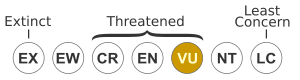
The IUCN Red List is a list that shows which animals are at risk of disappearing. It lists P. auritus as "Vulnerable". This means its population is decreasing, and its habitat is shrinking and becoming broken up.
Threats to Their Survival
One of the biggest problems for these bats is habitat destruction. People are clearing forests for farming, which takes away the bats' homes. Their habitat is also becoming fragmented, meaning it's broken into smaller, separate pieces. Another threat is when people disturb their cave roosts. This can scare the bats away or harm them.
Conservation Efforts
Luckily, the Grandidier's trident bat lives in three protected areas in Madagascar. These include Réserve Spéciale d'Ankarana, Réserve Spéciale d'Analamerana, and a forest near Daraina. Scientists recommend that we focus on watching over and protecting the caves where these bats live. This will help ensure they have safe places to roost and raise their young.
