
Hemenway Southwestern Archaeological Expedition facts for kids
The Hemenway Southwestern Archaeological Expedition was a major science trip that explored the American Southwest. It took place between 1886 and 1894. A wealthy woman named Mary Tileston Hemenway paid for the expedition.
Frank Hamilton Cushing was the first leader. Later, in 1889, Jesse Walter Fewkes took over. This expedition was very important because it helped discover the ancient Hohokam culture. Years later, in the 1930s, a student named Emil Haury studied the expedition's old records. He wrote a book in 1945 about a site called Pueblo de Los Muertos, which the Hemenway team had explored. This site was from the Hohokam culture.
Contents
Why the Expedition Started
Mary Tileston Hemenway was a rich woman who lived in New England. She was very impressed by Frank Hamilton Cushing's work. He was studying the Zuni people in New Mexico. Mary Hemenway wanted to create a special museum in Salem, Massachusetts. It would be called the Pueblo Museum. This museum would be a place to study ancient Native American finds.
So, she worked with Cushing to set up the expedition. They formed a team with a board of directors to help manage everything. Cushing hoped the expedition would be a strong foundation for archaeology and human sciences. The team planned to explore areas in Fort Wingate, New Mexico, and the Salt River Valley near Phoenix, Arizona.
Who Was on the Team


Many people joined the Hemenway Expedition. Here are some of the key members:
- Frank Hamilton Cushing: He was the first leader of the expedition. His wife, Emily, and her sister, Margaret Magill, also joined. Margaret was an artist.
- Frederick Webb Hodge: He was an assistant from the Smithsonian Institution. He later married Margaret Magill.
- Sylvester Baxter: A journalist who helped manage the expedition's money.
- Adolph Francis Alphonse Bandelier: He was a historian.
- Herman Frederik Carel ten Kate: He studied human remains.
- Jesse Walter Fewkes: He was an ethnologist. He became the new leader in 1889.
- Charles A. Garlick: He was a former mapmaker and managed the field work.
- Dr. Jacob Lawson Wortman: He helped preserve any bones they found.
- Washington Matthews: An army doctor who took care of the team's health.
The Expedition's Journey
The expedition started in December 1886. They left from Albion, New York. This was the first expedition of its kind in the American Southwest. Their main base was called Camp Hemenway. It was located in Tempe, Arizona. They also set up other camps, like Camp Baxter in Arizona and Camp Cibola in New Mexico.
In the summer of 1888, the team moved to Zuni. Camp Cibola became their new base. In 1889, Cushing's leadership ended. He had become ill. Also, the expedition's directors felt his exploration methods were not organized enough. Jesse Walter Fewkes was chosen as the new leader. He was an ethnologist, but he didn't have much archaeology experience.
The expedition ended in 1894 when Mary Hemenway died. At that time, the team was studying the Hopi people.
Archaeological Discoveries
The expedition found many ancient skulls. Most of them were from people with short, broad heads (called brachycephalic). They found these skulls at several ancient sites. These sites included Las Acequias, Los Guanacos, Los Muertos, and Halonawan, which was near Zuni.
What Happened After the Expedition
After losing his leadership role, Frank Cushing became ill and sad. He published only a few short papers before he died in 1900. His main reports were never published. After Cushing's death, his manuscripts were kept by the Hodges family.
Several team members wrote about the expedition. The Hemenway Expedition Records, 1886–1914 was published in 1886. Bandelier published two books about the expedition's findings and history. Baxter also wrote a book called The Old New World in 1883. Fewkes published his Note Book on Hemenway Expedition in 1891. In 1893, Matthews, Wortman, and John Shaw Billings wrote about the human bones found.
In 1895, the Hemenway family gave a box of records and artifacts to Harvard’s Peabody Museum of Archaeology and Ethnology.
20th Century Discoveries
The box of artifacts stayed unopened at the Peabody Museum until the 1930s. Then, a professor asked a student named Emil Haury to study its contents for his school project. Haury's report was published in 1945. It was a detailed study of La Pueblo de Los Muertos. This report helped us understand the history of the Zuni people. It also showed how the ancient Hohokam culture developed. Haury did not have access to all the expedition's reports. Many were kept in other museums and libraries.
The full report of the expedition was not published for over 100 years. Cushing's old notes, diaries, and partial reports had to be carefully copied and studied. Between 1991 and 2001, two researchers, Hinsley and Wilcox, looked through all the Hemenway records. They then published their reports about the expedition in three volumes.
Images for kids
-
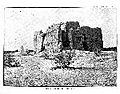
The Hohokam culture's Casa Grande from the northeast around 1890.

