
Hose's broadbill facts for kids
Quick facts for kids Hose's broadbill |
|
|---|---|
 |
|
| Conservation status | |
Scientific classification  |
|
| Kingdom: | Animalia |
| Phylum: | Chordata |
| Class: | Aves |
| Order: | Passeriformes |
| Family: | Calyptomenidae |
| Genus: | Calyptomena |
| Species: |
C. hosii
|
| Binomial name | |
| Calyptomena hosii Sharpe, 1892
|
|
 |
|
| Script error: The function "autoWithCaption" does not exist. | |

Script error: No such module "Check for conflicting parameters".
The Hose's broadbill (Calyptomena hosii) is a special kind of bird that lives only on the island of Borneo. It belongs to a bird family called Calyptomenidae. This bird was first described in 1892 by a British scientist named Richard Bowdler Sharpe. It got its name from another British scientist, Charles Hose, who found the very first example of this species.
Hose's broadbills are about 19–21 cm (7.5–8.3 in) long. Female birds usually weigh around 92 g (3.2 oz), while males are a bit heavier, weighing 102–115 g (3.6–4.1 oz). Male Hose's broadbills are a bright, shiny green. They have cool black spots on their wings and black marks on their heads. Their bellies are blue, and their flight feathers (the long feathers used for flying) are black. They also have a big green tuft of feathers that covers most of their beak!
Female Hose's broadbills look a little different. Their forehead tufts are smaller, and their bellies are a lighter, lime-green color with sky blue instead of the darker blue seen on males. They don't have the black markings on their heads, except for a small black spot right in front of their eye.
These birds live in the mountains of northern, central, and southeastern Borneo. They prefer forests that are high up, usually between 600–1,220 m (1,970–4,000 ft) above sea level. Hose's broadbills eat both plants and insects, which means they are omnivores. They mostly enjoy fruits like figs and berries, but they also munch on insects and leaf buds. You'll often see them alone or in pairs, but sometimes they gather in small groups of 6 to 8 birds, especially when there's a tree full of ripe fruit.
Hose's broadbills lay their eggs between April and October. They build delicate nests that hang from branches. A female usually lays 2 to 4 eggs. Sadly, the number of Hose's broadbills is slowly going down. Because of this, the International Union for Conservation of Nature has listed them as "near-threatened". This means they could become endangered if their forest homes continue to be destroyed.
Contents
Discovering the Hose's Broadbill
The Hose's broadbill was officially named Calyptomena hosii in 1892. The scientist who named it was Richard Bowdler Sharpe. He studied birds that were found on Mount Dulit in Borneo.
The name of the bird's group, Calyptomena, comes from ancient Greek words. Kaluptos means "covered," and mēnē means "moon." The second part of its scientific name, hosii, and its common name, Hose's broadbill, honor Charles Hose. He was the zoologist who first collected a sample of this bird.
Besides Hose's broadbill, people sometimes call this bird the blue-bellied broadbill or the magnificent broadbill.
What Does a Hose's Broadbill Look Like?
Hose's broadbills are 19–21 cm (7.5–8.3 in) long. Males weigh about 102–115 g (3.6–4.1 oz), and females weigh around 92 g (3.2 oz).
Male birds have bright, shiny green feathers on their backs and heads. They have a big tuft of feathers on their forehead that covers most of their beak. Around their eyes, they have a thin, pale green ring. You can also see a black spot in front of their eyes and black patches behind their ears, on the back of their neck, and across their upper back. Their wing feathers have clear round black spots, and their flight feathers are black with green edges. The chest of the male is a deep blue, and its belly and the feathers under its tail are a bright azure blue.
Female birds have smaller forehead tufts. Their green feathers are a bit lighter, with a hint of olive color. Their bellies are lime-green, and the feathers under their tail are sky blue, not the darker azure blue of the males. Females also have lime green eye-rings and no black on their heads, except for the small spot in front of the eye.
Both male and female Hose's broadbills have blackish eyes, dark brownish-black beaks, and dark olive green feet. Young birds look mostly like females. As young males grow, they start to look more like adult males but have fewer black markings on their heads and less blue on their bellies.
You can tell the Hose's broadbill apart from other similar birds by its blue belly. The green broadbill is smaller and has bars on its wings instead of spots. The Whitehead's broadbill is larger and has a black patch on its chest.
The only sound recorded from a Hose's broadbill is a soft, pleasant, dove-like "coo-wooo." They make this sound while bobbing their heads.
Where Hose's Broadbills Live
Hose's broadbills live only on the island of Borneo. They are found in the northern and central parts of the island. You can find them in places like Mount Kinabalu, the Müller Mountains, Kayan Mentarang, and the Dulit Range. They also live in southeastern Borneo. Sometimes, they might move around locally to find trees that are fruiting.
These birds mostly live on hillsides in different types of forests, including dipterocarp forest and lower montane forest. They prefer elevations between 600–1,220 m (1,970–4,000 ft), but they can sometimes be seen as low as 300 m (980 ft) or as high as 1,680 m (5,510 ft).
Life and Habits of the Hose's Broadbill
Hose's broadbills are omnivorous, meaning they eat both plants and animals. Their main food is fruit, especially figs and berries. They have been seen eating soft, yellowish-grey berries and small orange figs. They also eat insects and young leaf buds. They usually look for food in the lower parts of the forest.
These birds are often seen alone or in pairs. However, when there's a tree full of ripe fruit, you might see small groups of 6 to 8 broadbills feeding together.
Reproduction and Nesting
Hose's broadbills have been seen breeding from April to October. They build a delicate hanging nest using dead leaves, rattans, and bamboo. The outside of the nest is covered with green moss and lichen, and it has a long "tail" made of rattan leaves. One nest found was about 25 cm × 15 cm (9.8 in × 5.9 in) in size and hung from a low branch about 1.5 m (4.9 ft) off the ground. A female usually lays 2 to 4 eggs in her nest. We don't know how long it takes for the eggs to hatch or for the young birds to leave the nest.
Protecting the Hose's Broadbill
The International Union for Conservation of Nature has listed Hose's broadbill as "near-threatened". This means their population is decreasing at a moderately fast rate. The biggest reason for this decline is habitat destruction, especially in the lower parts of the forests where they live.
Even though they are found in some protected areas like Gunung Mulu National Park, their numbers drop when deforestation happens. A lot of logging has taken place in the lowland forests of Borneo. However, because these birds prefer to live in mountain forests, they might be safer for a little while. To help protect them, scientists need to study how much their population has decreased and find out exactly what kind of habitats they prefer. Protecting these suitable habitats is very important for the future of the Hose's broadbill.
Images for kids
-
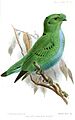
An illustration of a Hose's broadbill.
-
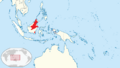
A map showing where the Hose's broadbill lives in Borneo.
