
Hyacinth macaw facts for kids
Quick facts for kids Hyacinth macaw |
|
|---|---|
_head.JPG) |
|
| Eating a nut in the Pantanal, Brazil | |
_in_flight.JPG) |
|
| in flight in the Pantanal | |
| Conservation status | |
Scientific classification  |
|
| Kingdom: | Animalia |
| Phylum: | Chordata |
| Class: | Aves |
| Order: | Psittaciformes |
| Family: | Psittacidae |
| Genus: | Anodorhynchus |
| Species: |
A. hyacinthinus
|
| Binomial name | |
| Anodorhynchus hyacinthinus (Latham, 1790)
|
|
 |
|
| Script error: The function "autoWithCaption" does not exist. | |

Script error: No such module "Check for conflicting parameters".
The hyacinth macaw (Anodorhynchus hyacinthinus) is a truly amazing parrot. It lives in central and eastern South America. This beautiful bird is known for its stunning blue feathers.
It is the longest parrot species in the world. From its head to the tip of its tail, it can be about one meter long! It is also the largest type of macaw and the biggest flying parrot. Sadly, these wonderful birds are in danger. Losing their homes and being caught for the pet trade has hurt their numbers. Because of this, they are listed as a Vulnerable species. This means they need our help to survive in the wild.
Contents
The Amazing Hyacinth Macaw
The hyacinth macaw is a special bird. It belongs to a group of macaws called Anodorhynchus. An English scientist named John Latham first described this macaw in 1790. He gave it the scientific name Psittacus hyacinthinus.
What Does It Look Like?
This macaw is truly a giant among parrots. It can grow to be about 1 meter (3.3 feet) long. It weighs between 1.2 and 1.7 kilograms (2.6 to 3.7 pounds). Each of its wings can be up to 42.5 centimeters (16.7 inches) long.
Its feathers are mostly a bright, deep blue color. The feathers on its neck can sometimes look a little gray. The underside of its wings and tail are black. A bright, sunny yellow ring surrounds its eyes. There is also a patch of vibrant yellow skin just under its beak. This makes its face look very striking!
Where Do They Live?
Hyacinth macaws live in three main areas of South America. You can find them in the Pantanal region of Brazil. They also live in parts of eastern Bolivia and northeastern Paraguay. Another home for them is in the cerrado areas of eastern Brazil. They also live near big rivers like the Tocantins River in the eastern Amazon Basin.
These macaws like places that are somewhat open and have some trees. They usually stay away from thick, wet forests. Instead, they prefer areas like savannah grasslands or dry thorn forests. They also love places with lots of palm trees or swamps. In Bolivia, they are a special symbol of their region. Local people sometimes even feed them corn!
What Do They Eat?
Hyacinth macaws have incredibly strong beaks. They use them to crack open very hard nuts and seeds. Their favorite foods are nuts from certain palm trees. These include the acuri and bocaiuva palms. Their beaks are so powerful they can even crack open coconuts! They can also break open large Brazil nut pods and macadamia nuts.
These birds also have unique tongues. They are dry and smooth, with a bone inside. This helps them get to the fruit inside. Interestingly, acuri nuts are so hard that macaws can only eat them after they have passed through a cow's digestive system! They also enjoy eating other fruits and plant matter. They will travel far to find the ripest foods.
Smart Birds: Using Tools
Hyacinth macaws have been seen using simple tools. Both wild and pet macaws sometimes do this. They might use a chewed leaf or small pieces of wood. They hold these items when they are eating very hard nuts. The tool helps to keep the nut still. This stops it from slipping while they try to open it.
Scientists are not sure if they learn this from other macaws. It might also be something they know how to do naturally. But it shows how clever these birds are!
Life Cycle and Family
Hyacinth macaws build their nests between July and December. They often choose holes in trees or cracks in cliff faces. In the Pantanal, most nests are in Manduvi trees. These trees are very important for the macaws.
A bird called the toco toucan helps spread the seeds of the Manduvi tree. This means more trees for the macaws to nest in. However, toucans also sometimes eat macaw eggs. Other animals like jays, crows, opossums, skunks, and coatis also sometimes eat their eggs.
Finding a good nesting spot can be tough. The holes need to be large enough. Only trees that are about 60 years old or older have these big holes. Macaws will make existing holes bigger. They then fill them partly with wood chips.
A female macaw usually lays one or two eggs. But often, only one baby bird survives. This is because the second egg hatches later. The younger, smaller chick might not get enough food. This is like an "insurance plan" for the parents. They lay an extra egg in case the first one doesn't hatch or survive.
The eggs hatch after about a month. The male macaw takes care of his mate while she sits on the eggs. The baby macaws leave the nest when they are about 110 days old. They stay with their parents until they are about six months old. They are ready to have their own families when they are about seven years old.
Gentle Giants
Hyacinth macaws are the longest parrots in the world. They are also known for being very calm and gentle. People sometimes call them "gentle giants." They are usually not aggressive birds. They seem to enjoy playing with people.
These birds are very intelligent. They can even learn to use words and phrases. They might not be the best talkers among parrots, but they are smart! In captivity, they can live for over 50 years.
Predators
One of the main predators of their eggs is the toco toucan, which unfortunately eats a large number of macaw eggs. Other animals that also prey on hyacinth macaw eggs include jays, crows, opossums, skunks, and coatis.
Sometimes, tiny fly larvae can also be parasites to the young chicks, which means they live on or in the chicks and can cause them harm. These predators are a natural part of the ecosystem, but they do make it harder for baby macaws to survive and grow up.
Protecting These Special Birds
The hyacinth macaw is listed as a 'Vulnerable' species. This means their population has dropped quickly. They face serious dangers in the wild.
Why Are They in Danger?
One big problem is that their homes are disappearing. People are clearing land for cattle ranches and farms. New dams for electricity also change their environment. Farmers sometimes set grass fires. These fires can destroy the trees where macaws nest.
Another major threat is people catching them from the wild. These birds are sometimes taken to be sold as pets. This is very harmful to the wild population. Hyacinth macaws are naturally noisy, curious, and don't scare easily. This makes them easier for people to catch. Also, they rely on only one or two types of palm trees for food. If these trees are destroyed, the macaws are in trouble.
Finding nesting spots is also hard. They need old Manduvi trees with big holes. If these old trees are cut down, it limits where macaws can raise their young.
Laws protect hyacinth macaws in Brazil and Bolivia. But sometimes, people still try to catch them without permission. When birds are taken from their natural homes, they often get sick. Many young birds caught this way do not survive. This leads to more adult birds being caught, which further harms the wild population.
Helping the Hyacinth Macaw
Many people and groups are working hard to protect these birds. The Hyacinth Macaw Project in Brazil is doing important research. They put rings on individual birds to track them. They also build artificial nests to help macaws find places to lay eggs. This project also teaches cattle ranchers about protecting the macaws on their land. Many ranchers now help keep the birds safe.
The Minnesota Zoo, BioBrasil, and the World Wildlife Fund are also involved in conservation efforts. On July 3, 2025, the hyacinth macaw became the official symbolic bird of Mato Grosso do Sul, a state in Brazil. This recognition helps raise awareness and can boost tourism, which supports conservation.
International rules, like those from CITES, ban the trade of wild hyacinth macaws. This helps stop people from taking them from their homes.
A Bright Future?
For the hyacinth macaw to thrive, we need to protect their homes. This means managing the three main groups of macaws separately. We need to make sure their numbers don't fall too low.
If we can successfully manage and replant their food trees, it will help a lot. Building more nest boxes is also important. Ranch owners can help by leaving large trees standing. They can also stop people from catching birds on their land. If everyone works together, the hyacinth macaw can have a much brighter future.
Hyacinth Macaws as Pets
Some people keep hyacinth macaws as pets. However, they are not for everyone. These birds need a lot of space and regular exercise. Their powerful beaks can easily break most bird cages. They need a very strong, custom-built cage.
Hyacinth macaws also need a lot of social interaction. They need to play with humans or other birds to stay healthy. They love to chew things. Because they are so big and strong, they can cause a lot of damage. It's often suggested that they have a whole room to themselves. This room should have lots of safe wooden and leather toys for them to chew.
These birds are also very expensive pets. A young hyacinth macaw can cost around US$10,000. The World Parrot Trust suggests that they should not be kept indoors all the time. They should have access to a large outdoor enclosure for at least part of the year.
While they are generally gentle, they can accidentally pinch hard with their strong beaks during play. It's important to teach them gentle behavior when they are young.
Images for kids
-
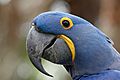
Close-up of head
-
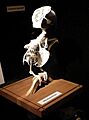
A skeleton exhibited at Dvůr Králové Zoo in Dvůr Králové nad Labem, Czech Republic
-
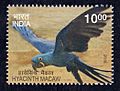
on a postage stamp


See Also
