
Indoplanorbis facts for kids
Quick facts for kids Indoplanorbis |
|
|---|---|
 |
|
| Conservation status | |
| Scientific classification | |
| Kingdom: | |
| Phylum: | |
| Class: | |
| (unranked): | |
| Superfamily: |
Planorboidea
|
| Family: |
Planorbidae
|
| Subfamily: |
Bulininae
|
| Tribe: |
Bulinini
|
| Genus: |
Indoplanorbis
Annandale & Prashad, 1921
|
| Species: |
I. exustus
|
| Binomial name | |
| Indoplanorbis exustus (Deshayes, 1834)
|
|
| Synonyms | |
|
Planorbis exustus Deshayes, 1834 |
|

Indoplanorbis exustus is a type of freshwater snail that breathes air. It's the only known species in its group, called Indoplanorbis. This snail is a kind of mollusk that lives in water and belongs to the Planorbidae family, also known as ram's horn snails because of their shell shape.
You can find Indoplanorbis exustus in many warm parts of the world. It's important to scientists because it can carry tiny parasites called trematodes. These snails are also considered an invasive species in some places, meaning they can spread easily and affect local environments.
Contents
About the Snail's Family Tree
Indoplanorbis exustus is currently the only species officially recognized in the Indoplanorbis group. Even though it's been known for a long time and lives in many places, scientists still think it's just one species. However, some studies suggest there might be more than one species hiding within this group, especially when looking at snails from India compared to those from Southeast Asia.
The snail group most closely related to Indoplanorbis is called Bulinus.
Where Indoplanorbis exustus Lives

This freshwater snail is found in many countries. You can find it in places like Iran, Nepal, India, Sri Lanka, and across Southeast Asia (like Thailand). It also lives in central Asia (Afghanistan), parts of Arabia, and Africa.
The first place this snail was officially found and described was in the marshes along the coast of Malabar in southwestern India.
Indoplanorbis exustus is very common in Southeast Asia and the Indian sub-continent. It has also been found in the Middle East (like Oman) and in African countries such as Nigeria and the Ivory Coast. Scientists believe these snails arrived in Africa and the Lesser Antilles (islands in the Caribbean) in the last 50-100 years, likely carried by people.
This snail is already present in the United States. It's seen as a possible pest and an invasive species there. This means it could harm farming, natural areas, human health, or trade. Because of this, some people think it should be a top priority for national quarantine in the US.
How the Snail Spread Over Time
Scientists have different ideas about how Indoplanorbis spread across the world. One idea is that it came from Africa a very long time ago, possibly riding on the Indian craton (a large piece of land) as it moved north towards Asia. Another idea is that it spread from Africa to India more recently, perhaps through land connections in the Middle East.
Newer research suggests that the snail started to spread and develop new groups around 5 to 10 million years ago. Different groups of these snails then spread across India and Southeast Asia over millions of years.
What the Snail Looks Like

The shell of Indoplanorbis exustus looks similar to other snails like Planorbella duryi and Biomphalaria pfeifferi.
Because this snail is found in so many places, scientists have studied many things about it. For example, they've looked at how it handles calcium and its blood cells (called hemocytes).
Snail's Life and Environment
In a lab, Indoplanorbis exustus can be fed lettuce and spinach. Sometimes, they are also given sheep's liver or rat food, especially when preparing them to lay eggs.
Habitat
You can find these snails in small ponds, pools, and sometimes in rice paddy fields. They can also live in temporary pools that form when fields flood. During dry seasons, they can survive by burying themselves in the mud. Adult snails can handle drying out very well, but young snails cannot. This means they might spread when mud sticks to animals like cattle, or by floating on mats of plants in the water. It's also possible that birds could carry them.
Life Cycle and Reproduction
Indoplanorbis exustus is a hermaphroditic snail, meaning each snail has both male and female reproductive parts. They can even fertilize their own eggs! They lay a lot of eggs, which helps them spread quickly. Within a year of arriving in a new place, they can form large groups, even if other snails are already there.
For the snails to grow up and lay eggs, the water temperature needs to be warmer than 15°C (59°F). At their best temperature of 30°C (86°F), one snail can lay up to 800 eggs! Each group of eggs usually has about 20 eggs, but it can be anywhere from 2 to 43. Being able to fertilize themselves and lay many eggs helps them become an invasive species. An average Indoplanorbis exustus snail lives for about 4 months and lays around 60 egg clusters during that time.
Who Eats the Snail?
Experiments have shown that the snail Pomacea bridgesii (also known as the mystery snail) can eat and destroy the eggs of Indoplanorbis exustus. Because of this, scientists think Pomacea bridgesii could be used to help control the population of Indoplanorbis exustus.
Snail and Parasites
Indoplanorbis is important because it helps spread several types of Schistosoma parasites. These parasites can infect cattle, making them less productive. The snail is also important in human health because it can cause a skin rash called cercarial dermatitis (also known as "swimmer's itch") for people working in rural areas, especially in India.
Indoplanorbis exustus is best known for being the middle host for Schistosoma nasale and S. spindale. It also hosts other parasites like Echinostoma species. A third Schistosoma species, S. indicum, is also spread by I. exustus. While other snails can also carry these parasites, I. exustus is the most important host for them, especially in India. It might even be the only natural host for these three Schistosoma species in the Indian sub-continent.
Indoplanorbis exustus also acts as a middle host for many other parasites, including:
- Artyfechinostomum malayanum
- Hypoderaeum conoideum
- Fasciola gigantica
- Paramphistomum mehrai
- Paramphistomum explanatum
- Gastrodiscus secundus
- Petagifer srivastavi
- Plasmiorchis orientalis
- Pseudodiscus collinsi
- Gastrothylax crumenifer
- Enterohaemotrema paleorticum
- Cotylophoron cotylophorum
- Cotylophoron indica
- Cotylophoron bhaleraoi
- Cotylophoron mathurapurensis
Outbreaks of cercarial dermatitis in humans have been linked to Indoplanorbis exustus in India, Laos, Malaysia, and Thailand. This skin rash happens when tiny parasite larvae (called cercariae) leave infected snails in freshwater like lakes, ponds, and rice fields. When these larvae try to get into a person's skin (mistaking them for their usual animal host), they cause an itchy rash and bumps.
Ways to Control the Snail
Scientists have found that extracts from certain plants can kill Indoplanorbis exustus. For example, a liquid from the common Indian medicinal plant Euphorbia tithymaloides can act as a molluscicide (snail killer).
An extract from Solanum xanthocarpum also has molluscicidal activity against this snail. The sap (latex) from Euphorbia milii can also kill the snails, and its strength depends on the type of plant.
Other plant saps from Cascabela thevetia, Alstonia scholaris, and Euphorbia pulcherrima have also been studied for their ability to kill Indoplanorbis exustus.
Snail as a Pet
Indoplanorbis exustus is sometimes sold as an ornamental pet for freshwater aquariums.
Images for kids
-
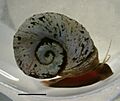
An Indoplanorbis exustus snail.
-
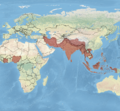
Distribution map of Indoplanorbis exustus.
-
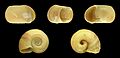
Five views of an Indoplanorbis exustus shell.
