
Lettuce facts for kids
Quick facts for kids Lettuce |
|
|---|---|
 |
|
| A field of iceberg lettuces in California | |
Scientific classification  |
|
| Kingdom: | Plantae |
| Clade: | Tracheophytes |
| Clade: | Angiosperms |
| Clade: | Eudicots |
| Clade: | Asterids |
| Order: | Asterales |
| Family: | Asteraceae |
| Genus: | Lactuca |
| Species: |
L. sativa
|
| Binomial name | |
| Lactuca sativa |
|
| Script error: The function "autoWithCaption" does not exist. | |
| Synonyms | |
|
|
Script error: No such module "Check for conflicting parameters".
Lettuce (Lactuca sativa) is an annual plant that belongs to the Asteraceae family, just like the sunflower. Farmers grow it mainly as a crunchy leaf vegetable. Many people eat the fresh leaves raw in tasty green salads, deli sandwiches, and wraps. Some cooks even grill the heads or simmer them in warm soups. One special kind called celtuce is grown for its thick, edible stem. Today, farmers around the world grow millions of tonnes of this popular green leafy vegetable every single year.
Contents
How Lettuce Grew Through History

Long ago, people first gathered lettuce from its wild ancestor near the rugged Caucasus mountains. At first, humans did not eat the bitter leaves. Instead, they collected each seed to press out valuable vegetable oil for cooking.
The ancient Egyptians began growing the crop around 2680 BC. They painted tall lettuce plants inside stone tombs and sacred temples. Over time, farmers used selective breeding to make the leaves sweeter, softer, and much wider.
Ancient Greeks and Romans also loved eating fresh lettuce. The Roman people gave the plant its Latin name, lactuca. This word comes from lac, meaning milk, because the stem drips a milky white sap called latex when cut. Roman farmers like Columella wrote about several lettuce varieties that resemble types we eat today. In the 1490s, explorer Christopher Columbus brought the first lettuce seeds across the ocean to the Americas.
What the Lettuce Plant Looks Like


A regular lettuce plant grows about 15 to 30 centimeters tall. It anchors itself firmly in the dirt with a strong, deep taproot. Its leaves can be green, dark red, or even spotted with fancy patterns.
The Plant Life Cycle and Flowers
Most lettuce is picked young while its leaves taste tender and sweet. If the weather gets too hot, the plant starts bolting. Bolting means the plant quickly shoots up a tall stalk to bloom. This makes the leafy greens turn very bitter and unpleasant to eat.
When it bolts, the stalk grows up to one meter high with tiny yellow flowers. Each flower head contains tiny florets. These florets produce pollen on their anthers to fertilize the stigma. Afterward, the plant creates small, dry fruits that each hold a single seed. A fluffy parachute called a pappus helps the seed float away on the wind.
Popular Types of Lettuce

Gardeners sort lettuce into several main groups based on how their leaves grow:
- Iceberg lettuce: Forms round, tightly packed balls. It stays crunchy and holds lots of water, making it great for burgers.
- Romaine lettuce: Grows in tall, sturdy heads with crisp ribs. Cooks always pick romaine to make classic Caesar salads.
- Butterhead: Has soft, tender leaves that feel smooth. Popular kinds include Boston and Bibb lettuce.
- Leaf lettuce: Has loose, ruffled leaves that do not form a tight head. This includes colorful red leaf lettuce.
- Celtuce: Grown across Asia for its thick, crunchy stem rather than its leaves.
How Gardeners Grow Lettuce

Lettuce is a hardy vegetable that loves cool, sunny weather. Seeds sprout best in soil with plenty of nitrogen. Farmers often start tiny seedlings in small trays before transplanting them into outdoor garden rows.
Gardeners must watch out for hungry pests. Slimy slugs, caterpillars, aphids, and creeping cutworms love chewing big holes in the leaves. Wild animals like rabbits and groundhogs also sneak into gardens for a leafy snack. Plant diseases like powdery mildew and mosaic virus can also harm young crops.
Healthy Nutrition and Kitchen Safety
Lettuce leaves are packed with healthy nutrients. Crisp greens provide plenty of dietary fiber to help your digestion. Darker leaves, like romaine, offer tons of beta-carotene, which your body turns into vitamin A for healthy eyes. They also contain vitamin K for strong bones, as well as minerals like calcium and iron.
Because people usually eat lettuce raw without cooking it, washing leaves thoroughly with clean water is very important. Fresh leaves can sometimes carry germs like E. coli or Salmonella from farm soil. Washing your greens keeps every salad crisp, delicious, and safe to enjoy!
Images for kids
-

Mature lettuce inflorescence in fruit
-

Lettuce seeds raw and pelleted with clay
-

A selection of lettuce cultivars
-

The lettuce variety celtuce is grown for its stem
-

A butterhead lettuce
-
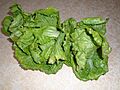
Prajzerica, a lettuce variety from Croatia
-

A lettuce plant surrounded by weeds
-

A lettuce plant that has bolted


See also
 In Spanish: Lechuga para niños
