
Ipswich Uniting Church facts for kids
Quick facts for kids Ipswich Uniting Church |
|
|---|---|
|
|

Church eastern facade, 2020
|
|
| 27°36′53″S 152°45′26″E / 27.6147°S 152.7572°E | |
| Country | Australia |
| Denomination | Uniting (since 1977) |
| Previous denomination | Methodist |
| History | |
| Status | Church |
| Dedicated | June 1858 |
| Architecture | |
| Functional status | Active |
| Architect(s) |
|
| Architectural type | Church |
| Style | Gothic Revival |
| Years built | 1858–1892 |
| Specifications | |
| Materials | Brick; corrugated iron |
| Administration | |
| Parish | Ipswich |
| Presbytery | Bremer Brisbane |
| Synod | Queensland |
The Ipswich Uniting Church is a very old and special church located on Ellenborough Street in Ipswich, Australia. It's considered a "heritage-listed" building, which means it's important to history and protected. This church was first designed and built by Samuel Shenton in 1858.
Over the years, it has been known by several names. These include Ipswich Central Mission, Wesleyan Chapel, and Ellenborough Street Methodist Church. In 1992, it was officially added to the Queensland Heritage Register.
A Look Back: The Church's History

The Ipswich Uniting Church is made of brick. The very first part of it was built in 1858. Back then, it was called the Wesleyan Chapel. The first design might have been by Samuel Shenton, who was the builder and later became an architect.
The church was made bigger in 1863. This extension was designed by Benjamin Backhouse. Later, in 1892, more parts were added. These were designed by Henry Wyman.
Queensland's Oldest Church
This church is very special because it's the oldest church in Queensland that has been used continuously. It's also one of the few churches in the state that existed before Queensland became its own separate colony.
Early Days of Worship
The first Wesleyan church services in Ipswich started in 1848. Reverend William Moore led these services in places like the local Court House. He would travel all the way from Brisbane to Ipswich just to hold the services. In 1849, a timber (wooden) chapel was built on Limestone Street.
How the Church Grew
In 1858, a new brick chapel was built on Ellenborough Street by Samuel Shenton. This is the main part of the church we see today. In 1863, it was extended to the east. This new part included a gallery, which is like a balcony, with seats for 130 people.
Even more additions were made in 1892. North and south "transepts" (parts that stick out from the main building) and a "vestry" (a room for clergy) were added. These were designed by Henry Wyman.

Renovations and Changes
The church has been updated several times over the years. It was renovated in 1923 for its 75th birthday and again in 1948 for its 100th birthday. A side porch was added in 1924. In the 1980s, a new brick and steel fence was built around the church. A big project to preserve the church was done in 1990. The church's pipe organ was put in place in 1905 and fixed up in 1977.
Other Buildings on Site
A two-storey house for the minister, called a parsonage, was built next to the church in 1864. This building was damaged by fire in 1920 and later changed into offices.
The Sunday School Hall, where children learn, was built in 1877 and has been updated many times. Another hall for young men was built in 1921. A second parsonage was built in 1958 and is now used as a care centre.
Helping the Community
The church has always been very important to the Ipswich community. In 1954, it changed its name to Ipswich Central Mission. It started focusing more on helping people. It began many important social programs. These include the Ipswich Blue Nursing Service, which helps people at home. It also started workshops for people with disabilities and the Lifeline crisis help service. The church also helped create centres for older people and supported "street kids."
The church started as a Wesleyan Chapel, then became a Methodist church. In 1977, it became part of the Uniting Church in Australia.
What the Church Looks Like
The church has a simple design. It was extended over time to include an entrance area and side rooms. It also has a gallery above the entrance.
Outside the Church
The church has a steeply sloped roof made of corrugated iron. It has a timber (wooden) vent on the roof ridge. The older parts of the building are made of painted brick with parts that stick out, called buttresses. It also has tall, narrow windows called lancet windows. The newer parts of the church have exposed brickwork. The window sills are made of painted sandstone.
Inside the Church
Inside, the floor is made of hoop pine wood. The walls are painted plaster. The roof is supported by special wooden beams that look like scissors. Steel rods connect these beams.
At the front of the church, there is an upper gallery. This area was built for the choir and the organ. It's made of timber and has a stepped floor. It's supported by cast iron columns and can be reached by a small staircase.
The main area at the back of the church is called the sanctuary. It has a raised pulpit, which is where the minister speaks. There are also organ pipes and a beautiful stained glass window. Many marble plaques are on the side walls, remembering people. The church has many lovely stained and coloured glass windows, most of which are memorials.
The wooden parts inside the church are very detailed. The older parts are made of cedar and pine. Newer parts, like the entrance area, are made of silky oak. The newest parts, like the hymn boards, are made of Queensland maple. The church pews, where people sit, are made of pine and have a traditional design.
The church is on a corner in the city and stands out. It is surrounded by a brick wall and a metal fence. Other buildings on the site are either new or have been changed a lot over time.
Why It's a Heritage Site
The Ipswich Central Mission – Wesleyan Chapel was added to the Queensland Heritage Register on October 21, 1992. This means it meets certain important standards.
- Shows Queensland's History: The church helps us understand how churches developed in Queensland. It shows how people wanted to build strong, lasting buildings for worship.
- Rare and Special: Finished in June 1858, it's the oldest church in Queensland that's still being used. It's also the oldest Uniting Church in Queensland. It's rare because it was built before Queensland became a separate colony.
- Typical Church Features: Its design, structure, furniture, and windows show what a Protestant church building usually looks like.
- Beautiful Design: The church is a great example of a simple Gothic Revival style building. People in the community value its beauty. Its location on a prominent corner makes it a local landmark. It's part of a group of important historic buildings in central Ipswich.
- Strong Community Connection: The church has a strong link with the Ipswich community. This is because of its social welfare programs and important groups it started, like Ipswich Blue Nurses and Ipswich Lifeline.
- Important People: It is connected to the work of important early architects like Benjamin Backhouse and Henry Wyman. It also has a special link to the builder and architect Samuel Shenton.
Images for kids
-
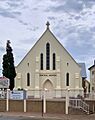
Church eastern facade, 2020
 | Bessie Coleman |
 | Spann Watson |
 | Jill E. Brown |
 | Sherman W. White |
