
Kan Yuet-keung facts for kids
Quick facts for kids
Yuet-keung Kan
|
|
|---|---|
|
簡悅強
|
|
 |
|
| Life member of the Court of University of Hong Kong | |
| In office 1 February 1972 – 2012 |
|
| Life member of the Council of Chinese University of Hong Kong | |
| In office 1983–2012 Serving with Sir Run Run Shaw, Sir Quo-wei Lee and Dr. Hon-chiu Lee
|
|
| Chairman of the Council of Chinese University of Hong Kong | |
| In office 1971–1982 |
|
| Preceded by | Sir Cho-yiu Kwan |
| Succeeded by | Sir Quo-wei Lee |
| Personal details | |
| Born | 26 July 1913 Hong Kong |
| Died | 14 September 2012 (aged 99) Hong Kong |
| Spouses |
Ida, Lady Kan
(m. 1940; died 1999) |
| Education | Diocesan Boys' School |
| Alma mater | University of Hong Kong (BA, 1934) London School of Economics (LLB, 1937) |
| Occupation | politician, banker, solicitor |
| Kan Yuet-keung | |||||||||||||
|---|---|---|---|---|---|---|---|---|---|---|---|---|---|
| Traditional Chinese | 簡悅強 | ||||||||||||
| Simplified Chinese | 简悦强 | ||||||||||||
|
|||||||||||||
Sir Yuet-keung Kan (born 26 July 1913 – died 14 September 2012) was an important person in Hong Kong. He was a successful banker, a lawyer, and a politician. He held top positions in the government's Legislative Council and Executive Council during the 1960s and 1970s. He also led the Bank of East Asia for 20 years.
Contents
Sir Yuet-keung Kan's Life Story
Growing Up and Education
Yuet-keung Kan was born in Hong Kong on 26 July 1913. His family was wealthy and came from Shunde, Guangdong, China. He had many brothers and sisters, thirteen in total. His father, Tong-po Kan, helped start the Bank of East Asia. Yuet-keung's youngest brother, Professor Yuet-Wai Kan, became a famous American doctor. He even won a big science award called the Shaw Prize in 2004.
Yuet-keung went to Diocesan Boys' School when he was young. After school, he wanted to be a doctor. But his family did not agree with this idea. So, he went to the University of Hong Kong instead. He lived in a place called Morrison Hall. He finished his studies in 1934 and earned a degree in Arts. He remembered the great team spirit of the students there.
Later, he moved to the United Kingdom to study law. He attended the London School of Economics. After graduating, he worked for a short time at a law firm in England. He came back to Hong Kong in 1938 and started working as a lawyer.
His Career in Business
Sir Yuet-keung Kan quickly became successful in law, business, and banking in Hong Kong.
Law and Business Roles
He was a senior partner at a well-known local law firm called Lo & Lo. He also led the Law Society of Hong Kong for a time. This group helps manage lawyers in Hong Kong. He was also a director for big companies like Hong Kong Land and Harbour Centre Development Limited.
Leading the Bank of East Asia
Following in his father's footsteps, Sir Yuet-keung took over the family banking business. He was the chairman of the Bank of East Asia from 1963 to 1983. This was a very important role in Hong Kong's financial world.
Promoting Hong Kong Trade
From 1970 to 1975, he was the chairman of the Hong Kong Trade Development Council. This council helps Hong Kong businesses trade with other countries. During his time, the council grew a lot. They opened new offices in cities like Frankfurt, Vienna, Tokyo, and Amsterdam. In 1973, the council helped Hong Kong companies join the New York's International Toy Fair for the first time.
He left the council in 1975 but came back in 1979. In his second time as chairman, he traveled to many countries. He worked hard to show the benefits of trading with Hong Kong. The council also built stronger ties with Japan. They opened an office in Osaka in 1979. In 1980, he led a business trip to Canton in China. He finally retired from the council in 1983.
Public Service in Hong Kong
Sir Yuet-keung Kan also dedicated much of his life to public service. He helped the government and people of Hong Kong in many ways.
Early Public Roles
In 1957, he became a council member of the Urban Council. This council helped manage city services. He also served on the government's Public Service Commission from 1959 to 1961.
He was recognized for his service and received an award called Officer of the Order of the British Empire (OBE) in 1959. In 1961, he left the Urban Council. He then became a member of the Legislative Council. He also led the government's Transport Advisory Committee.
Star Ferry Fare Increase and Public Reaction

In 1966, while he was leading the Transport Advisory Committee, the Star Ferry company asked to raise its first-class ticket price. The Star Ferry is a famous boat service that crosses Victoria Harbour. The committee approved the small price increase. This change mainly affected wealthier people, as the third-class fare stayed the same.
However, many people were upset when the fare increase was announced. The Star Ferry was a main way to cross the harbor back then. The chairman of Star Ferry made things worse with a public comment. This anger contributed to public unrest in Kowloon later that year.
Dealing with Challenges
In 1966, Sir Yuet-keung was also appointed to the Executive Council. This was a time when Hong Kong and mainland China faced political challenges. In 1967, these challenges led to big protests in Hong Kong, known as the Leftist Riots. These protests started from a worker dispute.
During these difficult times, Sir Yuet-keung believed strong action was needed to restore order. He spoke in the Legislative Council, saying that those who caused serious harm should face justice. For his efforts, he received another award, Commander of the Order of the British Empire (CBE), in 1967.
After the protests, he was promoted to a senior position in the Legislative Council in 1968. He then took on many other public roles. These included leading or being a member of groups like the School Medical Service Board and the Social Welfare Advisory Committee.
Later Public Service and Retirement
In 1972, Sir Yuet-keung was given the title of Sir. He traveled to Buckingham Palace in July to receive this honor. He left the Legislative Council that year but continued to serve on the Executive Council. In 1974, he became the senior unofficial member of the Executive Council.
Around this time, the price of rice in Hong Kong went up a lot, causing general price increases. To help with this, the government made Sir Yuet-keung the first chairman of the Consumer Council. This council helps protect the rights of shoppers.
In 1978, there was a strike by government workers. Sir Yuet-keung helped talk with the workers and successfully solved the problem. When Queen Elizabeth II visited Hong Kong for the first time in 1977, Sir Yuet-keung gave the welcome speech to her at the City Hall.
In 1979, he went on a secret trip to Beijing with the governor, Sir Murray MacLehose. They met with Deng Xiaoping, a very important leader in China. During this visit, Sir Yuet-keung learned that China wanted Hong Kong back by 1997. He felt worried about Hong Kong's future. After this trip, he received the highest honor, Knight Grand Cross of the Order of the British Empire (GBE). He retired from the Executive Council in 1980, stepping away from politics.
Later Years and Legacy
Even after retiring from politics, Sir Yuet-keung remained involved with education. He became a life member of the Court of the University of Hong Kong in 1972. In 1983, he also became a life member of the Council of the Chinese University of Hong Kong. He had been the chairman of the Council of the Chinese University from 1973 to 1982. From 1983 to 1996, he was the Pro-Chancellor of the Chinese University, a very respected position.
In his retirement, Sir Yuet-keung lived a quiet life in Hong Kong. He passed away on 14 September 2012, at the age of 99. His funeral was held privately. He is buried in the Hong Kong Cemetery.
Sir Yuet-keung Kan's Family
Sir Yuet-keung Kan married his wife, Ida, in 1940. They had two sons and one daughter.
Honors and Awards
Sir Yuet-keung Kan received many honors for his service:
He also received special degrees from universities:
- Honorary Doctorates of Law from the Chinese University of Hong Kong (1968) and the University of Hong Kong (1973).
- Honorary Fellowship from the London School of Economics (1980).
Images for kids
-
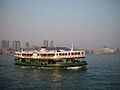
A cross-harbour Star Ferry
