
Kronosaurus facts for kids
Quick facts for kids Kronosaurus |
|
|---|---|
 |
|
| QM F18827, the skull of one of the proposed neotype specimens of K. queenslandicus | |
Scientific classification  |
|
| Unrecognized taxon (fix): | Kronosaurus |
| Type species | |
| †Kronosaurus queenslandicus Longman, 1924
|
|
| Synonyms | |
|
|
Kronosaurus (pronounced KRON-oh-SOR-us) was a giant, short-necked pliosaur. Pliosaurs were a type of marine reptile with a large head and a short neck. This amazing creature lived in the seas of what is now Australia during the Early Cretaceous period, about 125 to 99.6 million years ago.
Its name, Kronosaurus, means "lizard of Kronos". Kronos was a powerful Titan from Greek mythology. This name was chosen because of the animal's huge size and fierce nature. The full scientific name, Kronosaurus queenslandicus, also honors Queensland, the Australian state where its first fossil was found.
The first piece of Kronosaurus was discovered in 1899. It was part of its lower jaw. In 1924, scientist Albert Heber Longman officially described it. Later, in the 1930s, a big expedition from Harvard University found more fossils in Australia. One of these was a famous skeleton, but it was heavily rebuilt with plaster.
Today, scientists are still studying Kronosaurus. Because the very first fossil was only a small piece, it's hard to be sure which other fossils belong to the same species. Scientists have suggested two other skeletons could be "neotypes" (new main examples) to help understand this incredible ancient predator better.
Contents
Discovering Kronosaurus

The story of Kronosaurus began in 1899. A partial fossil of a sea reptile was sent to the Queensland Museum in Brisbane, Australia. Charles De Vis, the museum's director, first thought it was from an ichthyosaur, another type of marine reptile. However, its unique teeth made him rethink.
In 1924, Albert Heber Longman, De Vis's successor, officially described this fossil. He realized it belonged to a huge pliosaur. Longman named it Kronosaurus queenslandicus. He chose the name Kronosaurus because of its massive size and fierce look, like the Greek Titan Kronos. The queenslandicus part honors Queensland, Australia, where the fossil was found.
More fossils were found near Hughenden, Queensland, in 1929. These helped scientists learn more about the animal's limbs. In 1932, Longman even published one of the first drawings of Kronosaurus.
The Harvard Expedition and the "Plasterosaurus"
In 1931, the Museum of Comparative Zoology at Harvard University sent a team to Australia. They wanted to collect fossils of both living and extinct animals. William E. Schevill led the paleontology part of this expedition.
One of the most famous finds was a large skeleton, cataloged as MCZ 1285. A rancher named Ralph William Haslam Thomas had known about "something strange" in his horse enclosure for years. These "strange things" turned out to be Kronosaurus vertebrae. Schevill and his team worked hard to dig out the massive fossil. It was so big that it was shipped to the United States in 86 crates!

Once at Harvard, preparing the fossil took many years. In 1939, the skull was put on display. The rest of the skeleton was kept in the basement for over 15 years. A wealthy industrialist, Godfrey Lowell Cabot, heard about it. He donated money to help finish the restoration.
The Harvard skeleton was finally displayed in 1958. However, over time, scientists realized there were problems with its reconstruction. Many bones were missing, so a lot of plaster was added. This made it hard to study the real fossils. Some even jokingly called it "Plasterosaurus." Scientists also believe it was rebuilt with too many vertebrae and incorrect skull proportions. Today, researchers hope to use CT scans to see the real bones hidden under the plaster.
What is a True Kronosaurus?
The very first Kronosaurus fossil (QM F1609) was just a small piece of jaw. Because it didn't have many unique features, scientists have debated if other fossils truly belong to the same genus. In 1962, Samuel Paul Welles even suggested that Kronosaurus might not be a valid genus on its own.
Since then, many more large pliosaur fossils have been found in Australia. In 2009, paleontologist Colin McHenry studied these new finds. He suggested two partial skeletons, QM F10113 and QM F18827, as possible "neotypes." These would serve as new main examples to help define the Kronosaurus genus more clearly.
In 2022, some scientists suggested that most fossils previously called Kronosaurus might belong to a new genus, Eiectus. They thought the original Kronosaurus fossil was too incomplete to be sure. However, other scientists, like Valentin Fischer and Stephen F. Poropat, disagreed in 2023. They argued that all these fossils should still be called Kronosaurus for now. They also supported QM F18827 as the best candidate for a neotype. This shows that scientists are still working to understand the exact family tree of these ancient marine giants.
Other Species Once Called Kronosaurus

For a while, scientists thought there might be other species of Kronosaurus. For example, the Harvard skeleton was once thought to be a different species because it was found in an older rock layer. However, its skull was heavily restored with plaster, making it hard to tell for sure. Most scientists now believe it belongs to K. queenslandicus.
Another famous fossil, found in Colombia in 1977, was also called Kronosaurus boyacensis. This nearly complete skeleton was nicknamed "El Fósil." But in 2022, after careful study, scientists realized it was different enough to be its own genus. They renamed it Monquirasaurus. This shows how new discoveries and better analysis can change our understanding of ancient life.
What Kronosaurus Looked Like
Kronosaurus was a type of plesiosaur called a "pliosauromorph." This means it had a very large head and a short neck. Like all plesiosaurs, it had a short tail and two pairs of powerful, paddle-like flippers.
How Big Was Kronosaurus?

Kronosaurus was one of the biggest pliosaurs ever found! Early estimates, based on the Harvard skeleton, suggested it could be around 13 meters (43 feet) long. That's longer than a school bus! However, we now know that the Harvard skeleton was rebuilt with too many bones.
More recent studies, from the early 2000s, suggest a more accurate size. The largest Kronosaurus likely measured between 9 to over 10 meters (30 to 33 feet) long. This would make it weigh about 10 to 12 tons. Even at this size, it was a truly massive marine reptile. For example, the proposed neotype specimen QM F18827 was about 8.9 meters (29 feet) long.
Its Powerful Skull and Teeth
.jpg)
The skull of Kronosaurus was enormous. The largest skulls found are even bigger than those of the largest theropod dinosaurs, like Tyrannosaurus! Its head could be up to 2.85 meters (9.3 feet) long.
Kronosaurus had a long, narrow snout, like a crocodile. The front part of its lower jaw was also long and spoon-shaped. It had up to six pairs of teeth in this front section. Its teeth were large and cone-shaped, perfect for grabbing big prey. The teeth at the front of its mouth were even larger than those further back. This type of varied teeth is called heterodont dentition.
Body and Flippers
While much of the Harvard skeleton is plaster, other fossils give us clues about the rest of its body. Kronosaurus had at least 35 vertebrae before its tail. Its ribs were strong and robust.
Its four limbs were modified into powerful flippers. The back flippers were larger and stronger than the front ones. For the biggest Kronosaurus, these flippers could create a "wingspan" of over 5 meters (16 feet) when swimming. This helped it move quickly through the water.
Kronosaurus in the Family Tree
When Kronosaurus was first described, scientists quickly realized it belonged to the Pliosauridae family. These were large, meat-eating marine reptiles.
Over time, scientists have refined its place in the family tree. Today, Kronosaurus is usually placed in a group called Brachaucheninae. This group includes many pliosaurs that lived during the Cretaceous period. These pliosaurs often had long snouts and teeth adapted for different kinds of prey. Kronosaurus is special because its teeth were shaped differently, showing it was a hunter of very large animals.
How Kronosaurus Lived
Plesiosaurs, including Kronosaurus, were well-suited for life in the ocean. They likely had a fast metabolism, similar to birds. This means they could keep their bodies warm, even in cold waters. This was important because the ancient seas where Kronosaurus lived could be quite chilly.
What Did Kronosaurus Eat?

With its huge size and powerful jaws, Kronosaurus was definitely the apex predator (top hunter) of its time in the Eromanga Sea. Scientists have found direct evidence of what it ate!
One amazing fossil, QM F10113, contained the remains of a sea turtle. This suggests that Kronosaurus hunted and ate sea turtles. The turtle was found in a position that suggests the Kronosaurus might have choked while trying to swallow its prey.
Kronosaurus also preyed on other large marine reptiles. Scientists found bite marks on the skull of an elasmosaurid (a long-necked plesiosaur) called Eromangasaurus. These bite marks matched the teeth of Kronosaurus. Since elasmosaurids had long necks, it seems Kronosaurus often attacked this vulnerable part of their bodies.
Did They Fight Each Other?
Scientists have found bite marks on the skull of a smaller, younger Kronosaurus specimen. These marks might have been made by an adult Kronosaurus. This could mean that adult Kronosaurus sometimes fought with younger one. However, it's also possible the bites happened after the younger animal had already died.
A Super Strong Bite
Kronosaurus had an incredibly powerful bite. Scientists have used special techniques to estimate its bite force. They found that Kronosaurus could bite with a force of about 15,000 to 27,000 newtons. To give you an idea, that's stronger than any living animal today! It was almost as strong as the bite of a Tyrannosaurus! This immense power helped it crush the bones of its large prey.
The World of Kronosaurus
The Ancient Eromanga Sea

All the Kronosaurus fossils have been found in an area of Australia called the Great Artesian Basin. Millions of years ago, during the Early Cretaceous, this area was covered by a vast inland sea called the Eromanga Sea. This sea was quite shallow and muddy.
The temperatures in the Eromanga Sea were often very cold, sometimes almost freezing! In some areas, seasonal ice might have even formed. However, during the later part of the Cretaceous, the sea became a bit warmer.
Other Animals in the Sea
The Eromanga Sea was full of life! Many invertebrates lived there, like ammonites (shellfish similar to modern nautiluses), belemnites (ancient squid-like creatures), and bivalves (like clams).
There were also many types of fish. Some were ray-finned fish like Cooyoo, while others were sharks like Cretoxyrhina. These fish came in all sizes and filled different roles in the ecosystem, from eating small invertebrates to being large predators themselves.

Marine reptiles were very diverse in this sea. There were sea turtles like Notochelone. Ichthyosaurs, like Platypterygius australis, also swam in these waters. Many other types of plesiosaurs lived alongside Kronosaurus, including long-necked elasmosaurids like Eromangasaurus.
Even some dinosaurs ended up in the Eromanga Sea! Fossils of land dinosaurs like the sauropod Austrosaurus and the armored Minmi have been found, likely from animals that drowned and were carried out to sea. Many pterosaurs (flying reptiles) also soared above the sea, perhaps hunting fish like modern seabirds.
Who Competed with Kronosaurus?
Even though Kronosaurus was a top predator, it sometimes faced attacks from other animals. Scientists found bite marks on a Kronosaurus jawbone that were made by large lamniform sharks, similar to Cretoxyrhina. These injuries healed, showing that the Kronosaurus survived the attack. This tells us that even the biggest predators had to fight for survival in the ancient Eromanga Sea.
Images for kids
-
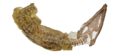
Skeleton of Brachauchenius, a close relative of Kronosaurus in the Brachaucheninae subfamily.
-
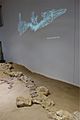
An assigned specimen of Kronosaurus displayed in the Kronosaurus Korner museum in Queensland, Australia.
.png)

See also
 In Spanish: Kronosaurus para niños
