
Landsborough's Blazed Tree (Camp 67) facts for kids
Quick facts for kids Landsborough's Blazed Tree (Camp 67) |
|
|---|---|
.jpg)
Landsborough's Blazed Tree (Camp 67), 2009
|
|
| Location | Mitchell Highway, Charleville, Shire of Murweh, Queensland, Australia |
| Design period | 1840s - 1860s (mid-19th century) |
| Architect | William Landsborough |
| Official name: Landsborough's Blazed Tree, Camp 67 | |
| Type | state heritage (landscape) |
| Designated | 18 June 2009 |
| Reference no. | 602716 |
| Significant period | 1860s |
| Significant components | tree |
| Lua error in Module:Location_map at line 420: attempt to index field 'wikibase' (a nil value). | |
Landsborough's Blazed Tree (Camp 67) is a special tree near Charleville, Australia. It was marked by the famous explorer William Landsborough in 1862. This tree is important because it shows where his team camped during their amazing journey across Australia. It is now protected as a heritage site.
Contents
Exploring Australia: The Search for Burke and Wills
This special tree at Camp 67 was marked during William Landsborough's big trip in 1862. He was exploring south from the Gulf of Carpentaria. His main goal was to find two other explorers, Robert O'Hara Burke and William John Wills. They had gone missing while trying to cross Australia.
The Missing Explorers
Burke and Wills started their journey from Melbourne in August 1860. They wanted to be the first to cross Australia from south to north. But by June 1861, they were reported missing.
Because of this, four official search teams were sent out. These teams came from different cities in Australia. William Landsborough led one of these important search parties. His team was set up in Brisbane.
Even though other teams found out what happened to Burke and Wills later, Landsborough's group had already left. News traveled slowly back then!
Who Was William Landsborough?
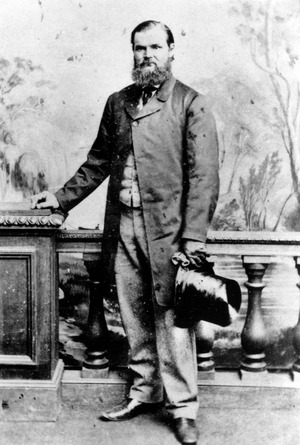
William Landsborough was a very experienced explorer. He was born in Scotland but became a skilled bushman in Australia. He even owned part of a large cattle station called Bowen Downs.
Before 1861, Landsborough had already explored many parts of Queensland. He found and named places like Mount Nebo and the Thomson River. He was known for finding new land for farming and raising animals. Because of his skills, he was chosen to lead the search for Burke and Wills from Brisbane.
The Journey Begins
Landsborough's expedition started on August 26, 1861. They sailed on a ship called the Firefly towards the Gulf of Carpentaria. Sadly, their ship was wrecked in the Gulf. But luckily, another ship, the Victoria, rescued them a few days later.
They set up a base camp on the Albert River. From there, Landsborough explored the area. He marked many trees with a special arrow symbol and the letter 'L'. This helped him find his way back.
Searching South-West
Landsborough's instructions were to search for Burke and Wills to the south-west of the Albert River. He explored for about two months, discovering rivers like the Gregory River. He reached a dry, desert-like area and realized it was too dangerous to continue. He had found no sign of Burke and Wills.
He returned to the Albert River base camp in January 1862. During this trip, he named important places like the Barkly Tableland. He also reported that the land was good for raising sheep.
Heading South Across the Continent
When Landsborough returned to the Albert River, he learned that another search party had already left. Even though his supplies were low, Landsborough decided to keep going south overland. He hoped to find new farms along the way to get more food.
His team included George Bourne, a sailor named W. Gleeson, and three Aboriginal guides: Jemmy, Jacky, and Fisherman. They had 14 pack horses and 6 riding horses. On February 10, 1862, they began their long journey south.
They followed rivers and traveled about 30 kilometers (20 miles) each day. Most of the land was well-watered and had plenty of grass, so their horses stayed healthy.
Marking the Way
It was Fisherman's job to mark trees at each campsite. Landsborough knew how important this was. He said that marks should be on strong, healthy trees in clear spots. This helped future travelers and explorers.
As they traveled, they looked for any signs of Burke and Wills. They named hills and followed rivers like the Flinders and Thomson. By April 1862, they were running low on food. Landsborough decided to head east towards more known areas.
He relied a lot on his Aboriginal guides. They often found water or the best routes. This knowledge was very important for their survival.
Challenges on the Journey
In late April 1862, Landsborough's team faced their first attack from local Aboriginal people. Luckily, Jemmy, the Native Police trooper, warned them, and they scared off the attackers.
By May 1, they found old wagon tracks, which meant they were getting closer to settled areas. On May 9, they reached the upper part of the Warrego River. They set up Camp 67 there. The team was very hungry.
The next day, Landsborough decided to leave the Warrego River to find a more settled area. But without local Aboriginal guides, they struggled. Their horses went without water for 72 hours! They had to turn back to the Warrego River. Jemmy also got badly burned during this time.
The End of the Search
On May 21, 1862, Landsborough's party finally reached a farm. There, they learned the sad news: Burke and Wills had died. Landsborough and his team were surprised, as they had found plenty of water on most of their journey.
From the farm, they got more supplies and continued south. They reached Melbourne in October 1862. Landsborough was celebrated as the first explorer to cross Australia from north to south. A town in Victoria was even named after him!
Landsborough's journey showed that there was valuable land in the Gulf country. This led to many people wanting to settle there. His success was largely because he listened to the local Aboriginal people. They helped him find water and the best paths. When he didn't have their help, his team almost didn't make it.
William Landsborough is still remembered for his important work. Many places in Queensland are named after him, including the Landsborough Highway.
What Does the Blazed Tree Look Like?
_-_blaze.jpg)
The blazed tree at Camp 67 is a Coolibah tree. It is located on a small creek bank about 10 kilometers (6 miles) south of Charleville.
The tree is very old and large. Its trunk is about 3.7 meters (12 feet) around. Its branches spread out about 13.5 meters (44 feet) from the trunk.
The Special Mark
The blaze, or mark, is on the southern side of the tree. It is now very close to the ground. This is because dirt has built up over almost 150 years of floods.
The mark says:
- +Q EXPN.
- L. C. 67 MAY 10 1862
The letters were carved deeply into the tree. They have been painted to make them easier to see.
It looks like the blaze was made on an old mark already on the tree. This old mark was likely made by Aboriginal people. Landsborough's team made it bigger to fit their message. There is also another mark on the opposite side of the tree. This was probably made by Aboriginal people removing bark.
Why is This Tree Important?
Landsborough's Blazed Tree, Camp 67, is listed on the Queensland Heritage Register. This means it is a very important part of Queensland's history.
A Piece of History
The tree was marked on May 10, 1862. It is a rare reminder of the first official journey across Australia from north to south. Landsborough's trip showed a good way to move animals overland to north-western Queensland.
Many of the trees he marked are gone now. They have been destroyed by floods, fires, or just time. So, the few blazed trees that are left, like this one, are very special. They show us where a major event in Queensland's history happened. This event led to many people moving to western Queensland in the 1860s.
A Rare Find
The blaze at Camp 67 is still very clear. It is rare to find such clear evidence of this amazing journey. It reminds us of Landsborough and his team's incredible achievement. They opened up much of western Queensland for settlement.
Connected to a Famous Explorer
This tree has a special connection to William Landsborough (1825–1886). It shows his important work in exploring western and north-western Queensland in 1861–1862.
