
List of New York State Historic Markers in Dutchess County, New York facts for kids
New York State Historic Markers are special signs that tell us about important places and events in history. They help us learn about the past right where it happened! This article is a list of these cool markers found in Dutchess County, New York.
Dutchess County is a really old place with lots of history. It was created way back in 1683 and was named after the Duchess of York. Many of these markers tell stories about the American Revolution, famous people, and how towns and villages grew over time. Let's explore some of these interesting spots!
Contents
- Exploring Amenia's Past
- Beacon: A City with a View
- Historical Sites in Beekman and Clinton
- Dover and East Fishkill's Revolutionary Stories
- Fishkill's Role in the Revolution
- Hyde Park's Famous Residents
- La Grange and Milan's Heritage
- North East's Burial Grounds and Borders
- Pawling's Military and Community Life
- Pine Plains: Mills, Taverns, and Schools
- Poughkeepsie: A Capital City's Legacy
- Red Hook and Rhinebeck: Revolutionary Connections
- Wappinger, Washington, and Union Vale's History
- Images for kids
- See also
Exploring Amenia's Past

The town of Amenia, New York has many historic markers. It was named by Dr. Thomas Young, who thought the area was "pleasant to the eye." He even helped name Vermont!
Early Settlers and Important Places
- Richard Sackett was the first person to settle in Amenia around 1711. His farm was here, and he's buried on a nearby hill.
- Uldrick Winegar and his son, Captain Garrett Winegar, settled here in 1724. They came from a group of German settlers called Palatines.
- The Amenia Seminary was a school built in 1835. It was run by the Methodist Church and was known for its great teachers and students.
- The Red Meeting House, also called "Carmel in Nine Partners," was the first church in Amenia. A famous preacher named George Whitefield visited here.
- Troutbeck was the home of Myron B. Benton, a poet and naturalist. He was friends with famous writers like John Burroughs, Ralph Waldo Emerson, and Henry David Thoreau.
Beacon: A City with a View

The City of Beacon was formed on May 15, 1913, when two villages, Mattewan and Fishkill Landing, joined together.
Fishkill Landing and Mattewan
- Fishkill Landing was one of the oldest places along the Hudson River where boats could dock. During the Revolutionary War, supplies for soldiers were brought across the river here. In 1869, it had about 1,100 people, churches, a newspaper, machine shops, and a steamboat landing.
- Mattewan was another important village. In 1860, it had about 1,476 people and was known for its factories, including machine works, clothing, and rubber shops. It used to have large cotton mills.
Mount Beacon: A Revolutionary Lookout
- Mount Beacon is a tall mountain, 1,640 feet above the Hudson River. During the Revolutionary War, it was part of a system of signal fires. Generals George Washington and George Clinton planned these beacons to warn people about British movements in the Highlands.
Historical Sites in Beekman and Clinton
- The Beekman Furnace was a large iron furnace built in 1873 by the Clove Spring Iron Works. It was 48 feet tall!
- The Dewitt House, built in 1773 by John Dewitt, is in Clinton. John Dewitt was a captain in the Revolutionary War and held many important jobs, including sheriff of Dutchess County.
Dover and East Fishkill's Revolutionary Stories

These towns hold tales of brave actions and important meetings during the American Revolution.
Dover's Natural Wonders and Taverns
- The Dover Stone Church is a cool cavern with a waterfall. It was a hiding place for Sassacus, a chief of the Pequot tribe, who was trying to escape after a battle.
- The Morehouse Tavern was a popular inn on the road from Hartford, Connecticut, to Fishkill, New York. Famous leaders like George Washington, Rochambeau, and De Chastellux stayed here.
East Fishkill's Heroes and Settlements
- Another Morehouse Tavern (also known as the Van Wyck Homestead) was built in 1740 by Judge Theodorus Van Wyck. From 1776 to 1777, John Jay used this house to hold provincial court meetings.
- Sibyl Ludington is a legendary figure who, at just 16 years old, supposedly rode horseback on the night of April 26, 1777. She rode to gather her father's regiment to fight the British at Danbury, Connecticut. However, some historians question if this story is completely true.
- Stormville Village was settled around 1730 by the Genet, George, and Isaac Storm families, after whom the village was named. Before 1860, it had about 20 houses.
- Markers also show the Town and County Line for East Fishkill, which was formed from Fishkill in 1849.
Fishkill's Role in the Revolution

Fishkill was a very important place during the American Revolution.
Military and Political Hub
- A Battery (a place with cannons) was located on a hill near Fishkill to defend the "gorge of the mountains."
- Colonel John Brinckerhoff built his house in 1738. George Washington used it as his headquarters when the army was in Fishkill.
- Enoch Crosby was an American spy during the Revolution. He pretended to join the British army and was "captured" and "tried" here, then allowed to escape to continue his spying.
- The Home of Hendrick Kip, built in 1753, was used as headquarters by Baron Von Steuben around 1777. George Washington and Count Pulaski also visited this house.
- The Site of Fishkill Tea Party marks where, on August 26, 1776, about 100 women made a storekeeper sell them tea at a fair price.
- Star Mills was a mill built by Abram Brinckerhoff. It burned down in 1777 but was rebuilt by order of General Washington to help feed his soldiers.
- The Verplanck House, built in 1740, was another headquarters for Baron Steuben. The Society of the Cincinnati, a group of Revolutionary War officers, was formed here in 1783.
- The Warton House was made famous by James Fenimore Cooper's novel "The Spy." It was General Putnam's headquarters during the Revolution.
- Washington's Sword was either made or repaired near Glenham by John Bailey. This sword is now in the Smithsonian Museum in Washington, D.C.
- The Dutch Church in Fishkill was built in 1725. It was used by the New York Provincial Congress in 1776 and also served as a prison during the Revolution.
- Trinity Church was organized in 1756 by Reverend Samuel Seabury. The Provincial Congress met here in September 1776, and it was also used as a hospital during the war.
Hyde Park's Famous Residents
Hyde Park is known for its connections to important American figures.
- The James K. Paulding House was the home of James K. Paulding from 1841 to 1860. Paulding was a famous author who worked with Washington Irving. He was also the Secretary of the Navy under President Van Buren.
- St. James Church was built in 1844. It was the church attended by Franklin D. Roosevelt, the 32nd President of the United States, and his family.
La Grange and Milan's Heritage

These towns have markers that tell us about early communities and important families.
Oswego and Milan's Roots
- Oswego was the old name for a community one mile east of Moore's Mills. It was an important center in the 18th century, with a meeting house for the Society of Friends (Quakers).
- The Indian Burial Ground in Milan is where Chief Crow and other Mohican Shacomecos, who followed the Moravian faith, were buried. The last burial here was around 1850.
- The Colonial Inn was built around 1773 in Jackson Corners. It served as a stagecoach inn, doctor's office, hotel, store, and post office.
- The Fulton Homestead was first owned by John Fulton in 1795 and stayed in the Fulton family until 1933.
- The Nobletown Road was an important road that ran from Livingston to Barrington, New Hampshire, and was in use before 1798.
North East's Burial Grounds and Borders

North East has several markers related to old burial grounds and its location near state lines.
Cemeteries and Community History
- The Bryan Burying Ground has its oldest stone from 1825.
- The Coleman's Station Burying Ground has its oldest stone from 1749.
- The Irondale Cemetery in Millerton has its oldest stone from 1818.
- The North East Center Burying Ground has its oldest stone from 1801.
- The Spencer's Corners Burying Ground belonged to the Baptist Church. The land for the church and graveyard was given by Reverend Simon Dakin in 1776. Its oldest stone is from 1701.
- Spencer's Corners was also the site of the first Baptist Covenant Meeting in North East.
- Markers also show the Town, County, & State Line where North East Township in Dutchess County, New York, meets Salisbury Township in Litchfield County, Connecticut.
Pawling's Military and Community Life

Pawling has markers about military figures and local history.
Notable Figures and Events
- John L. Worden was the commander of the USS Monitor, a famous ship that fought the Confederate ship Merrimac in 1862. He is buried here.
- The Kane House was occupied by General George Washington from September to November 1778, after the Battle Of Monmouth in New Jersey. He was planning an attack on New York City from here.
- The Methodist Church in Pawling had its first church built in 1809. The current church was built in 1864.
- Memorial Trees were dedicated on May 4, 1945, to honor the men from Pawling who died serving their country in World War II.
Pine Plains: Mills, Taverns, and Schools
Pine Plains has markers that tell about its early industries, social spots, and educational institutions.
Early Businesses and Gathering Places
- The West Pine Plains Christian Church was dedicated in 1859.
- Hubbell Spring was named for Mr. Hubbell, who built a cabin nearby around 1760. People have been getting water from this spring ever since.
- Mount Ross was named for Captain Thomas Ross, who was called "Baron Ross" and died in 1762.
- The Old Turnpike was part of the Rhinebeck-Salisbury Turnpike, created by a law passed in 1802.
- The Scythe Works Site is where stone was quarried. This stone was used for the basement walls of the Presbyterian Church and for foundations in Evergreen Cemetery.
- The Site of Dibble-Booth House was built around 1728. It was an Indian trading post and store and was torn down in 1878.
- The Site of Old Tavern was a log house inn in 1798. Later, a hotel was built here in 1804 and expanded over the years.
- The Seymour Smith Academy opened in 1879 and was known for its teachers and students.
- The Grinding Works were founded by Colonel Silas Harris around 1832.
- The Old Red Church was built by German Reformers in 1772 and torn down in 1826.
- The Union Library of Pine Plains was started in 1798 and was the first public library in the Town of North East.
Poughkeepsie: A Capital City's Legacy

Poughkeepsie played a big role in New York's history, even serving as the state capital.
Important Figures and Landmarks
- Matthew Vassar, the founder of Vassar College, lived in a house on this site for many years.
- The Nelson House stands on a site that was an inn from 1777 to 1807, then the Forbus House, and has been the Nelson House since 1876.
- Poughkeepsie was first settled in 1687. It was the New York State Capital from 1778 to 1783. The United States Constitution was ratified (approved) here by New York on July 26, 1788.
- Smith Thompson had his country home here. He was the Secretary of the Navy from 1818 to 1822 and a Justice of the Supreme Court from 1833 to 1843.
- The Glebe House was built in 1767 by members of the Church of England for their minister.
- Val Kill is a Dutch name meaning "Stream of Falls." The Native American name, "Pondanickrien," means "Crooked Place."
- The 1776 Shipyard was a Continental shipyard on the river where two frigates, the Congress and the Montgomery, were built to defend the Hudson River.
- George Clinton was the Vice President of the United States from 1804 to 1812, and his estate entrance is marked here.
- Speck Zyn Kill is Dutch for "Speck, his stream." Speck was a Native American who owned this land.
- Zephaniah Platt lived here from 1762 to 1798. He was a county court judge, a colonel in the militia, and a member of important political groups during the Revolution.
- The Poughkeepsie Railroad Bridge was added to the National Register of Historic Places in 1979. Today, it's known as the Walkway Over the Hudson, a popular park.
Red Hook and Rhinebeck: Revolutionary Connections

These towns have strong ties to the Revolutionary War and early settlements.
Red Hook's Historic Homes
- David Van Ness built a brick house here before 1797. He was a captain during the Revolution, a general in the state militia, and a state senator.
- Montgomery Place was the home of Janet Livingston, the widow of General Richard Montgomery, who was killed in Quebec in 1775. It was also the home of Hon. Edw. Livingston.
- The Old Red Brick Tavern, known as the Thomas House in 1789, was General Putnam's headquarters in 1777.
Rhinebeck's Early Days and Famous Visitors
- Brigadier General John A. Quitman was born here in 1799. He was a hero of the Mexican War, a senator, a judge, and a governor of Mississippi.
- Bogardus Land was a training ground for Revolutionary troops. It used to belong to William Traphagen, who founded the village of Rhinebeck.
- General Richard Montgomery occupied a house in Rhinebeck when he took command of the Northern Forces in 1775.
- The John Benner House held the first Methodist Church services in the town, led by Reverend Freeborn Garretson from 1791 to 1792.
- Landsman's Kill is a stream whose waters powered mills belonging to important families like Schuyler and Montgomery.
- Long Dock was a landing for a ferry that started in 1752, connecting roads on both sides of the Hudson River.
- Old Rhinebeck was the original location of the village and the site of the oldest church in the northern part of Dutchess County.
- Peter Pultz' Tavern, built around 1800, was a social center for the community. It had a courtroom, theater, and ballroom.
- The Kip-Beekman-Heermance House ruins are from a house built in 1700 by Hendrick Kip. It was later home to Colonel Henry Beekman, Jr., and his grandson, Colonel Henry B. Livingston of the Revolutionary Army.
- Gasmere was the birthplace of W.A. Duer, who was once president of Columbia College. Nearby was Ellerslie, the home of Levi P. Morton, who was a governor of New York and a Vice President of the U.S.
- White Corner was built in 1816 and was once the main business and financial center of the community.
Wappinger, Washington, and Union Vale's History
These towns have markers about early families, schools, and industries.
Local Landmarks and Education
- Mesier Park in Wappingers Falls has a pre-Revolutionary house that was home to the Mesier family from 1777 to 1890. The village bought it in 1891.
- Jacob Willetts and Deborah Willetts were well-known educators who lived here in the early 19th century.
- The Meeting House was built in 1780 by the Nine Partners Meeting of the Society Of Friends.
- The Nine Partners School was located on this site from 1796 to 1863. It was very important for education and known for its teachers and students.
- The Home Site of Hall-Christie Family marks where this family settled in the Clove area in the mid-1700s.
- The Freight House in Verbank was part of a railroad that transported milk, mail, fuel, and people from 1877 to 1905.
- The Steel Works in Wassaic was the site of a mill owned by James Read around 1775. It produced steel for the Continental Army during the Revolutionary War.
Images for kids
-
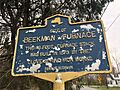
The Beekman Furnace marker.
-
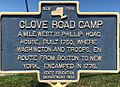
This marker tells about a camp where George Washington's troops stayed in 1776.
-
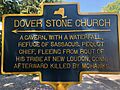
The Dover Stone Church, a natural cavern.
-
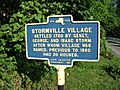
The Stormville Village historical marker.
-
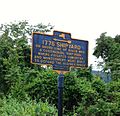
This marker points to the site of a shipyard from 1776.
-
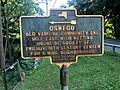
This marker shows the site of the Oswego Meeting House.
-
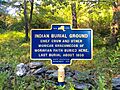
An image of the Indian Burial Ground marker.
-
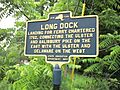
The Long Dock marker, showing a historic ferry landing.
-
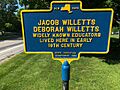
The marker for Jacob and Deborah Willetts, educators.
-
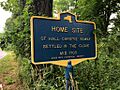
The marker for the Hall-Christie Family home site.
-
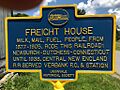
The Verbank Freight House marker.
-
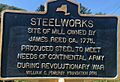
The Steelworks marker in Wassaic.
-
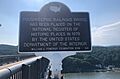
The Poughkeepsie Railroad Bridge, now the Walkway Over the Hudson.
-
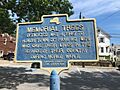
Memorial trees dedicated to World War II soldiers.
-
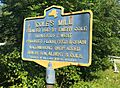
The Cole's Mill marker.
-
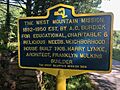
The West Mountain Mission marker.
-
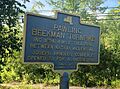
The Pawling Beekman Turnpike marker.
-
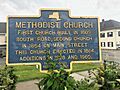
The Methodist Church marker in Pawling.
-
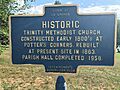
The Historic Trinity Methodist Church marker.


See also
