
List of presidents of Bangladesh facts for kids
The President of Bangladesh is the head of state of the People's Republic of Bangladesh. Since the nation gained its independence in 1971, many political leaders and judges have served in this important office.
The role of the president has changed several times throughout history. In some periods, the president held most of the governing power. In other periods, Bangladesh used a parliamentary system where the prime minister served as the head of government, while the president performed mostly ceremonial duties.


- Top left: Sheikh Mujibur Rahman, the first president of Bangladesh.
- Top right: Ziaur Rahman, the first directly elected president of Bangladesh.
- Bottom left: Hussain Muhammad Ershad, who served as president during the 1980s.
- Bottom right: Mohammad Abdul Hamid, the longest-serving president in Bangladeshi history.
Contents
Understanding the Role of the President of Bangladesh
What Does the President of Bangladesh Do?
In modern Bangladesh, the president is the official head of state. This means the president represents the entire country at home and abroad.
The everyday running of the government is handled by the prime minister and the cabinet. However, the president has several key responsibilities:
- Signing bills passed by the national parliament into law.
- Formally appointing the prime minister and other top officials.
- Welcoming foreign ambassadors and visiting foreign leaders.
- Serving as the ceremonial commander-in-chief of the armed forces.
- Granting official state honors and pardons.
How Has the Presidency Changed Over Time?
When Bangladesh declared independence in 1971, it established a provisional government. The country's first constitution in 1972 set up a parliamentary democracy.
Later in the 1970s and 1980s, the system changed into a presidential system. During this era, the president held executive power and made most major government decisions.
In 1991, Bangladesh returned to a parliamentary republic. Since then, the presidency has remained a non-partisan, ceremonial position representing national unity.
How Are Bangladeshi Presidents Numbered?
Historians and official sources sometimes count the presidents differently. This happens for several reasons:
- Some lists count temporary or acting presidents, while others do not.
- Some lists count the total number of presidential terms served.
- Other lists count the total number of individual people who held office.
Because of these differences, a leader might be described as the 16th president in one official book and the 20th president in another.
Complete List of Bangladeshi Presidents
- Political parties
Awami League (AL) Bangladesh Krishak Sramik Awami League (BaKSAL) Bangladesh Nationalist Party (BNP) Jatiya Party (JP(E))
- Other affiliations
Military Independent
- Status
Acting president
| No. | Portrait | Name (Birth–Death) |
Elected | Term of office | Political party (Coalition) |
|||
|---|---|---|---|---|---|---|---|---|
| Took office | Left office | Time in office | ||||||
 Provisional Government of Bangladesh (1971–1972) Provisional Government of Bangladesh (1971–1972) |
||||||||
| 1 |  |
Sheikh Mujibur Rahman শেখ মুজিবুর রহমান (1920–1975) |
— | 17 April 1971 | 12 January 1972 | 270 days | AL | |
| — |  |
Syed Nazrul Islam সৈয়দ নজরুল ইসলাম (1925–1975) |
— | 17 April 1971 | 12 January 1972 | 270 days | AL | |
 People's Republic of Bangladesh (1972–present) People's Republic of Bangladesh (1972–present) |
||||||||
| First parliamentary republic (1972–1975) | ||||||||
| 2 |  |
Abu Sayeed Chowdhury আবু সাঈদ চৌধুরী (1921–1987) |
— | 12 January 1972 | 24 December 1973 | 1 year, 346 days | AL | |
| 3 |  |
Mohammad Mohammadullah মোহাম্মদ মুহম্মদুল্লাহ (1921–1999) |
— | 24 December 1973 | 27 January 1974 | 1 year, 32 days | AL | |
| 1974 | 27 January 1974 | 25 January 1975 | ||||||
| Presidential and semi-presidential republic (1975–1991) | ||||||||
| (1) | .jpg) |
Sheikh Mujibur Rahman শেখ মুজিবুর রহমান (1920–1975) |
— | 25 January 1975 | 15 August 1975 | 202 days | BaKSAL | |
| 4 | |
Khondaker Mostaq Ahmad খন্দকার মোশতাক আহমেদ (1918–1996) |
— | 15 August 1975 | 6 November 1975 | 83 days | Independent | |
| 5 | |
Abu Sadat Mohammad Sayem আবু সাদাত মোহাম্মদ সায়েম (1916–1997) |
— | 6 November 1975 | 21 April 1977 | 1 year, 166 days | Independent | |
| 6 |  |
Ziaur Rahman জিয়াউর রহমান (1936–1981) |
1977 | 21 April 1977 | 12 June 1978 | 4 years, 39 days | Military | |
| 1978 | 12 June 1978 | 30 May 1981 | BNP | |||||
| 7 | .jpg) |
Abdus Sattar আব্দুস সাত্তার (1906–1985) |
— | 30 May 1981 | 20 November 1981 | 298 days | BNP | |
| 1981 | 20 November 1981 | 24 March 1982 | ||||||
| Post vacant (24 – 27 March 1982) | ||||||||
| 8 | |
A. F. M. Ahsanuddin Chowdhury আবুল ফজল মোহাম্মদ আহসানউদ্দিন চৌধুরী (1915–2001) |
— | 27 March 1982 | 10 December 1983 | 1 year, 258 days | Independent | |
| 9 |  |
Hussain Muhammad Ershad হুসেইন মুহাম্মদ এরশাদ (1930–2019) |
1985 | 11 December 1983 | 15 October 1986 | 6 years, 360 days | Military | |
| 1986 | 15 October 1986 | 6 December 1990 | JP(E) | |||||
| — |  |
Shahabuddin Ahmed শাহাবুদ্দিন আহমেদ (1930–2022) |
— | 6 December 1990 | 20 March 1991 | 104 days | Independent | |
| Second parliamentary republic (1991–present) | ||||||||
| (—) | |
Shahabuddin Ahmed শাহাবুদ্দিন আহমেদ (1930–2022) |
— | 20 March 1991 | 10 October 1991 | 204 days | Independent | |
| 10 | |
Abdur Rahman Biswas আবদুর রহমান বিশ্বাস (1926–2017) |
1991 | 10 October 1991 | 9 October 1996 | 4 years, 365 days | BNP | |
| 11 | |
Shahabuddin Ahmed শাহাবুদ্দিন আহমেদ (1930–2022) |
1996 | 9 October 1996 | 14 November 2001 | 5 years, 36 days | Independent | |
| 12 | _(Badruddoza_Chy.).jpg) |
A. Q. M. Badruddoza Chowdhury একিউএম বদরুদ্দোজা চৌধুরী (1930–2024) |
2001 | 14 November 2001 | 21 June 2002 | 219 days | BNP | |
| — | .jpg) |
Muhammad Jamiruddin Sircar মুহাম্মদ জমির উদ্দিন সরকার (1931–2026) |
— | 21 June 2002 | 6 September 2002 | 77 days | BNP | |
| 13 | .jpg) |
Iajuddin Ahmed ইয়াজউদ্দিন আহম্মেদ (1931–2012) |
2002 | 6 September 2002 | 12 February 2009 | 6 years, 159 days | Independent | |
| 14 |  |
Zillur Rahman জিল্লুর রহমান (1929–2013) |
2009 | 12 February 2009 | 20 March 2013 | 4 years, 36 days | AL | |
| 15 | .jpg) |
Mohammad Abdul Hamid মোহাম্মদ আব্দুল হামিদ (born 1944) |
— | 14 March 2013 | 24 April 2013 | 10 years, 41 days | AL | |
| 2013 2018 |
24 April 2013 | 24 April 2023 | ||||||
| 16 |  |
Mohammed Shahabuddin মোহাম্মদ সাহাবুদ্দিন (born 1949) |
2023 | 24 April 2023 | 24 July 2026 | 3 years, 91 days | AL | |
| Independent | ||||||||
| — |  |
Hafiz Uddin Ahmad হাফিজ উদ্দিন আহমদ (born 1944) |
— | 24 July 2026 | 21 August 2026 | 28 days | BNP | |
| 17 | .jpg) |
Mirza Fakhrul Islam Alamgir মির্জা ফখরুল ইসলাম আলমগীর (born 1948) |
2026 | 21 August 2026 | President-elect | 53 days | BNP | |
Key Eras in Bangladeshi Presidential History
The Independence Era and Early Republic (1971–1975)
Bangladesh declared independence in March 1971. Sheikh Mujibur Rahman was named the first president of the provisional government.
While Mujibur Rahman was detained abroad during the Liberation War, Syed Nazrul Islam served as the acting president. He helped guide the new government through the war until independence was achieved.
After returning home in January 1972, Sheikh Mujibur Rahman stepped down as president to become prime minister. Abu Sayeed Chowdhury then became president.
During this early stage, Bangladesh adopted its first formal constitution. In 1975, the government transitioned into a presidential system to address economic and political difficulties.
The Transition Years and Military Administration (1975–1990)
The late 1970s and 1980s saw significant political shifts. After political changes in 1975, Abu Sadat Mohammad Sayem, the Chief Justice of the Supreme Court, took over as president.
The Presidency of Ziaur Rahman
In 1977, Ziaur Rahman assumed the presidency. He introduced major political changes:
- He established the Bangladesh Nationalist Party (BNP).
- He moved the nation toward a multi-party political system.
- He held elections in 1978 to give the government a direct public mandate.
- He focused on rural development, food production, and regional cooperation in South Asia.
The Administration of Hussain Muhammad Ershad
After another period of political change in 1982, Hussain Muhammad Ershad came to power. He assumed the presidency in December 1983.
Ershad's administration lasted until 1990. During his term, he founded the Jatiya Party. His government focused on infrastructure projects and administrative decentralization. In late 1990, mass public demonstrations led to his resignation, paving the way for democratic reforms.
The Return to Parliamentary Democracy (1991–Present)
Following Ershad's resignation, Chief Justice Shahabuddin Ahmed became the interim acting president. He organized free general elections in early 1991.
Parliament amended the constitution in 1991 to return to a parliamentary democracy. Under this system, the prime minister became the executive leader, while the president took on a ceremonial role.
Long-Serving and Notable Modern Presidents
- Abdur Rahman Biswas (1991–1996): The first president elected under the restored parliamentary system.
- Shahabuddin Ahmed (1996–2001): Returned as president, earning widespread respect for his neutrality and legal expertise.
- Iajuddin Ahmed (2002–2009): Served during a complex political period in the mid-2000s.
- Zillur Rahman (2009–2013): A veteran politician who helped maintain political stability.
- Mohammad Abdul Hamid (2013–2023): The longest-serving president in Bangladeshi history, serving two full five-year terms.
- Mohammed Shahabuddin (2023–2026): A former judge and commissioner who served as president until July 2026.
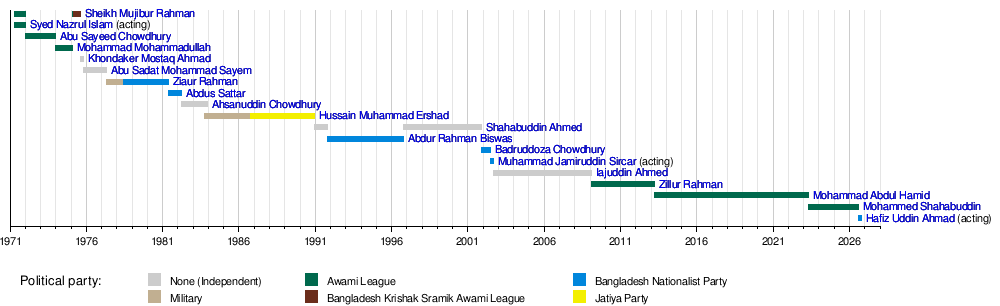
Timeline of Bangladeshi Presidents
See also
- Presidential elections in Bangladesh
- List of office-holders in the Government of Bangladesh
- Caretaker government of Bangladesh
- Chief Adviser
- Prime Minister of Bangladesh
- List of prime ministers of Bangladesh
- President of Bangladesh
- Vice President of Bangladesh
- List of rulers of Bengal
