
Marbled spinefoot facts for kids
Quick facts for kids Marbled spinefoot |
|
|---|---|
 |
|
| Conservation status | |
Scientific classification  |
|
| Kingdom: | Animalia |
| Phylum: | Chordata |
| Class: | Actinopterygii |
| Order: | Perciformes |
| Family: | Siganidae |
| Genus: | Siganus |
| Species: |
S. rivulatus
|
| Binomial name | |
| Siganus rivulatus |
|
| Script error: The function "autoWithCaption" does not exist. | |
| Synonyms | |
|
|
Script error: No such module "Check for conflicting parameters".
The Siganus rivulatus, also known as the marbled spinefoot or rivulated rabbitfish, is a type of fish that lives in groups. It mostly eats plants and belongs to the Siganidae family. This fish naturally lives in the western Indian Ocean and the Red Sea. From there, it swam into the Mediterranean Sea through the Suez Canal. It is the main example for its group, called Siganus.
Contents
Naming the Rabbitfish
The name Siganus comes from the Arabic word sijan, which means "rabbitfish". The name rivulatus means "marked with irregular streaks". This refers to the wavy yellow lines you can see on its sides.
A Swedish scientist named Peter Forsskål first described this fish. His friend Carsten Niebuhr published the information in a book in 1775.
What Does It Look Like?
The marbled spinefoot has a body that is flat on its sides. It has a dorsal fin (top fin) with 14 sharp spines and 10 soft rays. Its anal fin (bottom fin) has 7 spines and 9 soft rays. The tail fin is slightly forked, like a shallow "V".
This fish usually grows to be about 10 to 20 centimeters (4 to 8 inches) long. Some can get as big as 27 cm (11 inches), and the largest ever found was 40 cm (16 inches). Its color can change, but it often has dark spots and yellow wavy lines along its sides. The top part of its body is usually grey-green to brown, with a yellow or silvery-white belly.
About Its Venom
Like other rabbitfish, the Siganus rivulatus has venom in its fin spines. If you touch these spines the wrong way, they can sting you. The sting is very painful, but it is not deadly.
If someone gets stung, the best thing to do is treat the area with hot water, around 43-46 degrees Celsius (109-115 degrees Fahrenheit). This helps break down the venom. It's also important to get checked for any possible infection.
Where It Lives
The Siganus rivulatus naturally lives along the east African coast. This includes places like South Africa, the Red Sea, the Comoros islands, Madagascar, and the Seychelles.
In 1924, this fish was first seen in the Mediterranean Sea near Israel. It got there by swimming through the Suez Canal. Now, it is very common in the eastern Mediterranean, reaching as far as Sicily and parts of the Adriatic Sea.
Rabbitfish Life
The marbled spinefoot lives in shallow waters, usually less than 15 meters (50 feet) deep. It likes areas with algae, which can be on rocks, sand, or in seagrass beds. Sometimes, it can even live in places where fresh and saltwater mix, like estuaries.
These fish usually swim in large schools, with 50 to several hundred fish together. They prefer calm, sheltered spots. Their main food is algae, which they graze on.
Young fish larvae eat tiny plant-like organisms called diatoms. As they grow, they also eat small animals like copepods. Adult fish are mostly plant-eaters, feeding on different types of algae. However, they have also been seen eating jellyfish in the Red Sea.
Reproduction and Life Cycle
Siganus rivulatus can start having babies when it is about 13.7 cm (5.4 inches) long. They lay eggs when the water temperature is between 24 and 27 degrees Celsius (75-81 degrees Fahrenheit). In the Red Sea, this happens in March, April, and May. In the Mediterranean, it's a bit later, from May to July.
Spawning happens at dusk. The eggs are fertilized outside the mother's body. The eggs are small and sticky. After laying them, the adult fish do not take care of their young.
The baby fish, called larvae, float in the water for about three weeks. They don't eat for the first three days after hatching. After three weeks, they change form and gather into schools. Then, they swim to deeper water.
Ecological Impact
The Siganus rivulatus, along with another type of rabbitfish called Siganus luridus, has changed some areas off the coast of Turkey. By eating a lot of algae, these fish have made some underwater areas almost empty of plants. This reduces the variety of life in those places.
Uses of the Rabbitfish
Fishing
The Siganus rivulatus is caught by fishermen in many places where it lives. It is an important fish for local fishing communities. Fishermen usually catch it using nets, like beach seines or gill nets.
Even though it is caught, the number of these fish seems to be stable. There are no reports of big drops in their populations.
Fish Farming
Scientists are studying if Siganus rivulatus can be raised in fish farms. This is happening in both the Mediterranean and the Red Sea. Since these fish mainly eat plants, farming them might be better for the environment than farming fish that eat a lot of other fish, like salmon.
Research shows that Siganus rivulatus can grow and lay eggs in captivity. They also eat artificial food and can be raised in cages in the sea. There is a good demand for them in the market.
Health Concerns
Sometimes, Siganus rivulatus can carry toxins similar to ciguatoxin. There have been reports of people getting sick in Israel after eating this fish. This seems to happen when the fish are caught in polluted waters.
Images for kids
-
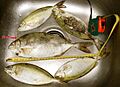
Siganus rivulatus Egypt
-
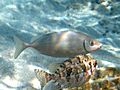
Siganus rivulatus Crete 2011


