
Margaret Lindsay Williams facts for kids
Quick facts for kids
Margaret Lindsay Williams
|
|
|---|---|

Williams with her portrait of US President Warren G. Harding (c.1923)
|
|
| Born | 18 June 1888 Cardiff
|
| Died | 4 June 1960 (aged 71) London
|
| Nationality | British |
| Education |
|
| Known for | Portrait painting |
Margaret Lindsay Williams (born June 18, 1888 – died June 4, 1960) was a talented Welsh artist. She became famous for painting portraits of important people. These included members of the British royal family, other European kings and queens, and even American presidents.
Margaret Williams was especially known for her portraits. She painted Queen Alexandra, Queen Mary, and Princess Margaret. She also painted Queen Elizabeth II at least five times, including when she was a young princess. Other famous people she painted were US President Warren G. Harding, businessman Henry Ford, and military leader Field Marshal Slim. During her life, Margaret Williams was very well-known. However, after she passed away, her amazing artwork was not as widely remembered.
Contents
Early Life and Art Training
Margaret Williams was born in Cardiff, Wales. She was the older of two daughters. Her father, Samuel A. Williams, worked as a shipbroker in Barry Docks. Her mother, Martha Margaret Lindsay, had Scottish family roots. From the age of nine, Margaret lived in Barry, a town near Cardiff.
Becoming an Artist: School and Awards
Margaret began her art studies at the Cardiff School of Art. She was very good and won a gold medal for her art in 1904. The next year, in 1905, she moved to London. She enrolled at the Pelham Street School of Painting in Kensington. This school helped her prepare for the famous Royal Academy School, which she joined in 1906.
At the Royal Academy School, Margaret won many awards. In 1911, she won a gold medal for her painting called The City of Refuge. At that time, she was the youngest artist ever to win a gold medal there. She was also the first artist from Wales to achieve this honor.
Setting Up Her Studio and Travel
Also in 1911, Margaret's father helped her set up her own art studio. It was located in Eaton Terrace in St John's Wood, London. The following year, she won a special scholarship that allowed her to travel and study art. She spent 18 months studying in Italy and Holland. This was based on advice from another famous painter, John Singer Sargent.
In March 1914, Margaret Williams had her first solo art show. She displayed about 58 paintings at the New Galleries in Cardiff. This was a big step in her career.
Margaret Williams and World War I
When World War I began, Margaret Williams wanted to help. She wrote to David Lloyd George, who was a powerful politician from Wales. She asked to become an official war artist with the Welsh soldiers in France. Lloyd George thought it was a good idea for an artist to be with the soldiers. However, he would not allow a woman to go so close to the front lines. So, he said no to her request.
Art for the War Effort
Lloyd George did support her application to work for the Ministry of Information, but that also did not happen. Still, Margaret found ways to use her art for the war. In 1915, she created illustrations for a book of Welsh stories. This book was organized by Margaret Lloyd George (David Lloyd George's wife) to raise money for Welsh troops. Margaret Williams used these Welsh legend themes again for a painting in 1916 and an illustrated book in 1917.
In 1915, Margaret also organized an art exhibition in Cardiff. The money raised went to the Netley Military Hospital, which cared for wounded soldiers. This exhibition led to her getting many important painting jobs.
Large-Scale War Paintings
One of her large commissions was Cardiff Royal Infirmary during the Great War, painted in 1916. This showed the hospital during wartime. She also painted a scene in Cardiff City Hall. This painting showed David Lloyd George unveiling statues of Welsh heroes. This huge artwork included 114 individual portraits! Margaret had to visit Downing Street (where the Prime Minister lives) several times to paint Lloyd George and other government officials.
Her biggest painting was of the Welsh National Service. This event took place in Westminster Abbey in June 1918. It was held to support Welsh prisoners of war. Margaret Williams spent two years working on this massive painting, which was 20 by 16 feet, right inside the Abbey. She then found a studio large enough to finish it. She spent another year on the work, which ended up having about 150 portraits. Important figures like Queen Alexandra and her daughter Princess Victoria were included. A wealthy shipping owner, Lord Glanely, paid for this painting. He later gave it to the City of Cardiff, where it is still displayed in the city's Law Courts.
Later Works and Legacy
By the end of World War I, Margaret Williams was a very successful and well-known artist. In the years during and after the war, she painted several imaginative works with religious themes. These included The Devil's Daughter (1917), The Triumph (1918), The Imprisoned Soul (1920), and The Menace (1925).
Focus on Portrait Painting
By the mid-1920s, Margaret decided to focus mainly on portrait painting. She received a steady flow of requests for portraits. Even though she lived in London, she painted many important Welsh families. These included the Morgan family, who owned the David Morgan department store in Cardiff. She also painted members of the Novello Davies family, including the famous composer Ivor Novello.
In London, she had a supporter named Lord Riddell. He sat for four of her portraits and helped her get other important jobs. One of her most notable works was St Paul's Cathedral Thanksgiving Service. This large group portrait was shown at the Royal Academy in 1933. It marked the re-opening of the Cathedral after five years of repair work. This painting included both King George V and Queen Mary.
Royal and Presidential Portraits
Margaret Williams painted another portrait of Queen Mary in 1938 for St Thomas' Hospital. Her other royal commissions included portraits of Princess Margaret (given to South Africa in 1937), Prince Charles, and Princess Anne. As mentioned, she painted Queen Elizabeth II at least five times, including when she was a young princess.
Margaret visited the United States at least five times. In 1922, she was asked to paint a large, almost life-size portrait of US President Warren G. Harding. Other important people she painted included Henry Ford and Field Marshal Slim. She also created decorative art for the Cardiff home of Sir William James.
Later Life and Artistic Style
Margaret Williams exhibited her work with the South Wales Art Society throughout her life. She became a Vice-President of the Society in 1931. However, after 1934, she did not visit Wales very often because her parents moved to London.
Margaret lived in Hamilton Terrace in St Johns Wood, London. She hosted parties and receptions there, especially when she had new paintings to show. However, she seemed to live a quiet life otherwise and never married. Her painting style was somewhat academic and formal. Yet, her portraits often had a lively and energetic feel. She chose not to be influenced by new art movements happening around her.
Margaret Williams was a lifelong member of the Welsh Congregational Church. Her funeral was held at the Windsor Road Congregational Church in Barry. She is buried in Barry Cemetery. A special Blue plaque now marks her connection to Barry at 9 Windsor Road.
Images for kids
-
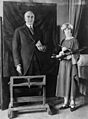
Williams with her portrait of US President Warren G. Harding (c.1923)
