
Meretseger facts for kids
Quick facts for kids Meretseger |
|
|---|---|
 |
|
| Major cult center | Theban Necropolis, Deir el-Medina |
| Symbol | Cobra snake |
Meretseger was a cobra-goddess in ancient Egyptian religion. Her name means "She Who Loves Silence". She was the guardian of the Theban Necropolis, a large cemetery area on the west bank of the Nile. Her main job was to protect the famous Valley of the Kings, where many pharaohs were buried.
She was very important to the workers who built the royal tombs. These workers lived in a village called Deir el-Medina. They believed Meretseger watched over them and the tombs they created. Her worship was most popular during the New Kingdom of Egypt (1550–1070 BC).
Contents
Who Was Meretseger?
Meretseger was a unique goddess because she was a local deity. She was mostly worshipped by the artisans and builders in Thebes. These workers cut tombs into the rock and decorated them with beautiful paintings.
Guardian of the Tombs
The Valley of the Kings contained great treasures buried with the pharaohs. Robbers often tried to break into these tombs to steal gold and jewelry. The workers believed Meretseger watched the valley to stop these crimes. She was both dangerous and kind. She protected the dead kings but also looked after the honest workers.
The Peak of the West
Meretseger was closely connected to a mountain peak called el Qurn, which means "The Horn". This peak rises above the Valley of the Kings and looks like a natural pyramid.
The ancient Egyptians called this peak "The Peak of the West". They believed the mountain was the goddess herself in a different form. It was considered a gateway to the Duat, or the underworld. Workers often climbed the paths of the mountain to leave small stone tablets, called stelae, as prayers to her.
Justice and Mercy
The workers of Deir el-Medina feared Meretseger's anger but also trusted her mercy. They believed she knew everything that happened in the necropolis.
Punishment for Crimes
If a worker committed a crime, Meretseger would punish them. Crimes included stealing from the tombs, stealing copper tools, or breaking a serious promise (an oath). The workers believed she would strike the guilty person with a snakebite or cause them to go blind. This fear helped keep order in the village and on the work sites.
The Story of Neferabu
_-_099.jpg)
Although she was fierce, Meretseger was also forgiving. If a person was punished, they could pray to her and say they were sorry. If their regret was true, she would heal them.
We know this from a stone tablet made by a worker named Neferabu. He was a draftsman who drew designs for the tombs. He became blind and believed it was a punishment from the goddess for a mistake he made. He wrote a prayer on a limestone stela asking for forgiveness.
Neferabu wrote:
I was an ignorant man and foolish, who knew not good from evil, I did the transgression against the Peak, and she taught a lesson to me... I called upon my Mistress, I found her coming to me as a sweet breeze; she was merciful to me... she made my malady forgotten.
This shows that unlike many other gods who seemed distant, Meretseger was personally involved in the lives of the common people.
Temples and Worship
Because Meretseger was a local goddess, she did not have huge temples like the god Amun. Instead, she had small rock shrines.
- Rock Shrines: Her main shrine was near the village of Deir el-Medina. It was a set of caves arranged in a semicircle.
- Offerings: Workers left many stone tablets and small chapels at the foot of her hill.
- Decline: When the capital of Egypt moved away from Thebes and the Valley of the Kings was no longer used for royal burials, the worship of Meretseger faded away. By the 10th century BC, her cult had mostly disappeared.
How She Was Depicted

In ancient Egyptian art, Meretseger appeared in several different forms. This helped people understand her different powers.
Artistic Forms
- Coiled Cobra: She was most often shown as a coiled cobra snake, ready to strike enemies.
- Woman with a Snake Head: Sometimes she appeared as a woman with the head of a cobra.
- Snake with a Woman's Head: She could also be a snake with a human face.
- Triple Form: Rarely, she was shown with three heads: a woman, a snake, and a vulture.
She often wore a special crown with feathers or the sun disk. Artists painted her inside the tombs of kings and queens to provide eternal protection. For example, she appears in the tomb of Ramesses VI and Ramesses IX.
Images for kids
-
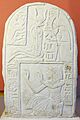
A worker named Nakhtimen praying to Meretseger. Louvre, Paris.
-
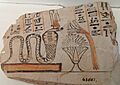
Meretseger drawn on a piece of stone called an ostracon. Egyptian Museum, Cairo.
-
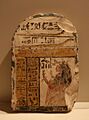
A stela showing a woman worshipping the goddess. Egyptian Museum of Berlin.
-
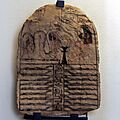
A stela with a woman adoring Meretseger above many snakes. Louvre, Paris.


