
Mixcoatlus melanurus facts for kids
Quick facts for kids Mixcoatlus melanurus |
|
|---|---|
 |
|
| Conservation status | |
Scientific classification  |
|
| Kingdom: | Animalia |
| Phylum: | Chordata |
| Class: | Reptilia |
| Order: | Squamata |
| Suborder: | Serpentes |
| Family: | Viperidae |
| Genus: | Mixcoatlus |
| Species: |
M. melanurus
|
| Binomial name | |
| Mixcoatlus melanurus (L. Müller, 1924)
|
|
| Script error: The function "autoWithCaption" does not exist. | |
| Synonyms | |
|
|
Script error: No such module "Check for conflicting parameters".
The Mixcoatlus melanurus is a type of venomous snake. It is also known as the black-tailed horned pitviper. This snake is a pitviper species that lives only in the mountains of southern Mexico. When a species lives only in one place, it is called endemic.
Contents
Meet the Horned Pitviper
This snake is known for its unique look. Adult Mixcoatlus melanurus snakes usually grow to be about 37.5 to 50 centimeters (15 to 20 inches) long. They have a body that is fairly thick and strong.
Why is it called "Horned"?
In Mexico, people sometimes call this snake a necazcoatl. This name comes from the Nahuatl language. Necaztli means "ear" and coatl means "snake." So, necazcoatl means "eared-serpent." This name refers to the special horn-like scales above its eyes, which make it look like it has ears or horns.
Where Does It Live?
The black-tailed horned pitviper lives in the mountains of southern Mexico. You can find it in two Mexican states: southern Puebla and Oaxaca. These snakes prefer to live at high elevations, usually between 1,600 and 2,400 meters (about 5,250 to 7,875 feet) above sea level.
Its Home Range
The first place where this snake was officially found and described was simply listed as "Mexico." This specific location is called the type locality in biology. It helps scientists know where the first example of a species was found.
How It Behaves
The Mixcoatlus melanurus is a terrestrial snake. This means it lives on the ground. It spends its time moving along the forest floor or rocky areas, rather than climbing trees or swimming in water.
Protecting This Snake
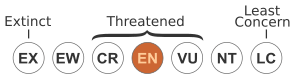
The Mixcoatlus melanurus is an endangered species. This means it is at a very high risk of disappearing forever from the wild. The IUCN Red List of Threatened Species has classified it as Endangered (EN).
Why is it Endangered?
Scientists believe this snake is endangered because its habitat is shrinking and becoming broken up. Its living area is estimated to be very small, less than 5,000 square kilometers (about 1,930 square miles). Also, there are only a few places where these snakes are known to live, perhaps no more than five. This means their population is getting smaller.
In 2007, when scientists last checked, the number of these snakes was going down. This makes it even more important to protect their homes and help them survive.
