
Net (device) facts for kids

A net is a special kind of open fabric made of cords, threads, or yarns. These strands are knotted, looped, or twisted together to create a criss-cross pattern full of evenly spaced holes called a mesh. The clever grid pattern blocks large objects while letting small items, air, and fluids pass through easily.
Because of all these open holes, a net uses much less material than solid cloth or sheets of plastic. This gives a net excellent transparency, meaning you can easily see through it. Nets are also very light and bendable, which makes them easy to fold up, carry around, and pack away. Humans have built nets since prehistoric times to catch animals, carry heavy loads, and play fun outdoor games.
Contents
The Ancient History of How Nets Began

Nets are among the very oldest tools ever invented by human beings. People have used them since at least the Mesolithic period, which is also known as the Middle Stone Age. Some scientists believe that early hunters created nets even earlier, during the Upper Paleolithic era.
Most ancient nets were made from plant stalks, bark, animal sinew, or grass. Because these natural fibers rot away over time, very few ancient nets survive for archaeologists to discover today. However, archaeologists have uncovered pieces of nets preserved in cold mountain ice and wet, muddy bogs. In some ancient camps, scientists have found clay impressions of nets, which are marks left behind in dried mud from prehistoric hunting gear.
Making and Repairing Strong Nets


Long ago, every single net had to be crafted by hand, one knot at a time. Today, giant machines make most nets quickly in factories. Even so, many people around the world still practice the ancient art of hand netting.
Starting the First Row of Knots
To build a rectangular net, the netmaker starts with a strong top line called a headrope. Loops of string are attached across this rope at exact spaces using basic knots, such as slipped overhand knots or clove hitches. Circular nets, like hair nets or round bags, start differently from a single center point. After the first row is finished, new rows are tied underneath using strong bends, especially the famous sheet bend. Not all nets use knots; cozy hammocks are often made by looping and twisting strings together loosely.
Clever Tools for Net Makers
Pulling a long, loose string through every hole would take forever and cause tangled messes. To solve this problem, netmakers wrap their string onto a special flat tool called a netting shuttle or netting needle. The tool carries the string neatly without twisting it.
To keep every single hole the exact same size, the crafter uses a smooth, flat stick called a gauge. The maker wraps the string snugly around this gauge before tying each knot. The very first and last rows often use a smaller gauge so the net has neat, clean edges.
How to Mend and Fix a Broken Net
Nets often snag on sharp rocks or branches and rip open. When a strand breaks, the open area creates extra pull on nearby strands. Engineers call this problem stress concentration. This extra pulling force can quickly make the rip grow bigger. Net users must quickly fix damaged spots by hand using fresh cord and needles. People often say a funny riddle about this: when a hole is torn in a net, it actually has fewer holes than it did before!
Tough Materials Used to Weave Nets
People can weave nets out of almost any kind of flexible strand. In ancient times, people used whatever strong plants grew in their local region. For example, early European fishermen spun their nets from smooth plant fibers called linen.
Today, synthetic fibers made from plastics have replaced plant twines because they do not rot in water. Thin Nylon monofilament lines are see-through, strong, and water-resistant. Because these clear plastic nets are almost invisible underwater, fish cannot spot them easily.
How Nets Stretch and Hold Weight


A net behaves very differently depending on how you pull it. The straight strands between the knots do not stretch very much. However, when you pull on the net diagonally across the holes, the entire diamond mesh widens and stretches out. In fabric making, this diagonal pull is called stretching on the bias.
Builders carefully design nets to match the exact jobs they must do. For example, a heavy-duty safety net at a construction site or circus must catch a falling worker or acrobat safely. These nets cannot snap back like a stiff trampoline. Instead, their clever weave obeys a curved stress–strain curve. This means the net stretches gently at first, slowing down the falling person softly so they do not get hurt.
Wonderful Ways People Use Nets
Nets appear everywhere in our daily lives, from sports fields to ocean research boats.
Moving Heavy Cargo and Food
Nets make great storage bags because they change shape to fit any item. Workers use massive cargo nets on docks and airplanes to hoist giant stacks of crates and luggage into the air. Farmers and grocery stores also pack fresh foods like onions, oranges, and potatoes in mesh sacks so fresh air can reach them and stop mold from growing.
Scoring Goals in Sports and Games
Nets are essential in many popular sports. In games like football, ice hockey, and basketball, players try to shoot or kick a ball or puck into a mesh goal to score points. The net catches the ball so players and referees can clearly see that a goal was scored.
In other games, known as net sports, a high net splits the court into two halves. In sports like volleyball, tennis, badminton, and table tennis, players must hit the ball or birdie over the net to keep the game going. Athletes also practice hitting balls inside enclosed cricket nets to keep stray balls from flying away and hitting spectators.
Helping and Catching Animals Safely
Humans have used fishing nets for thousands of years to catch fish from rivers, lakes, and oceans. Curious nature explorers use soft butterfly nets to catch and study insects without harming their delicate wings. Gardeners spread lightweight bird netting over fruit trees and berry bushes to keep hungry birds from eating their harvest.
Wildlife scientists rely on clever trapping nets to study wild animals up close. Researchers set up super-fine mist nets to gently trap songbirds or bats so they can record their health and attach identification bands to their legs. Wildlife rangers also use wide rocket nets and handheld netguns to safely catch large wild animals that need medical care or relocation to a safer forest.
Furniture and Comfortable Living
Nets make wonderful furniture for relaxing. Woven hammocks sway between trees to give campers a soft, cool place to take an afternoon nap. In warm and tropical regions, families hang fine mesh mosquito nets over their beds to protect themselves from itchy insect bites while they sleep. High-speed sailing catamarans often stretch springy mesh nets between their double hulls so sailors can walk across the open water safely.
Clothes, Fashion, and Ships
Nets can even be worn as clothing! People wear fine hair nets to keep hair tucked away neatly while cooking food in kitchens. Artists use intricate net embroidery to make fancy lace for dresses and curtains. Even large navies use strong steel Anti-submarine nets across harbor entrances. These underwater fences are placed by specialized net-laying ships to protect quiet ports and ships at anchor.
See Also
Images for kids
-

A cargo net lifting heavy cargo sacks at Haikou New Port
-
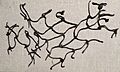
An ancient fragment of a prehistoric fishing net
-
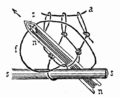
The traditional way to tie knots using a needle and gauge
-

A skilled fisherman carefully repairing torn mesh by hand
-

A craftsperson hand-knotting a new fishing net
-
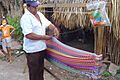
Weaving a comfortable Mayan hammock out of soft twisted cord
-
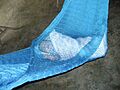
A flexible net hammock securely holding a sleeping baby
