
Pancho Medrano facts for kids
Quick facts for kids
Pancho Medrano
|
|
|---|---|
_(cropped).jpg)
Medrano at the dedication of the UAW Local 848 building.
|
|
| Personal details | |
| Born |
Francisco F. Medrano
August 2, 1920 Dallas, Texas, U.S. |
| Died | April 4, 2002 (aged 81) Dallas, Texas, U.S. |
| Spouse | Esperanza Jimenez |
| Children | Francisco Jr., Roberto, Ricardo, Rolando, and Pauline |
| Occupation | Activist |
| Known for | Civil rights movement Labor rights |
Francisco F. Medrano (born August 2, 1920 – died April 4, 2002) was an important American activist. He worked hard for the rights of workers and for civil rights. Civil rights mean fair treatment and equal opportunities for everyone.
Medrano's work helped people all over Texas and the United States. His family also became well-known leaders in Dallas. He is famous for his motto: "In America, everything is politics, from the day you are born, until the day you die." This means he believed that politics affects every part of our lives.
Medrano did not agree with the idea that Mexican-Americans should be seen as "white." He faced unfair treatment because of how he looked. Once, he was not hired for a job because he looked "too much like a Negro." He also felt frustrated with some Mexican-American groups. He thought they were not willing to organize protests to fight for rights. Medrano preferred to be called a Chicano, which was a term of pride for Mexican-Americans.
Contents
Growing Up in Dallas
.jpg)
Francisco Medrano was born on August 2, 1920. His parents were Sabas Medrano and Nicolasa Franco. They lived in the Little Mexico neighborhood of Dallas, Texas. He went to Our Lady of Guadalupe Church. There, he joined the Catholic Youth Association. A priest taught the children how to box.
Medrano often talked about the unfair treatment he saw in Dallas. He remembered metal rails built around Pike Park. These rails were to stop Mexican-American and African-American children from playing there. His mother was once refused service at a restaurant because of her background.
He went to St. Anne's School and later Crozier Tech High School. But he left high school early. His principal sent him home for a dress code rule. Medrano's shoes had big holes in them. The principal helped him get a job breaking rocks. This job was near Bachman Lake. He earned money to buy new shoes.
His boss at the rock quarry helped him join a Works Progress Administration (WPA) school. There, he learned new skills. He then got a job at a North American Aviation plant. This is where he learned about boxing and unions. He started boxing during his lunch breaks. He became a local light heavyweight boxer. Later, he became the heavyweight champion at the plant.
Fighting for Workers' Rights
Medrano learned about unions when organizers handed out flyers at his plant. He worked with them to start a union there. Because of this, he lost his job. But in 1943, Local 645 of the United Auto Workers-Congress of Industrial Organizations (UAW-CIO) was formed. Medrano got his job back.
He was later chosen as Sergeant at Arms for Local 645. This local union became Local 848 in 1962. In 1955, he was elected as a trustee. Medrano left his plant job in 1963. He became a full-time official for the UAW.
.jpg)
In 1967, Medrano went to Starr County, Texas. His job was to help workers gain more rights. He supported workers on the picket lines. These were places where workers protested. There was often violence between the Texas Rangers and the picketers. Texas Rangers sometimes beat picketers during arrests.
Medrano himself was arrested during one conflict. He was taking photos of Texas Rangers arresting union workers. A Texas Ranger opened his camera. The Ranger said he was checking if the camera was a weapon. Medrano was punched in the face while being arrested.
In 1968, Medrano filed a lawsuit. He claimed that the Texas Rangers and others tried to stop unions. He also said that some Texas laws used during labor disputes were unfair. This lawsuit was called Medrano v. A Y Allee. The Supreme Court of the United States sided with Medrano. They said some Texas laws were unconstitutional, meaning they went against the U.S. Constitution. The court also stopped officials from interfering with the civil rights of the workers. This case was argued again in 1973-1974.
Civil Rights and Political Work
Medrano continued to represent the UAW until he retired. He met many important politicians and leaders. In 1977, he visited President Jimmy Carter at the White House. He was part of a UAW group of 15 people.
In 1979, Medrano was invited to another White House event. This was because of his work on the Medrano v. Allee lawsuit. He also helped farm workers and migrants. At this event, he met Pope John Paul II. He brought a paper he wrote for the Pope to read. He also brought religious items for the Pope to bless. Medrano called this meeting a very important moment in his life.
Sources also say Medrano was at the Selma and Birmingham marches. These marches were led by Dr. Martin Luther King, Jr.. He also helped protect Lyndon B. Johnson during his visit to Dallas in 1960. Medrano also worked with Cesar Chavez in Texas.
_and_Cesar_Chavez,_Rio_Grande_City,_Texas_(10010577).jpg)
In 1954, Medrano and other Dallas Mexican Americans started a Dallas chapter of the American GI Forum. In 1970, Medrano and activist Guadalupe Delesma asked that a school in Dallas be named after a Mexican American.
Trinity River Incident
Medrano became more well-known in Dallas after an incident in 1971. Mr. and Mrs. Thomas Rodriguez were shot by Dallas policemen. This happened when police raided their apartment. They were looking for a suspect in the murders of three other policemen. This event became known as the Trinity River Massacre.
Medrano helped Thomas Rodriguez by paying his bond. At a gathering for the family, Medrano explained why few people attended. He said people were afraid and did not know they could stand up for their rights. He noted that the first supporters of the Rodriguez family were from the Southern Christian Leadership Conference.
State Representative Paul Moreno came to Dallas to support the Rodriguez family. Medrano encouraged the community to vote against certain local politicians. He said the Dallas Sheriff was not listening to the community. Medrano reached out to Senator Birch Bayh's office. Senator Bayh then looked into police violence against Mexican Americans in Texas.
Medrano led a march in support of the Rodriguez family. About 200 people marched. Medrano worked to bring different groups together. He worked with Dallas leaders like Al Lipscomb to build support.
Santos Rodriguez Shooting
After the police shooting of Santos Rodriguez in 1973, Medrano became very active. He helped organize community responses and protests. In 1978, Medrano spoke at a rally for Santos at Reverchon Park. He told the crowd that Santos's name would live on. He praised the community for coming together.
Texas-Wide Activities
In January 1975, Medrano joined the Tejano Political Action Committee (Tex-PAC). This group was based in Austin, Texas. Its goal was to promote fair laws and teach Mexican-Americans about politics.
Medrano's Family Life
Medrano's father, Sabas Medrano, died when he was young. His family never knew what happened to him. Medrano said his father was arrested by Dallas police. After that, his family never saw him again. Medrano's mother later married Pedro Centeno.
Pancho Medrano married Esperanza Jimenez. They had five children: Francisco Jr., Roberto, Ricardo, Rolando, and Pauline. Many of his children became involved in politics. Roberto was a Dallas school board member for 13 years. Ricardo was on the Dallas City Council from 1979 to 2003. Pauline was also on the council from 2005 to 2013. She even served as Dallas Mayor Pro Tem. Rolando also went to college and earned a master's degree.
The Medrano children often joined their father in political activities. Francisco Jr.'s son, Adam Medrano, was elected to the Dallas City Council in 2013. He also serves as Mayor Pro Tem.
Several of Medrano's children and friends were interviewed for a project. They shared his story and his lasting impact. Dallas ISD's Francisco "Pancho" Medrano Middle School is named after him.
Francisco Medrano passed away on April 4, 2002. He was buried at Calvary Hill Cemetery and Mausoleum in Dallas.
Images for kids
-
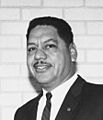
Medrano at the dedication of the UAW Local 848 building.
-
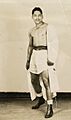
Pancho Medrano in boxing attire
-
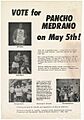
Medrano campaign leaflets, Sergeant at Arms for UAW Local 645
-
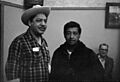
Pancho Medrano and Cesar Chavez in Rio Grande City, Texas
