
Tompot blenny facts for kids
Quick facts for kids Tompot blenny |
|
|---|---|
 |
|
| Conservation status | |
| Scientific classification | |
| Synonyms | |
|

The tompot blenny (Parablennius gattorugine) is a cool type of fish called a combtooth blenny. You can find it in the shallow, coastal waters of western Europe, the Mediterranean Sea, and North Africa.
Contents
About the Tompot Blenny
The tompot blenny is a fairly large blenny. It has a long body, a big head, and large eyes. This fish can grow up to 30 centimeters (about 12 inches) long!
Its eyes are special because they have two colors: brown on top and white on the bottom. Above each eye, there's a single branched tentacle, which looks like a little antenna. It also has tentacles over its nostrils.
Most tompot blennies are yellow-brown. Sometimes, they can be a bit greenish. They have at least seven dark stripes that start at their dorsal fin (the fin on their back) and go down to their belly.
The lateral line (a line of special sensing organs along the side of the fish) is mostly continuous. But it breaks up a bit near the tail.
When male tompot blennies are ready to breed, they turn a chocolate brown color. They also grow special bulb-like glands on the spines of their anal fin (the fin on their underside).
The dorsal fin runs along almost the entire length of its body. It's split into two parts by a small dip. The front part has spiny rays, and the back part has soft rays. This fin has 13-14 spines and 17-20 rays. The anal fin has 2 spines and 19-23 rays. They also have pretty big pectoral fins (the fins on their sides).
Each tompot blenny has unique markings on its face scales. This helps scientists tell them apart when they study them!
Where They Live
You can find the tompot blenny along the Atlantic coast of Europe. This includes places from southern England and Ireland all the way down to Morocco. They also live throughout the Mediterranean Sea, reaching the Sea of Marmara and the Black Sea.
In Great Britain, they are mostly seen off the south and west coasts. They are not usually found on the North Sea coasts. However, they have been spotted on shipwrecks off the North Norfolk coast and even as far north as the Shetland Islands in eastern Scotland.

Habitat and Life Habits
Their Home
Tompot blennies are very territorial. This means they like to have their own space and defend it. Their home is usually a small crack or hole in a rocky reef. They use this spot for shelter.
They live in shallow seas, usually at depths of 3 to 32 meters (about 10 to 105 feet). Smaller blennies can even be found in rockpools. Sometimes, during very low tides, you might find them above the water line. They hide under rocks or among exposed plants to stay safe.
What They Eat
Tompot blennies have sharp, comb-like teeth. They use these teeth to scrape food off rocks and other surfaces. They enjoy eating sea anemones and other small creatures without backbones. This includes prawns and other crustaceans like crabs.
They are most active at dawn and at dusk. This means they are crepuscular!
Reproduction
Tompot blennies lay their eggs between March and May. The male blenny will mate with several females. After the females lay their eggs, the male guards them carefully.
The eggs are laid on the bottom of the sea. Like all blenny eggs, they stick to the surface with a sticky patch. The male protects the eggs until the baby blennies hatch. This usually takes about a month.
Male blennies are very protective of their territories during breeding season. They often fight other males, and sometimes they get injured. When they are breeding, the males grow pale, cauliflower-like glands on their anal fins. Scientists think these glands help attract females and might even help clean the eggs.
What's in a Name?
The specific name of the tompot blenny, gattorugine, has an interesting story. It was first used by Francis Willughby in 1688. He saw these blennies in Venice, Italy. People there called them gatto ruggine, which he thought meant "rusty cat" or "rust color." He wasn't sure if he understood the name completely.
However, the real name is actually gatto rusola or gotto rosula. This is a local name for blennies in general along the Adriatic coast of Italy. It's a smaller version of gotto roso, which means "thick throat."
Images for kids
-
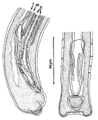
Pseudocapillaria bainae, a tiny worm that can live inside tompot blennies.

