
Polydactyl cat facts for kids

A polydactyl cat is a special kind of cat that is born with more than the usual number of toes on one or more of its paws. This happens because of a natural physical trait called polydactyly. These unique cats are often found along the East Coast of North America (in the United States and Canada) and also in parts of South West England and Wales.
Contents
How Do Polydactyl Cats Get Their Extra Toes?
Normally, cats have 18 toes in total: five on each front paw and four on each back paw. But polydactyl cats can have many more! Some have been known to have as many as nine toes on a single paw. For example, Jake, a Canadian polydactyl cat, and Paws, an American polydactyl cat, both hold a Guinness World Records title for having 28 toes each!
This special trait is passed down through a cat's genes. It's like getting a specific eye color or hair color from your parents. A small change in a cat's genetic instructions, specifically in an area that controls limb development, causes these extra toes to grow. Most often, the extra toes appear only on the front paws. It's much rarer to see them only on the back paws, and even more unusual for a cat to have extra toes on all four paws.
-
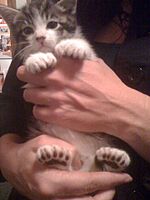
A kitten showing off its many toes.
-
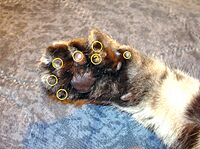
The right front paw of a polydactyl cat. The circles show where the toes are.
-
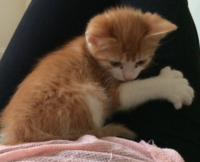
A cute polydactyl red Maine Coon kitten.
-

This image shows how a specific gene (Shh) can cause extra toes to grow.
-
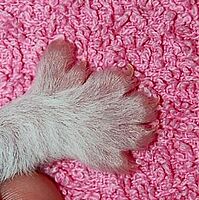
A Maine Coon cat with extra toes on its right front paw.
-
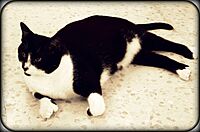
A domestic polydactyl cat.


Where Do These Special Cats Live?
Polydactyl cats are especially common in places like the East Coast of North America and parts of England and Wales. For a long time, these cats were very popular as ship's cats. Sailors loved them because their extra toes gave them amazing climbing and hunting skills, which helped keep ships free of rodents. Some sailors even believed these cats brought good luck on their voyages!
It's thought that many polydactyl cats spread around the world because they traveled on ships sailing from Boston, Massachusetts. The more trade a port had with Boston, the more likely it was to have polydactyl cats in its population.
A famous fan of polydactyl cats was the author Ernest Hemingway. A ship captain once gave him a six-toed cat named Snow White. After Hemingway passed away in 1961, his former home in Key West, Florida, became a museum. Today, it's also home to about 50 descendants of his cats, and about half of them are polydactyl! Because of his love for them, polydactyl cats are often called "Hemingway cats."
The Science Behind Extra Toes
The extra toes in polydactyl cats come from a small change, or mutation, in their DNA. Think of DNA as a detailed instruction manual for building a cat. In polydactyl cats, there's a tiny "typo" in a specific part of this manual. This typo affects a gene called SHH, which is very important for how limbs and digits (toes) develop.
Normally, the SHH gene tells the cells where and how to grow toes in a specific pattern. But with the mutation, the SHH gene gives slightly different instructions, causing extra cells to grow in the paw area. These extra cells then develop into one or more new, complete toes, often with their own nerves, blood vessels, muscles, and ligaments. It's amazing how a tiny change can lead to such a complex and perfectly formed extra part!
Scientists have found that many different small changes in the same area of the DNA can all lead to a cat having extra toes. This shows how a small genetic difference can create a wonderful variation in nature.
See also
Notable polydactyl cats
