
Pulley facts for kids
Quick facts for kids Pulley |
|
|---|---|

Pulleys on a ship. In this context, pulleys are normally known as blocks
|
|
| Classification | Simple machine |
| Industry | Construction, transportation |
| Wheels | 1 |
| Axles | 1 |
A pulley is a simple tool that helps people lift heavy things. It is made of a wheel that turns on an axle or a shaft. A flexible cord like a rope, cable, or belt runs over the wheel. The wheel usually has a grooved rim called a sheave. This groove keeps the rope in place between outer edges called flanges around its circumference.
When you pull down on one side of the rope, the load on the other side moves up. Pulleys make work easier by changing the direction of your pull or by sharing the heavy load.
Contents
How Were Pulleys Invented in History?
People have used pulleys for thousands of years to build great structures. Builders in Ancient Egypt used early pulley devices during the Twelfth Dynasty around 1991 BC. Workers in ancient Mesopotamia also used them during the second millennium BC to move heavy building stones.
Later, thinkers in Ancient Greece studied how they worked. The Greek mathematician Archytas of Tarentum wrote about them. A scientist named Hero of Alexandria in Roman Egypt listed the pulley as one of the six classic simple machines.
The famous writer Plutarch wrote a story about the great scientist Archimedes in his book Parallel Lives. Archimedes used a clever system of connected pulleys to move a giant, fully loaded ship all by himself!
How Do Different Pulley Systems Work?
Pulleys can be arranged in different ways depending on what needs to be moved.
The Simple Fixed Pulley
A fixed pulley stays tied to one spot, like the top of a flagpole. Its axle does not move. When you pull down on the rope, the flag goes up. A fixed pulley does not make the object lighter, but pulling downward is much easier because the force of gravity helps your body.
The Movable Pulley
A movable pulley is attached directly to the heavy load instead of the wall or ceiling. As you pull the rope, both the wheel and the heavy object move together. Two parts of the same rope hold up the weight. This cuts the effort you need right in half, giving you a handy mechanical advantage.
The Block and Tackle


When you connect fixed pulleys and movable pulleys together, you build a block and tackle. In sailing, a group of pulley wheels in one frame is called a block.
A block and tackle lets one person lift huge weights, like car engines or boat sails. The ideal mechanical advantage tells you how many times easier your job will be. It simply equals the number of rope strands supporting the moving load. If four rope parts support the weight, the load feels four times lighter! Engineers draw a free body diagram to balance the pulling tension force against the weight.
What Are Pulleys Used For Today?


Pulleys are all around us in modern machines. Big construction cranes use a hoist with strong steel cables to lift steel beams into the sky.
Pulleys also transfer motion from one spinning shaft to another. A belt connects two pulleys together to share mechanical power, twisting torque, and speed. This setup works like a bicycle chain drive or a toothed spur gear.
Long ago, factories used long line shafts to run many machines at once with pulleys. Farmers had big pulleys on vintage tractors to run grain grinders. Today, cars use pulleys and rubber belts to run alternators and water pumps, and modern drill presses change speeds using stepped pulleys.
Images for kids
-

Pulley in an oil derrick
-
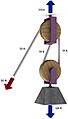
A gun tackle with two rope parts supporting the load
-
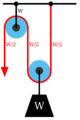
Diagram of forces inside a simple tackle
-
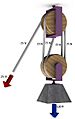
A double tackle using four rope parts
-
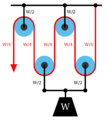
Diagram of forces inside a double tackle
-
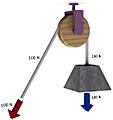
A fixed pulley
-
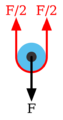
Force diagram for a moving pulley
-
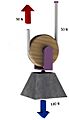
A movable pulley
-
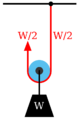
Force diagram for a single movable pulley
-
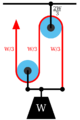
Gun tackle arranged to increase lifting force
-
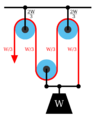
Luff tackle adding another wheel


See also
 In Spanish: Polea para niños
