
Quercus petraea facts for kids
The Quercus petraea, often called the Sessile Oak, is a type of deciduous oak tree. This means it loses its leaves every autumn. It grows naturally across most of Europe, reaching into parts of Asia like Anatolia and Iran.
The Sessile Oak is a very special tree. It is the national tree of Ireland. It is also an important symbol in Wales and Cornwall.
Quick facts for kids Quercus petraea |
|
|---|---|
 |
|
| A mature Sessile Oak tree | |
| Conservation status | |
Scientific classification  |
|
| Kingdom: | Plantae |
| Clade: | Tracheophytes |
| Clade: | Angiosperms |
| Clade: | Eudicots |
| Clade: | Rosids |
| Order: | Fagales |
| Family: | Fagaceae |
| Genus: | Quercus |
| Subgenus: | Quercus subg. Quercus |
| Section: | Quercus sect. Quercus |
| Species: |
Q. petraea
|
| Binomial name | |
| Quercus petraea (Matt.) Liebl.
|
|
| Subspecies | |
 |
|
| Where the Sessile Oak grows | |
| Script error: The function "autoWithCaption" does not exist. | |

Script error: No such module "Check for conflicting parameters".
Contents
Discovering the Sessile Oak
What Does It Look Like?
The Sessile Oak is a tall, strong tree. It can grow up to 40 meters (about 130 feet) high. It belongs to the "white oak" group of trees. It looks quite similar to another oak, the pedunculate oak (Q. robur).
Its leaves are about 7 to 14 centimeters (3 to 5.5 inches) long. They are 4 to 8 centimeters (1.5 to 3 inches) wide. Each leaf has five to six rounded sections, called lobes, on each side. The leaf is attached to the branch by a short stem, called a petiole, which is about 1 centimeter (0.4 inches) long.
In spring, the tree produces male flowers. These flowers hang in long, thin clusters called catkins. The tree's fruit is an acorn. These acorns are 2 to 3 centimeters (0.8 to 1.2 inches) long and 1 to 2 centimeters (0.4 to 0.8 inches) wide. They take about six months to fully grow.
How Is It Different from Other Oaks?
The Sessile Oak has some key differences from the pedunculate oak. The most important difference is in its leaves and acorns. The Sessile Oak has leaves with short stalks (petioles). Its acorns, however, grow directly on the branch without a stalk. This is why it's called "sessile," which means "sitting directly" or "without a stalk."
The pedunculate oak is the opposite. Its leaves grow directly on the branch. But its acorns hang from long stalks, or "peduncles."
Sessile Oaks usually grow in higher areas, above 300 meters (about 1,000 feet). They prefer places with more rain and shallow, sandy soils that are a bit acidic. Its scientific name, petraea, means "of rocky places." The pedunculate oak, on the other hand, likes richer, deeper soils in lower areas. Sometimes, these two types of oaks can mix and create hybrid trees. These hybrids share features from both parent trees.
The Sessile Oak's Family Tree
Naming the Oak
The Sessile Oak first received its scientific name in 1777. A scientist named Heinrich Gottfried von Mattuschka first described it. He thought it was a type of Quercus robur. Later, in 1784, Franz Kaspar Lieblein decided it was a unique species of its own.
Different Types of Sessile Oaks
Just like people, trees can have different varieties. Scientists call these "subspecies." As of early 2026, experts recognize several subspecies of Quercus petraea. These different types might have slight variations in their leaves, acorns, or where they grow.
Challenges and Uses of the Sessile Oak
Pests and Diseases
Like all living things, Sessile Oaks can face challenges. They can be affected by diseases such as Acute oak decline and Sudden oak death. These diseases can harm or even kill oak trees.
There are also insects that like to live on these trees. For example, the Welsh oak longhorn beetle (Pyrrhidium sanguineum) is named after this tree. Its young, called larvae, feed on the dead wood under the bark.
Why Is This Oak Important?
The Sessile Oak is very important in Europe. It has both economic and ecological value. Its strong wood has been used for centuries. People traditionally used it for building houses, making ships, and crafting furniture.
Today, the best quality oak wood is used for fine cabinetmaking. It is also used for thin sheets of wood called veneers. Another special use is for making barrels, especially for aging wine. Less perfect wood is still useful for things like fences and roof beams. Oak wood also has natural properties that help prevent the growth of germs. It is also a good wood to burn for fuel.
In autumn, when there are many acorns (called "mast years"), farmers traditionally let their animals, like pigs, graze under the trees. The animals eat the acorns, which helps them grow strong and healthy.
Famous Sessile Oaks
The Pontfadog Oak: A Welsh Legend
One of the most famous Sessile Oaks was the Pontfadog Oak. It was known as "Wales's national tree." Many believed it was the oldest oak tree in the United Kingdom. This amazing tree grew near Chirk in North Wales. In 1881, its trunk measured over 53 feet (about 16 meters) around! People thought it was more than 1,200 years old. It lived so long partly because it was regularly "pollarded." This is a way of pruning trees by cutting off the upper branches. This encourages new growth and can extend a tree's life. The inside of its hollow trunk was still very wide, measuring 42 feet 5 inches (about 12.9 meters) around.
Sadly, the Pontfadog Oak fell down in strong winds in April 2013. However, its story didn't end there. The Crown Estate, which manages royal lands, grew a young tree, called a sapling, from the original tree. This sapling was planted in Windsor Great Park. Five more saplings were also grown from the Pontfadog Oak. Three of these were planted at the National Botanic Garden of Wales. The other two were planted near Pontfadog, at Chirk Castle and Erddig. These plantings were part of a special woodland memorial for those who passed away during the COVID-19 pandemic.
See also
- Faux de Verzy
Images for kids
-
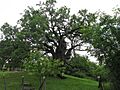
An old sacred oak in Divljana, Serbia
-
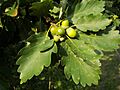
A shoot with leaves and an acorn
-
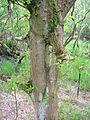
Two trees that have grown together, called an inosculated tree
-
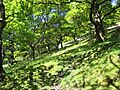
A Sessile Oak growing in a forest


