
Shaft-tailed whydah facts for kids
Quick facts for kids Shaft-tailed whydah |
|
|---|---|
 |
|
| Male in breeding plumage | |
| Conservation status | |
Scientific classification  |
|
| Kingdom: | Animalia |
| Phylum: | Chordata |
| Class: | Aves |
| Order: | Passeriformes |
| Family: | Viduidae |
| Genus: | Vidua |
| Species: |
V. regia
|
| Binomial name | |
| Vidua regia (Linnaeus, 1766)
|
|
| Script error: The function "autoWithCaption" does not exist. | |
| Synonyms | |
|
Emberiza regia Linnaeus, 1766 |
|

Script error: No such module "Check for conflicting parameters".
The shaft-tailed whydah (also called the queen whydah) is a small bird that looks a bit like a sparrow. Its scientific name is Vidua regia. These birds are known for their amazing looks, especially the males during breeding season!
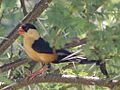
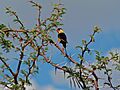
During the time they are looking for a mate, male shaft-tailed whydahs have a black head and back. Their chest is a bright golden color. The most special part is their tail: they grow four very long, black feathers with cool, wide tips. When the breeding season ends, the male loses these long tail feathers. He then grows feathers that look more like the female's, which are olive-brown.
You can find the shaft-tailed whydah in open areas and grasslands across Southern Africa. They live in countries like south Angola and south Mozambique. These birds have a unique way of raising their young: they are brood parasites. This means they lay their eggs in the nests of other birds, like the violet-eared waxbill, and let the other birds raise their chicks! Their main food is seeds.
The shaft-tailed whydah is a common bird and lives in a very large area. Because of this, experts say it is a species of "least concern" on the IUCN Red List of Threatened Species. This means they are not currently in danger of disappearing.
What's in a Name?
The shaft-tailed whydah got its scientific name, Vidua regia, a long time ago. In 1766, a famous Swedish scientist named Carl Linnaeus gave it the name Emberiza regia. He was updating his big book, Systema Naturae, which lists and names all known animals and plants.
The word regia comes from Latin and means "royal." This is probably because of the male's fancy, "royal" tail feathers! Later, in 1816, another scientist named Georges Cuvier placed this bird in the genus Vidua, where it still belongs today.
Gallery
-
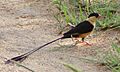
Shaft-tailed whydah
-
-


_(7000402705).jpg)
