
St Matthew's Church, Langford facts for kids
Quick facts for kids St Matthew's Church, Langford |
|
|---|---|
| Parish Church of St Matthew, Langford | |
 |
|
| 51°43′33.6″N 1°38′34.8″W / 51.726000°N 1.643000°W | |
| Location | Langford, Oxfordshire GL7 3LG |
| Country | United Kingdom |
| Denomination | Church of England |
| History | |
| Dedication | Saint Matthew |
| Earlier dedication | Saint Mary |
| Architecture | |
| Style | Anglo-Saxon, Norman, Early English Gothic, Decorated Gothic and Perpendicular Gothic |
| Administration | |
| Parish | Langford St Matthew, including Grafton and Radcot, Langford |
| Deanery | Witney |
| Archdeaconry | Oxford |
| Diocese | Oxford |
| Province | Canterbury |
The Parish Church of Saint Matthew, Langford is a historic church in the village of Langford. It is a Church of England parish church located in West Oxfordshire. Langford is about 3 miles (5 km) northeast of Lechlade. This church is very old and has many interesting features from different time periods.
Contents
How the Church Was Organized
This church started as a smaller church, called a chapelry. It was part of a larger, more important church in Bampton. Later, during the Anglo-Saxon era, Langford's church became a "minster." This meant it was a main church with smaller churches depending on it. It had chapels in nearby places like Grafton and Radcot. These smaller chapels are no longer there. However, Grafton and Radcot are still part of Langford's church area.
Langford was part of the Diocese of Lincoln for a long time. A diocese is a large area managed by a bishop. In 1541, under King Henry VIII, the Diocese of Oxford was created. Langford then became part of this new diocese. The church used to be dedicated to Saint Mary. Later, it was rededicated to its current patron, Saint Matthew.
Today, the church is part of a group of parishes called the Benefice of Shill Valley and Broadshire. This group includes churches from several other villages.
Ancient Anglo-Saxon Building Parts


The oldest parts of St Matthew's Church are its bell tower and the main part of the church, called the nave. These sections were built in the second half of the 11th century. This was around the time of the Norman conquest of England. Even so, they show amazing work by Anglo-Saxon builders. These parts are considered some of the most important Anglo-Saxon remains in Oxfordshire.
Around the year 1200, side sections called aisles were added to the north and south. The south porch was also added in the 13th century. These additions were built in the Early English Gothic style. The west walls of the nave and both aisles have narrow, pointed windows from the 13th century. The porch used to have two floors. The upper floor is gone now, but you can still see where its doorway and stairs were inside the south aisle.
The porch also has two ancient Anglo-Saxon stone carvings called roods. A rood is a cross or crucifix. These carvings were moved here from somewhere else, so we don't know their original spots. One carving on the east wall of the porch is from the 8th century. It has lost its head. The other carving, on the south gable of the porch, is from the 10th century. It shows Christ with Saint Mary and Saint John the Evangelist. Interestingly, Christ's arms are swapped, and the figures of Mary and John are also in the wrong places!
Later Changes and Additions
In the 13th century, the chancel (the area around the altar) was rebuilt. It was made wider and taller. You can still see the outline of the older, 11th-century Anglo-Saxon roof against the tower's east wall. The unique diamond shapes at the top of the chancel windows are very unusual for the 13th century. There's also a fancy cupboard in the chancel's north wall called an aumbry. It has six sections under three pointed tops. This suggests that Langford was a wealthy parish back then.
Many of the windows in the north and south aisles were added in the 14th or 15th centuries. These windows are in the Decorated Gothic or Perpendicular Gothic styles. The church's current font, used for baptisms, is from the 15th century.
In 1574, two flying buttresses were added to the north side of the north aisle. These are supports that help hold up the wall. One of them has a carving that shows the date it was built, during the reign of Queen Elizabeth I. Also in the 16th century, two tall, round decorations were added to the west end of the nave.
The pulpit, where sermons are given, was made in 1673. It is in the Jacobean style. An old clock was put in the church in the late 1600s. It no longer tells time but is displayed in the south aisle.
Restoration and Care
The church has been repaired and updated many times over the centuries. In 1829, an architect named Richard Pace worked on the building. More repairs were suggested in 1848 and done the next year. In 1864, another architect, Ewan Christian, restored the nave roof. He brought it back to its original steep shape.
St. Matthew's Church is now a Grade I listed building. This means it is a very important historic building in England and is protected.
Church Bells
The tower has a set of six bells that can be rung together. Four of these bells were made in 1741 by Henry III Bagley. He had a bell-foundry (a place where bells are made) in Witney at the time. The two largest and smallest bells were made much later, in 1953, by the famous Whitechapel Bell Foundry in London.
Gallery
-
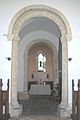
The 11th-century arches inside the tower and a 12th- or 13th-century window on the west side.
-
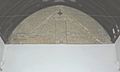
The east wall of the 11th-century tower, showing where the old roof used to be, inside the 13th-century chancel.
-
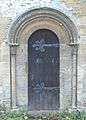
The Norman north doorway of the nave, built around 1200.
-
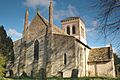
A view of the church from the west, showing the Early English windows and tall 16th-century decorations.
-
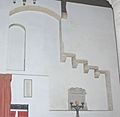
A blocked doorway and the outline of the old stairs that led to a former upper room in the porch. This is probably from the 13th century.
-
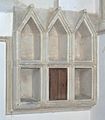
A 13th-century aumbry (cupboard) in the chancel.
-
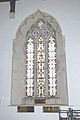
A 14th-century window in the south aisle of the nave with three sections and decorative stone work.
-
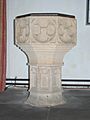
The 15th-century font used for baptisms.
-
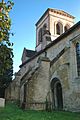
Flying buttresses from the Elizabethan era supporting the north wall of the north aisle.
-
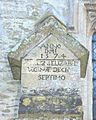
A carving on a buttress showing the date 1574.
-
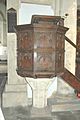
The 17th-century Jacobean pulpit.
-
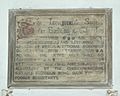
A wooden plaque from 1867, recording a grant from a society that helped build and repair churches.


