
Star Trek: The Original Series facts for kids
Quick facts for kids Star Trek: The Original Series |
|
|---|---|
 |
|
| Genre |
|
| Created by | Gene Roddenberry |
| Starring | |
| Theme music composer | Alexander Courage |
| Country of origin | United States |
| Original language(s) | English |
| No. of seasons | 3 |
| No. of episodes | 79 (list of episodes) |
| Production | |
| Executive producer(s) | Gene Roddenberry |
| Producer(s) |
|
| Running time | 51 minutes |
| Production company(s) |
|
| Budget | Per episode: Season 1: $190,000 Season 2: $185,000 Season 3: $175,000 |
| Release | |
| Original network | NBC |
| Original release | September 8, 1966 – June 3, 1969 |
| Chronology | |
| Related shows |
|
Star Trek is a famous American science fiction TV show. It was created by Gene Roddenberry. The show follows the exciting adventures of a starship called the USS Enterprise (NCC-1701) and its brave crew. People often call it Star Trek: The Original Series (TOS) to tell it apart from all the other Star Trek shows and movies that came later.
The story takes place in the Milky Way galaxy between the years 2266 and 2269. The main characters are Captain James T. Kirk (William Shatner), his logical First Officer and Science Officer Spock (Leonard Nimoy), and the kind Chief Medical Officer Leonard H. "Bones" McCoy (DeForest Kelley). Each episode begins with a famous speech about exploring where no one has gone before.
The show first aired on NBC from September 8, 1966, to June 3, 1969. Even though it had low ratings at first, it became a huge international success through reruns in the 1970s. Star Trek is now a cult classic. It has inspired many other TV shows, movies, books, games, and toys. It is one of the most popular and influential TV series ever made.
Contents
How the Show Began: Creating a Universe

In 1964, Gene Roddenberry, a big fan of science fiction, wrote down his idea for a new TV show. He called it Star Trek. His vision was about a large starship named S.S. Yorktown (later changed to Enterprise). Its crew would explore the Milky Way galaxy in the 23rd century.
Roddenberry was inspired by many stories. These included tales of daring sea captains on long missions. He even joked that Captain Kirk was like "Horatio Hornblower in Space." He also thought of it as "Wagon Train to the stars." This meant each episode would be a new adventure during a continuous journey.
Roddenberry first imagined Captain Robert April, then Captain Christopher Pike, as the leader of the Enterprise. Eventually, William Shatner was cast as Captain James T. Kirk.
Building the Starship Enterprise

Once NBC decided to make Star Trek, a team of talented people brought the show to life. Art director Matt Jefferies designed the iconic starship Enterprise. He also created most of its interior rooms. His work was so important that a part of the ship, the "Jefferies tube", was named after him. He also designed the bridge of the Enterprise and the hand-held phaser weapons.
The costume designer, Bill Theiss, created the cool Starfleet uniforms. He also designed the outfits for many different aliens. These included the Klingons, Vulcans, and Romulans.
Artist and sculptor Wah Chang designed many of the show's props. He created the flip-open communicator, which some say inspired early cellular telephones. He also designed the "tricorder" device for sensing and recording. Chang helped create memorable aliens like the Gorn and the Horta.
Adventures on Television: Seasons and Stories
NBC ordered 16 episodes of Star Trek after the second pilot. The first regular episode, "The Man Trap", aired on September 8, 1966.
The First Missions: Season 1
The first season of Star Trek had mixed reviews. Some liked it, others were unsure. Its ratings were not very high. However, NBC noticed that the show had a special audience. Many viewers were well-educated and had higher incomes. This "quality audience" helped convince NBC to keep the show. They ordered more episodes and a second season.
Fans Save the Day: Season 2

During the second season, rumors spread that Star Trek might be canceled. Fans were very upset! A fan named Bjo Trimble and her husband, John, started a huge letter-writing campaign. They asked other fans to write to NBC to save the show.
Look! Look! It doesn't stop! They're lined up all the way down the street!
NBC received almost 116,000 letters between December 1967 and March 1968. Many letters came from doctors, scientists, and teachers. Even the Governor of New York, Nelson Rockefeller, wrote a letter! Students from colleges like Caltech and MIT held protests to support the show. This amazing fan effort convinced NBC to renew Star Trek for a third season. It was a rare event in TV history!
The Final Frontier: Season 3

For its third season, NBC moved Star Trek to a late Friday night slot. This time slot was not good for attracting many viewers. Gene Roddenberry was disappointed and stepped back from daily production. The show's budget was also cut. This led to some challenges in making the episodes.

The last day of filming for Star Trek was January 9, 1969. After 79 episodes, NBC canceled the show in February. Even with another fan campaign, it was too late.
A New Beginning: Syndication Success
Even though it was canceled, Star Trek found new life in television syndication. This means local TV stations bought the rights to show reruns. Airing in the late afternoon or early evening, the show attracted many new, often young, viewers.
By the 1970s, Star Trek became a huge cult classic. Fans, known as "trekkies," gathered at conventions. They traded merchandise, met actors, and watched old episodes. This strong fan base helped the show become incredibly popular. By 1987, Paramount was earning a lot of money from each episode. The reruns continued to air in many countries for decades.
Modern Look: Remastered Episodes
To celebrate the show's 40th anniversary in 2006, CBS Paramount Domestic Television created a new, enhanced version. They used CGI to update the visual effects. This gave Star Trek: The Original Series a more modern look. The Enterprise, alien planets, and other special effects were all recreated in high definition.
Meet the Crew: Star Trek Characters
The actors of Star Trek became very famous because of their roles. Here are the main crew members of the USS Enterprise:
-
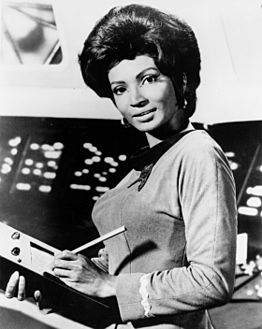
Nyota Uhura
-
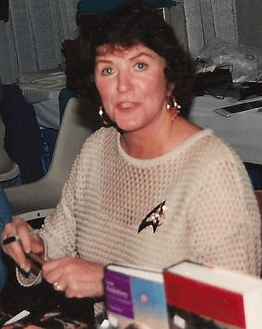
Majel Barrett, who portrayed Christine Chapel
-
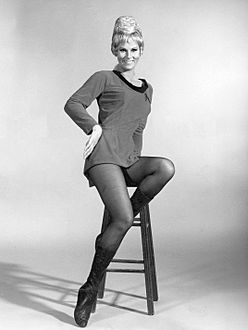
Janice Rand


| Actor | Character | Position | Appearances | Character's species | Rank |
|---|---|---|---|---|---|
| William Shatner | James T. Kirk | Commanding officer | Seasons 1–3 | Human | Captain |
| Captain Kirk is the brave leader of the USS Enterprise. He was born in Riverside, Iowa. His two best friends are Spock and Dr. McCoy. Spock offers logical advice, while McCoy gives emotional insights. | |||||
| Leonard Nimoy | Spock | First/Executive officer Science officer |
Seasons 1–3 | Half-Human/Half-Vulcan | Lieutenant commander Season 1 Commander Seasons 1–3 |
| Spock is the half-human, half-Vulcan second-in-command and science officer. He is one of Kirk's best friends and always uses logic to solve problems. | |||||
| DeForest Kelley | Dr. Leonard "Bones" McCoy | Chief medical officer | Seasons 1–3 | Human | Lieutenant Commander |
| Dr. McCoy is the ship's chief medical officer. He is Kirk's other best friend. He often gives advice based on his human feelings, which is different from Spock's logic. | |||||
| James Doohan | Montgomery "Scotty" Scott | Second officer and chief engineer | Seasons 1–3 | Human | Lieutenant commander |
| Scotty is the Enterprise's Scottish Chief Engineer and third-in-command. He is very protective of the ship. His amazing technical skills often help solve difficult problems at the last minute. | |||||
| Nichelle Nichols | Nyota Uhura | Communications officer | Seasons 1–3 | Human | Lieutenant |
| Uhura is the ship's communications officer. She is a skilled officer who can also take control of other stations on the bridge. She is also a talented singer. | |||||
| George Takei | Hikaru Sulu | Helmsman | Seasons 1–3 | Human | Lieutenant |
| Sulu is the ship's helmsman. He has many interesting hobbies, including gymnastics, fencing, and studying ancient weapons. | |||||
| Walter Koenig | Pavel Chekov | Navigator | Seasons 2 & 3 | Human | Ensign |
| Chekov is a young Russian navigator who joined the crew in the show's second season. | |||||
| Majel Barrett | Christine Chapel | Head nurse | Seasons 1–3 | Human | N/A |
| Nurse Chapel is the ship's head nurse and works closely with Dr. McCoy. Majel Barrett also voiced the ship's computer. | |||||
| Grace Lee Whitney | Janice Rand | Yeoman | Season 1 | Human | N/A |
| Janice Rand was Captain Kirk's personal assistant for part of the first season. | |||||
The show often featured characters, usually security personnel in red uniforms, who would be killed or injured soon after appearing. This became so common that it inspired the term "redshirt." A "redshirt" is a character whose main purpose is to show how dangerous a situation is for the main heroes.

The three main characters, Kirk, Spock, and McCoy, had very different personalities. Kirk was brave and sometimes aggressive, with a good sense of humor. Spock was always logical and calm. McCoy, or "Bones," was emotional, sometimes grumpy, but always caring. Their different ways of thinking often led to interesting discussions and helped Kirk make tough decisions. McCoy and Spock often argued, but they truly respected each other.
Famous Faces: Guest Stars
Many talented actors appeared as guest stars on Star Trek. Some notable ones include Ricardo Montalbán as Khan Noonien Singh in "Space Seed" and Joan Collins in "The City on the Edge of Forever". Mark Lenard played members of three different alien races, most famously Spock's father, Sarek.
Beyond the TV Screen: Star Trek's Legacy
Iconic Music: The Theme Song
The memorable theme song for Star Trek was written by Alexander Courage. This tune has been used in many other Star Trek shows and movies.
Top Adventures: Favorite Episodes
Many publications have ranked the best episodes of Star Trek. Here are some of the top-ranked episodes:
| Rank | Entertainment Weekly (1995) |
IGN (2012) |
Newsweek (2016) |
Hollywood.com (2013) |
Den of Geek (2021) |
|---|---|---|---|---|---|
| 1 | "The City on the Edge of Forever" | "The City on the Edge of Forever" | "The Doomsday Machine" | "The City on the Edge of Forever" | "A Taste of Armageddon" |
| 2 | "Space Seed" | "Balance of Terror" | "Space Seed" | "Arena" | "The City on the Edge of Forever" |
| 3 | "Mirror, Mirror" | "Mirror, Mirror" | "Mirror, Mirror" | "Mirror, Mirror" | "The Corbomite Maneuver" |
| 4 | "The Doomsday Machine" | "Space Seed" | "The Trouble with Tribbles" | "Balance of Terror" | "The Devil in the Dark" |
| 5 | "Amok Time" | "The Trouble with Tribbles" | "The Enterprise Incident" | "Space Seed" | "A Piece of the Action" |
| 6 | "The Devil in the Dark" | "Where No Man Has Gone Before" | "Journey to Babel" | "The Galileo Seven" | "Space Seed" |
| 7 | "The Trouble with Tribbles" | "The Enemy Within" | "Balance of Terror" | "Amok Time" | "Balance of Terror" |
| 8 | "This Side of Paradise" | "The Naked Time" | "Arena" | "Journey to Babel" | "Arena" |
| 9 | "The Enterprise Incident" | "This Side of Paradise" | "Amok Time" | "The Doomsday Machine" | "Let That Be Your Last Battlefield" |
| 10 | "Journey to Babel" | "Arena" | "The City on the Edge of Forever" | "The Enterprise Incident" | "The Man Trap" |
"The City on the Edge of Forever" and "Space Seed" are the only two episodes that appear on all five lists.
Awards and Recognition
Star Trek received many nominations for Emmy Awards, including for Outstanding Dramatic Series and for Leonard Nimoy as Mr. Spock. It won several Hugo Awards, which are top awards in science fiction. In 1967 and 1968, it won for the episodes "The Menagerie" and "The City on the Edge of Forever".
In 1967, Star Trek was also one of the first TV shows to receive an NAACP Image Award. Later, TV Guide ranked Star Trek as the greatest cult show ever in 2004 and 2007. In 2013, it was ranked as one of the greatest sci-fi shows and the #12 greatest show of all time.
From TV to Movies: The Films
After the original TV series ended, fans wanted more. The success of the reruns led to a series of Star Trek movies. The first film, Star Trek: The Motion Picture, came out in 1979. It was followed by five more movies starring the original cast, ending with Star Trek VI: The Undiscovered Country in 1991.
Later, a new set of Star Trek films began in 2009 with Star Trek. These movies show younger versions of the original crew. They are set in a slightly different timeline, called the "Kelvin Timeline." This allowed for new stories while still honoring the original series. These films include Star Trek Into Darkness (2013) and Star Trek Beyond (2016).
Toys, Comics, and More: Merchandising
Star Trek: The Original Series has inspired many products. These include toys, comic books, and games. In the 1970s, the Mego Corporation made popular Star Trek action figures. These included Captain Kirk, Mr. Spock, and other characters. Today, new versions of these classic toys are still being made.
The first Star Trek comics were published by Gold Key Comics from 1967 to 1978. These comics told new stories. Later, other companies like DC Comics and Marvel Comics also published Star Trek comic books.
Lasting Impact: Parodies and Fan Creations
Star Trek has been parodied many times in other TV shows. Saturday Night Live created famous sketches like "The Last Voyage of the Starship Enterprise." Shows like The Simpsons and Futurama have also made fun of Star Trek in loving ways. The movie Galaxy Quest is a comedy that spoofs the lives of a fictional space-drama crew, much like Star Trek.
Fans have also created their own Star Trek stories and films. These "fan productions" show how much people love the series. Some, like Star Trek: Phase II and "Star Trek: Continues", have even received support from original cast members.
The Star Trek Universe: Other Shows

The original Star Trek started a huge universe of stories. Many other TV shows have been made, continuing the adventures in the same shared world. These include:
- The Animated Series (1973–1974)
- The Next Generation (1987–1994)
- Deep Space Nine (1993–1999)
- Voyager (1995–2001)
- Enterprise (2001–2005)
- Discovery (2017–2024)
- Star Trek: Short Treks (2018–2020)
- Picard (2020–2023)
- Lower Decks (2020–2024)
- Prodigy (2021–2024)
- Very Short Treks (2023)
- Strange New Worlds (2022–present)
- Starfleet Academy (2026–present)
See also
 In Spanish: Star Trek: la serie original para niños
- "Beam me up, Scotty"
- Outline of Star Trek
- Timeline of Star Trek
