
Turkey vulture facts for kids
Quick facts for kids Turkey vulture |
|
|---|---|
_Orange_Walk.jpg) |
|
| C. a. aura Orange Walk District, Belize |
|
| Conservation status | |
Scientific classification  |
|
| Kingdom: | Animalia |
| Phylum: | Chordata |
| Class: | Aves |
| Order: | Accipitriformes |
| Family: | Cathartidae |
| Genus: | Cathartes |
| Species: |
C. aura
|
| Binomial name | |
| Cathartes aura (Linnaeus, 1758)
|
|
 |
|
| Range of C. aura Summer only range Year-round range | |
| Script error: The function "autoWithCaption" does not exist. | |
| Synonyms | |
|
Vultur aura Linnaeus, 1758 |
|

Script error: No such module "Check for conflicting parameters".
The turkey vulture (Cathartes aura) is a fascinating bird found across the Americas. It's the most common type of New World vulture. These birds live from southern Canada all the way down to the tip of South America. You can spot them in many places, like forests, grasslands, and even deserts.
Turkey vultures are amazing scavengers. This means they mostly eat dead animals, which helps keep our environment clean! They have a super sense of smell and sharp eyesight to find their meals. When they fly, they glide high in the sky, using warm air currents to save energy. They don't make many sounds, mostly just grunts or hisses. They build their nests in hidden spots like caves or hollow trees. Each year, they usually raise two chicks. These important birds are protected by law in many places, like the United States.
Contents
What's in a Name?
This bird has a few different names! In some parts of North America, people call it a "buzzard" or "turkey buzzard." But be careful, because in other parts of the world, a "buzzard" is a different type of bird, like a hawk! In the Caribbean, it's sometimes known as the "John crow" or "carrion crow."
Its main name, "turkey vulture," comes from how its bald red head and dark feathers look a bit like a male wild turkey. The word "vulture" comes from a Latin word meaning "tearer," which describes how it eats.
Understanding the Turkey Vulture's Family Tree
Scientists group living things to understand how they are related. This is called taxonomy. The turkey vulture belongs to a group called New World vultures. These birds live in North and South America.
Even though turkey vultures look a lot like Old World vultures (found in Europe, Africa, and Asia), they are not closely related! It's a cool example of convergent evolution. This means different animals can develop similar features because they live similar lives. Imagine two different types of cars that both need to go fast, so they both end up looking sleek and aerodynamic, even if they were designed by different companies.
Scientists used to think New World vultures might be related to storks. But newer studies, especially looking at their DNA, show that New World vultures are actually in their own special group. They are like cousins to birds of prey such as eagles and hawks, but not direct relatives.
Where Do Turkey Vultures Live?
The turkey vulture lives in a huge area! You can find them all over the Americas, from southern Canada down to the very tip of South America. They are one of the most common vultures in the world.
These birds love open spaces and areas with some trees. They often live where forests meet open fields. This gives them good places to nest and rest. They also like hilly or low mountainous areas, which makes it easier for them to take off into flight. You might see them flying over grasslands, deserts, and even near farms. They can adapt to many different environments.
Some turkey vultures in the northern parts of their range fly south for the winter, like many other birds. But those in warmer southern areas stay put all year.
In Uruguay, there's a place called Quebrada de los Cuervos (Crows Ravine). It's named after these birds and their cousins, the black vultures, who live there together.

Different Kinds of Turkey Vultures
There are five slightly different types, or subspecies, of turkey vultures. They mostly look alike but have small differences in size, color, or where they live.
| Image | Subspecies | Common Name | What Makes Them Special | Where They Live |
|---|---|---|---|---|
.jpg) |
C. a. aura
Linnaeus, 1758 |
Antillean turkey vulture | This is the original type. It's the smallest subspecies. | From Mexico south through South America and the Greater Antilles. |
_(cropped).jpg) |
C. a. jota
Molina, GI 1782 |
Chilean turkey vulture | These are larger and a bit browner than some others. | Found from the Andes in Colombia all the way to southern Argentina. |
 |
C. a. meridionalis
Swann, 1921 |
Western turkey vulture | This type is known for migrating long distances. | Breeds from southern Manitoba and British Columbia south to Baja California and Texas. They migrate as far as South America. |
 |
C. a. ruficollis Spix, 1824 | Tropical turkey vulture | These are darker, almost black, with some brown on their wings. Adults often have a pale yellow spot on their head. | Found in Panama south through Uruguay and Argentina, and on the island of Trinidad. |
.jpg) |
C. a. septentrionalis
Wied-Neuwied, 1839 |
Eastern turkey vulture | These birds have different tail and wing shapes compared to western types. They usually don't migrate as far south. | From southeastern Canada south through the eastern United States. |
What Does a Turkey Vulture Look Like?

Turkey vultures are big birds! Their wings can spread out between 160 and 183 centimeters (about 5 to 6 feet) wide. They are about 62 to 81 centimeters (2 to 2.5 feet) long and weigh between 0.8 and 2.41 kilograms (about 1.7 to 5.3 pounds). Birds living in colder northern areas tend to be a bit larger.
Both male and female turkey vultures look the same. Their bodies are mostly brownish-black. But when they fly, the underside of their wings looks silvery-gray, which stands out against their darker wing feathers.
Their head is small and red, with very few feathers. This bald head helps them stay clean when they eat. They have a short, hooked, ivory-colored beak. Their eyes are gray-brown, and their legs and feet are pinkish.

Turkey vultures have flat, weak feet that aren't good for grabbing things. Their claws are also blunt. This is because they don't hunt live prey like eagles do.
When they fly, their tail looks long and thin. You can tell them apart from black vultures because black vultures have shorter tails and wings. A cool fact about their nose: their nostrils are open all the way through their beak! You can see right through them from the side.
Young turkey vultures look a bit different. They have a gray head with a black beak tip. As they grow up, their head turns red and their beak becomes ivory, just like the adults.
How long do they live? We know of one turkey vulture named Lord Richard who hatched in 1974. As of today, he is 52 years old and lives at the Lindsay Wildlife Experience in California! Another vulture named Nero, also hatched in 1974, lived to be 47 years old before he passed away in 2022. In the wild, the oldest recorded turkey vulture lived for 16 years.
Sometimes, you might see a turkey vulture that looks very pale or white. These are called Leucistic birds. They are not true albinos, but they have less color in their feathers.
Just like most other vultures, turkey vultures don't sing. They can only make hissing and grunting sounds because they don't have a special voice box called a syrinx.
-
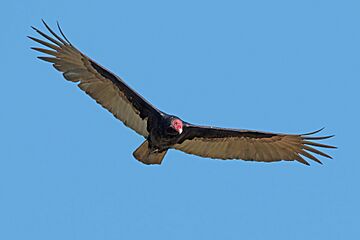
Antillean turkey vulture
C. a. aura, Cuba -
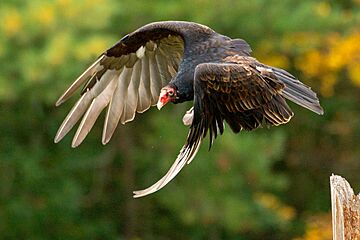
Eastern turkey vulture
C. a. septentrionalis, Canada -
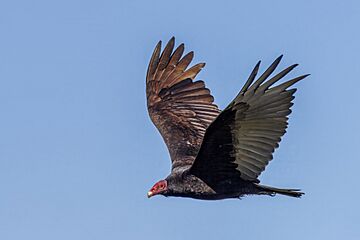
Chilean turkey vulture
C. a. jota, Chile
_in_flight.JPG)

_in_flight_Maipo.jpg)

How Turkey Vultures Live and Behave
Turkey vultures are social birds. They often gather in large groups to rest, especially at night. These groups, called roosts, can have hundreds of vultures, sometimes even including black vultures. They like to roost on tall, dead trees or man-made structures like water towers.
You might often see a turkey vulture standing with its wings spread wide open, like it's sunbathing. This pose helps them dry their wings, warm their bodies, and even kill bacteria on their feathers. They do this more often after a damp or rainy night. Other vultures and even storks do this too!

To cool down on hot days, turkey vultures have a unique trick. They sometimes poop on their own legs! This might sound strange, but as the water in their waste evaporates, it helps cool the blood flowing through their unfeathered legs and feet. This process is called urohidrosis.
Predators and Defenses
Turkey vultures have very few natural enemies. Young birds, eggs, and chicks might be eaten by animals like raccoons and opossums. Adult vultures can sometimes be caught by large birds of prey like great horned owls or golden eagles.
Their main way to defend themselves is quite gross but effective! If they feel threatened, they will throw up (regurgitate) their half-digested food. This smelly, messy substance can scare away most animals trying to bother them or their nest. Sometimes, they also throw up a heavy meal to become lighter so they can fly away quickly from danger.
Flying High
On the ground, turkey vultures walk a bit awkwardly, with a hopping motion. It takes a lot of effort for them to take off into the air. They flap their wings hard and push off the ground with their feet.
Once they are flying high, they are graceful masters of the sky. They hold their wings in a shallow "V" shape. They often tip from side to side, which makes their gray wing feathers look silvery in the sunlight. They are expert at "static soaring." This means they use rising currents of warm air, called thermals, to glide without flapping their wings very often. This saves them a lot of energy!
Reproduction and Life Cycle
The time when turkey vultures lay eggs and raise their young changes depending on where they live. In warmer southern areas, it starts in March. In northern places, it begins later and can last until August.
During courtship, several vultures might gather in a circle. They hop around with their wings partly open. In the air, one bird might follow another, flapping and diving in a special dance.
Nests and Chicks

Turkey vultures don't build fancy nests. They lay their eggs in safe, hidden spots. These can be in caves, cracks in rocks, hollow trees, or thick bushes. The eggs are laid right on the bare surface.
Usually, a female lays two eggs, but sometimes one, and rarely three. The eggs are cream-colored with brown or purple spots. Both parents take turns sitting on the eggs to keep them warm. After about 30 to 40 days, the chicks hatch.
Baby turkey vultures are helpless when they are born. Both adults feed their chicks by bringing up (regurgitating) food for them. They care for their young for about 10 to 11 weeks. If an adult vulture feels threatened while nesting, it might pretend to be dead or throw up on the intruder. If the chicks are in danger, they will hiss and throw up to defend themselves. The young birds learn to fly when they are about nine to ten weeks old. Family groups often stay together until the fall.
What Do Turkey Vultures Eat?
Turkey vultures are nature's clean-up crew! They mostly eat carrion, which means dead animals. They prefer animals that have died recently and avoid those that are too old or rotten. They eat all sorts of dead animals, from small mice to large deer.
They rarely hunt live prey. If they do, it's usually very small, weak, or sick animals, like bird eggs or baby reptiles. They have also been seen eating some plant matter, like fruits, and even animal droppings.
You often see turkey vultures along roadsides, eating animals that have been hit by cars. They also feed on dead fish washed up near water. By eating carrion, they play a super important role in the ecosystem. They help get rid of dead animals that could otherwise spread diseases.
-
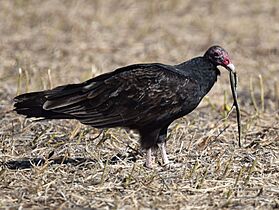
Eating a live garter snake
-
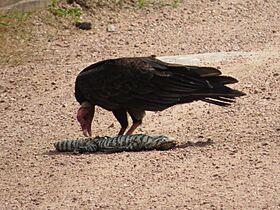
Tropical turkey vulture (C. a. ruficollis) eating an Argentine black and white tegu.
.jpg)


Amazing Sense of Smell
One of the most amazing things about turkey vultures is their incredible sense of smell! This is very rare for birds. They fly low to the ground to sniff out a gas called ethyl mercaptan. This gas is produced when dead animals start to decay. Their brain has a special part, called the olfactory lobe, that is much larger than in other animals, helping them process these smells.
Because they can smell so well, turkey vultures often find carcasses first. Other vultures, like king vultures and black vultures, sometimes follow turkey vultures to find food. These other vultures might not have as good a sense of smell.
When they find a large dead animal, bigger vultures like king vultures or condors might arrive and make the first tear in the tough skin. This helps the turkey vulture, which has a weaker beak, get to the meat. It's like teamwork! Black vultures can be more aggressive and often push turkey vultures away from food, especially when many black vultures arrive. However, turkey vultures are usually dominant over crows at a carcass.

Turkey Vultures and Humans

Sometimes, people worry that turkey vultures spread diseases to farm animals. However, studies show that viruses like the one causing hog cholera are destroyed in the turkey vulture's stomach. This means they don't spread the disease.
Farmers might also worry because black vultures sometimes attack newborn calves. But turkey vultures do not kill live animals. They only eat what is already dead. If you see a turkey vulture near a dead calf, it's just there to clean up, not because it caused harm.
The droppings from large groups of vultures can sometimes harm trees and plants where they roost.
Turkey vultures can face health risks from human activities. For example, they can get lead poisoning if they eat meat from animals shot by hunters using lead bullets. When they eat these lead pellets, the toxic lead gets into their bodies. Even small amounts of lead can make them sick, hurt their brains, or affect their ability to have babies.
These important birds are protected by law in many countries. In the United States, the Migratory Bird Treaty Act of 1918 makes it illegal to harm, kill, or even possess turkey vultures, their eggs, or feathers without a special permit. This law helps ensure these valuable scavengers continue to thrive. The turkey vulture is listed as a species of least concern by the IUCN Red List, meaning their populations are stable and not currently threatened.
See also
 In Spanish: Lore gallipavo para niños
