
Uber facts for kids
 |
|
_-2.jpg)
Headquarters in Mission Bay, San Francisco
|
|
|
Formerly
|
Ubercab (2009–2011) |
|---|---|
| Public | |
| Traded as | |
| Industry | |
| Founded | March 2009 |
| Founders |
|
| Headquarters |
|
|
Area served
|
70 countries and 15,000 cities worldwide |
|
Key people
|
|
| Services |
|
| Revenue |  US$52.017 billion (2025) US$52.017 billion (2025) |
|
Operating income
|
US$5.565 billion (2025) |
| US$10.053 billion (2025) |
|
| Total assets | US$61.802 billion (2025) |
| Total equity | US$27.041 billion (2025) |
|
Number of employees
|
34,000 (2025) |

Uber Technologies, Inc. is a large American transportation company. It connects riders with drivers using a handy mobile app. The company also offers food delivery, courier services, and freight transport for moving heavy cargo. Uber has its main headquarters in San Francisco, California. Today, it operates in roughly 70 different countries and 15,000 cities. It is the largest ridesharing company on the planet. Over 202 million monthly active users use the platform. More than 10 million active drivers and couriers help people travel every single day.
The company coordinates about 42 million trips and delivery orders each day. Since starting in 2010, Uber has completed over 72 billion customer trips. People can choose many options, ranging from basic rides to electric vehicle rides. Uber also partners with tech leaders like Nvidia, Baidu, and Rivian. Together, they develop modern robotaxi services that drive themselves safely without human hands.
Contents
What Is Uber and How Did It Begin?

In 2009, two entrepreneurs named Garrett Camp and Travis Kalanick had an idea. Camp had previously co-founded a website called StumbleUpon. One winter night in Paris, he had trouble finding an empty taxi. Later, on New Year's Eve, the two friends spent $800 on a private driver. They thought this price was way too expensive. Camp wanted to make hiring a car simpler and cheaper using a phone.
Camp created a prototype of the mobile app with his friends Conrad Whelan and Oscar Salazar. Kalanick served as an important advisor to help build the business. In February 2010, Ryan Graves joined as the first official employee. Graves quickly became the chief executive officer, also known as the CEO. Kalanick took over as CEO later that year in December. Graves then moved to the role of chief operating officer to manage daily operations.
The service began testing in May 2010 and opened to the public in San Francisco in 2011. At first, the company was called UberCab. Riders could only book fancy black luxury cars through the phone program. These rides cost about 50 percent more than a regular metered taxicab. Soon, taxicab operators complained about the original name. The founders shortened the name to Uber in late 2011.
Growing the Ride Network
Uber wanted to predict arrival times much better than basic Google APIs could. The team hired a computational neuroscientist, a nuclear physicist, and machine experts to study city traffic. In April 2012, Uber started service in Chicago, allowing riders to request standard city cabs.
In July 2012, the company introduced an affordable service called UberX. Originally, UberX drivers needed professional commercial licenses. However, other startup services like Sidecar, Lyft, and Wingz let regular citizens drive their own family cars. Earlier community carpools such as Homobiles inspired this friendly, everyday ride concept. In April 2013, Uber allowed regular drivers with clean records to join UberX. Drivers had to pass a background check and keep clean, safe personal cars.
By the end of 2013, Uber was operating in 65 cities. The newspaper USA Today named it the tech company of the year. In August 2014, Uber created a shared transport carpooling tool in the San Francisco Bay Area. That same month, it launched Uber Eats so hungry customers could order meals from local kitchens.
Expanding Around the Globe

Uber quickly expanded across many oceans, but entering foreign markets brought big challenges. In China, Uber faced intense competition from a popular local service named DiDi. After spending billions of dollars, Uber sold its Chinese branch to DiDi in 2016. In return, Uber gained an 18% ownership share in DiDi.
In early 2018, Uber combined its operations in Russia, Belarus, and Kazakhstan with Yandex Taxi. Years later, in 2023, Yandex bought out Uber's share for over $700 million. In March 2018, Uber joined forces in Southeast Asia with its competitor Grab. In exchange, Uber received a large ownership stake in Grab.
In the Middle East, Uber purchased a company named Careem in 2020 for $3.1 billion. In Turkey, Uber bought control of a grocery delivery business called Trendyol Go. It also bought DanTaxi, the leading taxicab network across Denmark. To speed up meal drop-offs around the world, Uber bought the delivery group Postmates. In 2026, Uber bought the international food ordering firm Delivery Hero for $14.8 billion.
New Inventions and Future Travel
Uber explores creative ways to move people and packages across crowded cities. In 2016, it purchased Ottomotto, a company creating a self-driving truck. The business created an internal artificial intelligence and machine learning research group called Uber AI. Uber later partnered with Waymo to improve long-distance freight hauling.
In May 2019, Uber transformed into an open public company on the stock market. Around that time, leadership changed. Dara Khosrowshahi, former leader of Expedia Group, became the CEO. Under his direction, the business focused on cleaner, greener travel. Uber set a goal to reach complete carbon neutrality by the year 2040. It encouraged drivers to switch to zero-emission electric vehicles, partnering with Tesla and rental groups.
Developing Driverless Robotaxis
Uber works closely with high-tech partners to design robotaxi fleets that steer on their own. It collaborated with Lucid Motors, ordering Lucid Gravity electric SUVs for self-driving tests. Uber also joined with Nuro to test tiny delivery robots that roll along sidewalks.
In 2026, Uber launched a specialized division called Uber Autonomous Solutions. It handles autonomous vehicles, automated delivery bots, and software support systems. The company teamed up with Rivian to deploy tens of thousands of electric robotaxis. It also works with Nvidia to run smart Nvidia Drive software inside autonomous cars. Outside of cars, Uber teamed with Joby Aviation to explore fast flights using VTOL electric aircraft.
Rules, Safety, and Fair Play
Working With City Leaders
As Uber grew, it sometimes launched without formal permits from local transportation boards. This led to disagreements with local city halls. In Pennsylvania, the company paid an $11.4 million fine for operating before receiving legal clearance. In some regions, Uber used lobbying to ask government leaders to update ancient transportation rules.
Traditional taxi drivers felt the competition was unfair because they bought expensive official licenses. In Boston and San Francisco, taxi groups took Uber to court. In Australia, a law group named Maurice Blackburn brought a class action case. Uber settled that Australian case by agreeing to pay AU$271.8 million to license holders.
Protecting Rider and Driver Rights
Uber must obey laws that guarantee equal access for everyone. In 2018, advocates pointed out that cities needed more wheelchair accessible van vehicles. In another case, an arbitrator ruled that Uber had to protect travelers using a guide dog. The ruling explained that the Americans with Disabilities Act requires drivers to welcome service animals.
Workers have also held rallies and organized strikes to ask for better earnings. Groups such as Rideshare Drivers United asked for fair treatment and honest pay. In 2019, lawmakers passed California Assembly Bill 5 (2019) to redefine how gig workers are treated under state law. In Europe, government agencies like the Dutch Data Protection Authority watch over automated smartphone systems. They make sure real human managers review important decisions that affect drivers.
Keeping Digital Information Safe
Because millions of riders enter personal details, data security is an important responsibility. In 2015, Uber reported that an unauthorized visitor accessed records from 50,000 drivers. In 2016, another data breach affected names, email addresses, and phone numbers. The company settled with the Federal Trade Commission to make sure its data protections remained secure. Uber continues updating its VPN networks and firewalls to protect rider and driver accounts.
Global Operations and Company Facts
| Business Segment | Sales in Billions | Percentage Share |
|---|---|---|
| Mobility Rides | $25.1 | 57.0% |
| Delivery Orders | $13.8 | 31.3% |
| Freight Shipping | $5.1 | 11.7% |
| Region | Sales in Billions | Share of Business |
|---|---|---|
| United States and Canada | $23.6 | 53.7% |
| Europe, the Middle East and Africa | $12.5 | 28.5% |
| Asia–Pacific | $5.0 | 11.5% |
| Latin America | $2.8 | 6.4% |
In March 2021, Uber moved into modern offices on Third Street in Mission Bay, San Francisco. The campus features large buildings joined together by skywalks and bridges. In 2023, the company reached an exciting milestone by earning its first full operating profit. By 2025, annual company revenue reached $52 billion. Today, Uber continues to shape how people travel and discover meals worldwide.
Images for kids
-
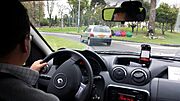
An Uber driver in Bogotá, Colombia with the Uber app on a dashboard-mounted iPhone
-
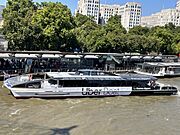
Uber Boat by Thames Clippers on River Thames, London
.jpg)

See also
 In Spanish: Uber para niños
