
Vanessa indica facts for kids
Quick facts for kids Indian red admiral |
|
|---|---|
 |
|
Scientific classification  |
|
| Kingdom: | Animalia |
| Phylum: | Arthropoda |
| Class: | Insecta |
| Order: | Lepidoptera |
| Family: | Nymphalidae |
| Genus: | Vanessa |
| Species: |
V. indica
|
| Binomial name | |
| Vanessa indica (Herbst, 1794)
|
|
| Script error: The function "autoWithCaption" does not exist. | |
| Synonyms | |
|
|
Script error: No such module "Check for conflicting parameters".
The Indian red admiral (scientific name Vanessa indica) is a colorful butterfly. People in the United States often call it the Asian admiral. Naturalist Herbst first described this butterfly species scientifically in 1794. It belongs to the brush-footed butterfly family. It is a very close relative of the famous painted lady. This insect is famous for its swift flight across high mountains.
Contents
Where does the Indian red admiral live?

This lively butterfly lives in high regions across parts of Asia. It is common in the high mountain areas of India. You can find it throughout the chilly peaks of the Himalayas. It also thrives down south in the lush Nilgiri Hills. Outside mainland India, it lives on the tropical island of Sri Lanka. It flies across the forests of Myanmar, China, Korea, Japan, and southeastern Russia.
The insect prefers areas higher than 2,000 feet (about 600 meters) above sea level. In southern India, it settles on smaller hill ranges as well. For example, it lives around the scenic Nandi Hills near Bangalore. It loves open sunny clearings near rivers inside mountain jungles. You can also spot it resting on grassy patches near quiet mountain roads.
Subspecies around the world
Scientists have split this insect into three main groups called subspecies:
- Vanessa indica indica lives across northern parts of India and Myanmar.
- Vanessa indica nubicola makes its home on the island of Sri Lanka.
- Vanessa indica pholoe stays in the mountain ranges of southern India.
What does the butterfly look like?
The Indian red admiral looks quite similar to the familiar painted lady. However, its colors are much darker and richer. The background of its wings shows deep brownish-black tones. Bright, deep orange-red bands sweep across its wings. These markings look stronger than those on other admiral butterflies. It is fairly large, with a full wingspan reaching around 5 inches (13 cm).
Underneath, the forewing shows fiery orange-red patches. Delicate white spots dot the dark tips of the forewings. Tiny blue dots sparkle just beyond the main wing cell. The underside of the hindwing has complex patterns of dark olive-brown and purple. It looks like tree bark, which provides fantastic camouflage. Subtle ocelli hide along the edges to fool hungry predators. Tiny black crescent shapes and violet scales decorate the lower margins. Its body has soft olive-brown fur to keep it warm in chilly winds.
Daily habits and behaviour
These insects fly with incredible speed through the cool mountain air. Because high mountains have chilly mornings, these cold-blooded creatures must warm up first. They spread their dark wings on sunlit rocks or warm soil. Basking in direct sunlight warms up their flight muscles. Once warm, they zoom through forest glades to look for food and friends.
Adult butterflies drink sweet nectar from wild blossom clusters. They also love sucking sugary juices from ripe fallen fruit. When moisture is scarce during dry seasons, males gather on damp soil. They sip mineral-rich water straight from the mud. This special habit helps them replace lost salt and body moisture.
Acrobatic courtship displays
Indian red admirals spend lots of time near patches of wild nettles. Male butterflies pick favorite sunny clearings and guard them closely. They are very territorial and chase away other insects that fly too close. Rival males frequently stage dramatic spiraling flights in the sky.
When a female visits the clearing, the male performs fancy aerial acrobatics. He circles around her swiftly to show off his strength. The female searches for healthy plants to begin her family life cycle.
The life cycle of the Indian red admiral
The life cycle has four stages: egg, larva, pupa, and adult. The mother butterfly searches for fresh, tender leaves on specific host plants. She lays her tiny eggs on young shoots. When the caterpillars hatch, they begin munching on the leaf tissue. They prefer feeding on the base of the leaf stems. This feeding pattern causes the leaves to droop down and dry out.
Caterpillar shelter and diet
The young caterpillar creates a cozy shelter to stay hidden from birds. It uses strong silk threads to fold leaf edges together. It stays hidden inside this folded home while munching away in safety. The larva feeds on several specific plants:
- Nettle plants belonging to the genus Urtica.
- The eastern nettle species Urtica thunbergiana.
- The large Himalayan nettle.
- Fibrous plants from the genus Boehmeria, including Boehmeria densiflora.
- The tough plant Boehmeria nivea, which people commonly call ramie.
Farmers do not consider this butterfly a danger to most farm crops. However, it can slow the growth of commercial ramie crops. When caterpillars eat the young leaves, the plant struggles to grow tall.
Metamorphosis into an adult
When the caterpillar reaches its full size, it prepares for metamorphosis. It secures itself firmly inside its folded silk-and-leaf home. There, it sheds its skin to become a chrysalis. Inside this protective shell, its body transforms completely. After some time, the chrysalis splits open. A brand-new adult butterfly crawls out into the sunlight. It pumps fluid into its soft wings until they become strong and ready for flight.
Gallery
-
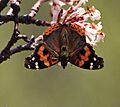
In Kullu district, Himachal Pradesh, India (around 11,500 feet (3,500 m))
-
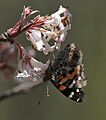
In Kullu district (around 11,500 feet (3,500 m))
-
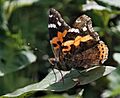
In Kullu district (around 7,500 feet (2,300 m))
-
At Samsing in Darjeeling district of West Bengal, India


_at_Samsing,_Duars,_West_Bengal_W_IMG_6369.jpg)
See also
- Red admiral (disambiguation)
